Getting Started: Building Your Sales Pipeline Foundation
Building a sales pipeline that consistently generates revenue requires a strong foundation. This isn't about simply gathering leads; it's about strategically structuring your process to guide qualified prospects toward becoming loyal customers. This involves understanding your Ideal Customer Profile (ICP) and mapping their buyer journey, aligning your team and processes around these crucial elements.
Defining Your Ideal Customer Profile
Defining your ICP is the first step in building a robust sales pipeline. This goes beyond simple demographics and explores the specific needs, pain points, and motivations of your best customers. For example, if you sell software to marketing agencies, your ICP might include agencies of a certain size, specializing in a particular industry, and struggling with current project management tools. This focused approach allows you to target your efforts effectively, attracting the prospects most likely to convert. You might find this resource helpful: How to master the sales recruitment process.
Mapping the Buyer Journey
Once you know who you're selling to, it's essential to understand how they buy. Mapping the buyer journey means identifying the stages a prospect goes through, from initial awareness to final purchase. These stages might include research, comparison, evaluation, and decision-making. By understanding this journey, you can tailor your messaging and content to resonate with prospects at each stage, nurturing them toward a conversion.
Common Pipeline Mistakes to Avoid
Many sales teams grapple with pipelines that leak opportunities. One common mistake is neglecting to qualify leads effectively, which leads to wasted time and resources pursuing prospects who are unlikely to convert. Another pitfall is a poorly defined sales process, resulting in inconsistent follow-up and lost deals. Failing to track and analyze key metrics can also prevent you from identifying bottlenecks and optimizing your pipeline for maximum performance. Recent data reveals some compelling trends: 80% of B2B decision-makers prefer digital channels, a 32% increase from 2021. 72% conduct in-depth research before contacting sales, and buying groups now involve an average of 11 stakeholders. More detailed statistics are available here. This highlights the importance of a strong digital presence in today's sales environment.
Structuring Your Pipeline Stages
A well-structured sales pipeline mirrors the stages of your buyer’s journey. It's a visual representation of your sales process, outlining the steps from initial contact to closed deal. Clear pipeline stages allow you to track progress, identify potential roadblocks, and forecast revenue accurately. Example stages might include:
- Prospecting: Identifying and qualifying potential leads.
- Contact: Initial outreach and engagement with qualified leads.
- Qualification: Determining if the prospect is a good fit.
- Proposal: Presenting a customized solution.
- Negotiation: Discussing terms and addressing objections.
- Close: Finalizing the deal and securing the customer.
By establishing this clear framework, you create a solid foundation for pipeline success, ensuring a systematic approach that moves prospects toward conversion and drives sustainable revenue growth. This is essential for long-term success in any competitive sales landscape.

Choosing the Right Tools for Pipeline Management Success
A well-structured sales pipeline is essential for consistent revenue growth. It's like a well-oiled machine, designed to move prospects efficiently through the sales process. But even the best pipeline needs the right tools to function at its peak. Choosing the right technology is crucial, impacting everything from initial contact to closing deals.
CRM Systems: The Core of Your Pipeline
Customer Relationship Management (CRM) systems are the foundation of any effective pipeline. They serve as a central hub for all prospect and customer data, offering a unified view of every interaction and stage of progress. A robust CRM system simplifies lead management, deal tracking, and pipeline performance analysis.
This centralized approach helps you quickly identify bottlenecks and discover opportunities for improvement. The global CRM market is projected to reach $80 billion by 2025, expanding at a rate of 12.6% year-on-year. This growth underscores the importance of CRM in driving sales efficiency and customer satisfaction – key factors in pipeline health. For a deeper dive into sales statistics, check out this insightful resource: Sales Statistics.
Automation Tools: Enhancing Efficiency
Beyond your core CRM, sales automation tools can greatly enhance pipeline management. These tools automate repetitive tasks such as email follow-ups and lead nurturing, freeing up your sales team to focus on building relationships and closing deals. This automation streamlines the workflow, allowing your team to dedicate their time to high-value activities.
To illustrate the impact of various tools on pipeline management, take a look at the comparison table below:
CRM Features Comparison for Sales Pipeline Management
A detailed comparison of essential CRM features that support effective pipeline building and management
| Feature | Basic CRM | Advanced CRM | Enterprise Solution | Impact on Pipeline |
|---|---|---|---|---|
| Contact Management | Basic contact details | Detailed contact history, segmentation | Advanced segmentation, social media integration | Improved organization and targeting |
| Lead Management | Basic lead capture | Lead scoring, automated lead distribution | Predictive lead scoring, advanced analytics | Increased lead qualification rate |
| Deal Tracking | Basic deal stages | Customizable deal stages, pipeline visualization | Real-time pipeline reporting, forecasting | Improved deal visibility and close rates |
| Reporting & Analytics | Basic sales reports | Customizable dashboards, sales performance tracking | Predictive analytics, revenue forecasting | Data-driven insights for pipeline optimization |
| Automation | Basic email templates | Automated workflows, email sequences | AI-powered automation, personalized outreach | Increased efficiency and productivity |
This table highlights the progression of features from basic to enterprise-level CRM solutions and their corresponding effects on pipeline management. Key differences lie in the level of customization, automation, and analytical capabilities.
AI-Powered Insights: The Future of Pipelines
Artificial intelligence (AI) is rapidly transforming sales pipelines. AI-powered tools analyze large amounts of data to identify patterns and predict future outcomes. This provides more accurate forecasting, personalized outreach, and proactive identification of at-risk deals. AI can significantly optimize your pipeline and drive revenue growth.
Integration Capabilities: A Connected Ecosystem
An effective technology stack is more than just a collection of individual tools; it’s a connected ecosystem. Seamless integration between your chosen tools is essential for a smooth and efficient workflow. Data should flow effortlessly between your CRM, automation tools, and other platforms, eliminating manual data entry and ensuring data consistency. For instance, integrating your marketing automation platform with your CRM streamlines lead capture and nurturing.
Cost-Effective Solutions: Scaling for Growth
Building the right technology stack doesn't have to be expensive. Many cost-effective CRM and automation solutions cater specifically to growing teams, offering essential features without the high cost of enterprise-level platforms. This allows smaller businesses to benefit from pipeline management technology without overspending.
Training and Adoption: Maximizing Your Investment
Investing in the right technology is only the first step. Ensuring your sales team effectively uses these tools is crucial for achieving a return on investment. Provide thorough training and ongoing support to encourage adoption and maximize the impact of your technology investments.

By carefully selecting and implementing the right tools, you can transform your sales pipeline into a powerful engine for growth. The goal is not simply to automate tasks, but to empower your sales team to build stronger relationships, close more deals, and achieve lasting success.
Tracking Pipeline Metrics That Actually Matter
Drowning in data? You're not alone. Many sales teams find it challenging to pinpoint the key performance indicators (KPIs) that truly reflect pipeline health. Let's explore the metrics that really matter, going beyond superficial numbers to uncover actionable insights. This involves understanding both leading indicators, which predict future performance, and lagging indicators, which reflect past results. Both are essential for developing a strong and predictable sales pipeline.
Identifying Your Key Metrics
Focusing on the right metrics is paramount for building a successful sales pipeline. Tracking conversion rates at each stage helps identify and address bottlenecks. Deal velocity, the speed at which deals progress through your pipeline, reveals your team's efficiency.
Pipeline coverage, the ratio of open opportunities to your revenue target, indicates whether you have enough deals in progress to hit your goals. Tracking daily metrics, such as the number of sales qualified leads (SQLs) added, follow-ups completed, and activity rates per sales rep, is also crucial. These daily insights provide an ongoing snapshot of pipeline activity, helping to identify areas for improvement and ensure consistent sales performance.
For deeper statistical insights into sales pipelines, visit this helpful blog post. Choosing the right sales tools can also significantly impact your success. For example, social media management tools can play a key role in lead generation and nurturing.
Here's a helpful table summarizing essential sales pipeline metrics:
To better understand your pipeline performance, let's look at some essential metrics and benchmarks. The following table outlines key indicators, how to calculate them, typical benchmarks, how often to track them, and what actions to take if they fall outside of the expected range.
Essential Sales Pipeline Metrics and Benchmarks
Key performance indicators for pipeline health with industry benchmarks and calculation methods
| Metric | Calculation | Industry Benchmark | Frequency | Action Triggers |
|---|---|---|---|---|
| Conversion Rate | (Number of Opportunities at Stage X+1) / (Number of Opportunities at Stage X) | Varies by industry and stage, typically 20-30% | Weekly | Investigate bottlenecks if significantly below benchmark |
| Deal Velocity | (Number of Won Deals * Average Deal Value) / Length of Sales Cycle | Varies by industry, aim for shorter cycles | Monthly | Analyze sales process for inefficiencies |
| Pipeline Coverage | (Total Value of Open Opportunities) / (Revenue Target) | Typically 3-4x | Weekly | Adjust lead generation efforts if significantly below target |
| Sales Qualified Leads (SQLs) | Number of leads that meet pre-defined qualification criteria | Varies by business, aim for steady growth | Daily | Review lead qualification process if numbers are stagnant |
| Activity Rate | Number of sales activities (calls, emails, demos) per rep | Varies by role and industry | Daily | Provide coaching and support if below expected levels |
This table offers a starting point for evaluating your pipeline's effectiveness. By consistently monitoring these metrics and comparing them to industry standards, you can gain valuable insights into your sales process and identify opportunities for improvement. Remember to adjust these benchmarks based on your specific business and industry context.
The infographic below visualizes total monthly leads versus qualified leads, and the average qualification time:
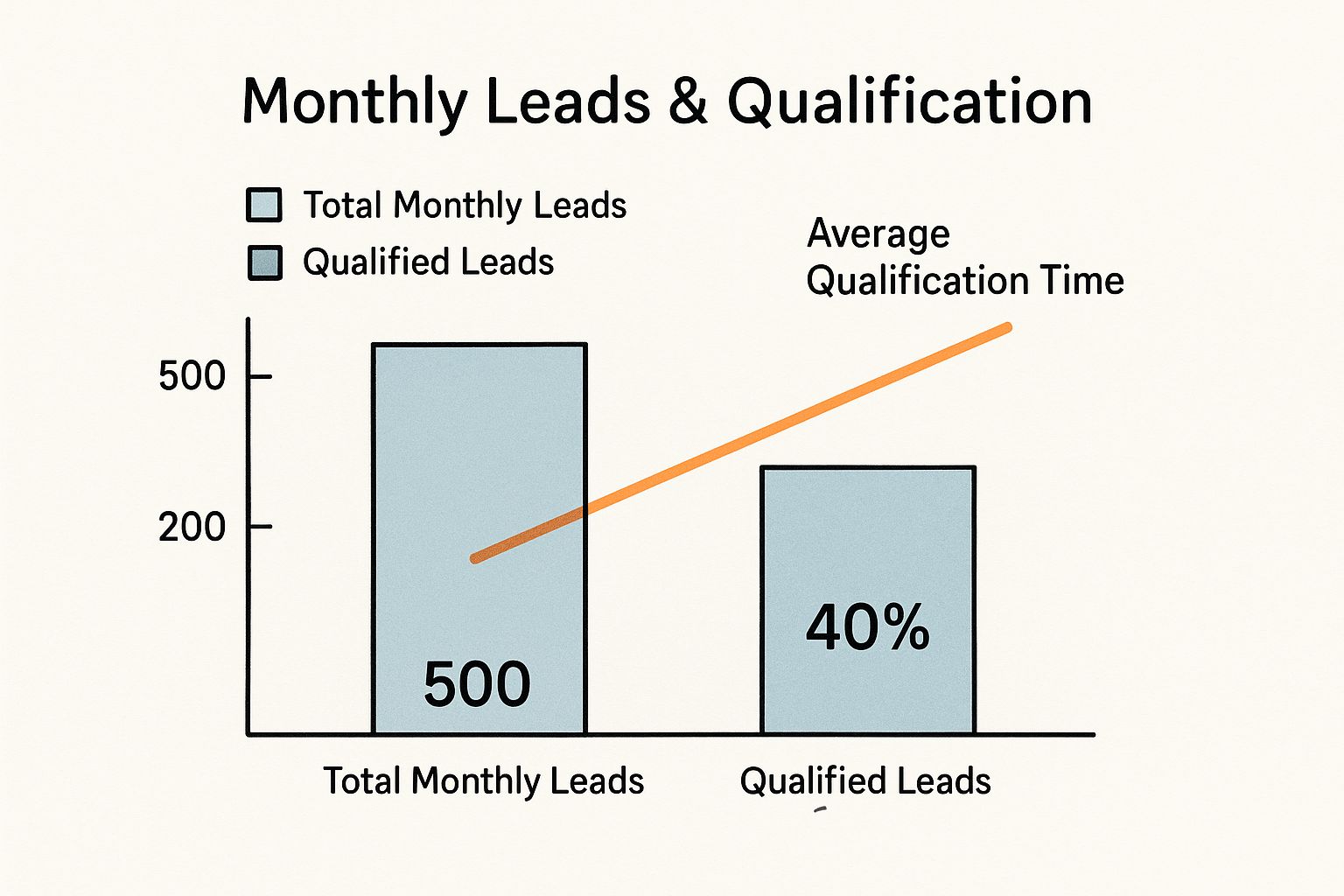
This data highlights the importance of focusing on lead quality over sheer quantity. A 40% qualification rate, coupled with a rapid 3-day average qualification time, suggests a strong emphasis on identifying and cultivating promising prospects. This quick turnaround enables efficient allocation of sales resources towards deals with a higher probability of closing.
Leading vs. Lagging Indicators
Leading indicators, such as sales activity and the number of SQLs generated, provide a glimpse into future performance. They act as early warning systems, flagging potential issues before they impact revenue. For example, a decline in sales activity could indicate the need for further training or motivation.
Lagging indicators, such as revenue and win rates, reflect past performance. While these metrics are valuable for evaluating overall results and pinpointing areas for long-term improvement, they don't offer the same predictive value as leading indicators.
Industry Benchmarks and Pipeline Reviews
Understanding industry benchmarks offers valuable context for your pipeline performance. A software company's average deal size, for instance, will likely differ significantly from that of a consulting firm. Comparing your metrics against these benchmarks can reveal your strengths and weaknesses.
Regular pipeline reviews, focusing on both leading and lagging indicators, ensure your team remains focused on achieving revenue targets. These reviews are not just status updates, but rather strategic discussions on continuous pipeline optimization. They also provide a forum to identify emerging trends and adapt strategies accordingly. This proactive approach to pipeline management is key for sustainable growth and hitting your sales goals.
Filling Your Pipeline With High-Quality Prospects
A sales pipeline’s effectiveness depends entirely on the prospects it contains. This makes prospecting, the art of identifying and qualifying potential customers, absolutely critical. Think of it like plumbing: a bigger pipe holds more water, sure. But if the source is contaminated, the pipe size is irrelevant.
Similarly, a large sales pipeline brimming with low-quality prospects won't deliver the desired outcomes.
Instead, prioritize attracting high-quality prospects who align with your product or service. These are the individuals more likely to become paying customers. This targeted approach paves the way for sustainable, long-term growth.
Identifying Your Ideal Prospects
Effective prospecting begins with understanding your ideal customer. Return to your Ideal Customer Profile (ICP) and buyer journey map. These tools offer invaluable insights into the characteristics, needs, and behaviors of your top-performing customers.
Use this knowledge to pinpoint and target similar prospects. For example, if your ICP reveals that your best customers are typically mid-sized tech companies, focus your prospecting efforts there. This concentrated approach saves valuable time and resources by prioritizing the most promising leads.
Strategies for Attracting High-Quality Leads
Several strategies can help you attract high-quality prospects:
- Social Selling: Engage with potential customers on platforms like LinkedIn, building relationships and establishing your expertise.
- Content Marketing: Create valuable content that addresses your target audience's pain points, drawing them to your brand.
- Referral Programs: Leverage the power of satisfied customers to generate new leads through word-of-mouth marketing.
Building a sales pipeline also often means expanding your team. Need help? Our guide on hiring a remote sales team offers valuable advice.
Effective prospecting significantly improves pipeline quality, with studies showing increases of up to 50%. Targeted outreach results in 3x higher response rates than generic approaches. Plus, systematic prospecting processes lead to 40% shorter sales cycles and 25% higher close rates. Learn more here.
Balancing Prospecting With Relationship Building
While efficient prospecting is key, remember to balance it with relationship building. Today’s buyers are informed and research-focused. They expect personalized interactions and valuable insights.
Position yourself as a trusted resource, guiding them through their decision-making journey rather than simply pushing a sale. This builds trust and cultivates lasting relationships, ultimately boosting conversions.
Identifying the Right Channels
Not every prospecting channel yields the same results. Some channels will be more effective than others depending on your target market and ICP. Experiment with different avenues, like email, social media, or networking events, to determine which ones deliver the highest quality leads for your business. This data-driven approach ensures your investments are strategically placed for maximum impact.
By prioritizing high-quality prospects and nurturing relationships, you establish a solid base for a thriving sales pipeline. Focus on lead quality over quantity, concentrating on prospects who are a good fit and likely to convert. This strategy maximizes your sales team’s effectiveness and fuels sustainable revenue growth.
Moving Prospects Through Your Sales Process
Guiding potential customers from initial interest to a final purchase requires a delicate balance of persistence and well-timed engagement. This involves understanding the art of lead nurturing: cultivating relationships with prospects, providing valuable information, and addressing their needs throughout their buying journey. Like a gardener tending to seedlings, sales professionals must nurture leads with care, providing the right resources at the right time.
The Art and Science of Lead Nurturing
Effective lead nurturing involves creating targeted communication sequences that resonate with different buyer personas. This means tailoring your messaging to address the specific pain points, motivations, and preferences of each segment of your target audience. For example, a prospect researching a new CRM system might benefit from case studies showcasing successful implementations, while a prospect further down the funnel might appreciate a personalized demo. Effective lead generation is critical for filling your sales pipeline. Here are some useful B2B lead generation techniques.
Additionally, the scale of the deal can influence your nurturing approach. High-value deals often require a more personalized, consultative approach, involving multiple touchpoints and in-depth conversations. Conversely, smaller deals might benefit from automated email sequences and self-service resources. Finding the right balance between personalization and automation is crucial for maximizing your team’s efficiency. This ensures prospects receive the right level of attention without overwhelming your sales team. Research shows that personalized nurturing sequences can increase conversion rates by 67%. Moreover, structured follow-up processes result in 35% higher deal closure rates and 28% faster progression through pipeline stages. Explore this topic further here.
Building Trust and Urgency
Effective communication strategies build trust and create a sense of urgency simultaneously. Sharing valuable content, such as blog posts, white papers, and webinars, positions you as a thought leader and builds credibility with prospects. However, it's equally important to highlight the potential consequences of not addressing their challenges.
This involves showcasing the benefits of your product or service in terms of improved efficiency, increased revenue, or reduced risk. By showcasing the value you bring to the table, you can motivate prospects to move forward in the sales process.
Handling Objections at Each Stage
Objections are a natural part of the sales process. Addressing them effectively requires active listening, empathy, and a clear understanding of the prospect’s concerns. Prepare for common objections at each pipeline stage, arming your sales team with the knowledge and resources to address them confidently.
For example, a prospect concerned about price might be swayed by a clear explanation of the return on investment (ROI), or a comparison of pricing tiers. By addressing objections proactively and offering tailored solutions, you can overcome obstacles and move prospects closer to a decision.
Leveraging Content and Social Proof
Content marketing and social proof play crucial roles in accelerating deals. Sharing relevant case studies, testimonials, and reviews from satisfied customers provides powerful validation for your claims. This builds confidence in your solution and helps overcome skepticism.
Strategic timing is equally important. For example, sharing a customer success story just before a demo can increase the prospect’s confidence and encourage them to move forward. This allows you to tailor content to specific stages of the buying process.
Accelerating Deals Without Pressure
Finally, remember that building a sales pipeline is not about pushing prospects into a sale. Instead, it’s about guiding them toward a solution that meets their needs. By building genuine relationships, providing valuable information, and handling objections with care, you can accelerate deals without appearing pushy or desperate. This consultative approach fosters trust and positions you as a valuable partner, setting the stage for long-term customer relationships. This builds a foundation of mutual respect and understanding, increasing the likelihood of closing deals and fostering customer loyalty.
Scaling and Optimizing Your Pipeline for Growth
Building a sales pipeline isn't a one-time project. It requires consistent nurturing, optimization, and strategic scaling to adapt to market changes and support business growth. This ongoing refinement is key to achieving and maintaining peak performance. Think of your pipeline as a living organism – it needs constant care to flourish.
Identifying Bottlenecks and Improving Conversion Rates
Analyzing your pipeline for bottlenecks is crucial. A bottleneck occurs when prospects get stuck at a particular stage, slowing down the flow of deals. These bottlenecks can arise from several issues, such as unclear messaging, insufficient follow-up, or a misalignment between sales and marketing. By identifying these friction points, you can implement targeted improvements that streamline the process and boost conversion rates. For example, if prospects consistently disappear after the initial contact, it might be time to revisit your outreach strategy. You might find this helpful: How to master SDR outsourcing.
Increasing Deal Velocity Without Sacrificing Quality
Deal velocity measures how quickly deals move through your pipeline. Increasing this velocity without compromising quality is crucial for maximizing revenue. This can be achieved by implementing Salesforce or other sales automation tools, streamlining internal processes, and equipping your sales team with the resources they need to close deals efficiently. Automating follow-up emails, for instance, can free up valuable time for your team to focus on building relationships and closing deals. Remember, speed should complement, not replace, personal interaction.
Conducting Effective Pipeline Reviews
Regular pipeline reviews are vital for ongoing optimization. These reviews should go beyond simply tracking numbers; they should be strategic discussions centered on identifying areas for improvement. Analyze conversion rates at each stage, assess deal velocity, and examine overall pipeline coverage. This data-driven approach helps you spot emerging trends, proactively address potential issues, and keep your pipeline aligned with your revenue goals. For example, a sudden drop in conversion rates at a specific stage might indicate a problem with your messaging or sales process.
Scaling Your Pipeline as Your Team Grows
As your sales team grows, scaling your pipeline becomes essential. This requires effective delegation, comprehensive training, and robust quality control to maintain consistent performance. Clearly defined roles and responsibilities within the team ensure efficient workflow and prevent duplicated efforts. Investing in ongoing training empowers your team with the knowledge and skills they need to succeed. For example, implementing a mentorship program can help new hires learn from experienced team members and quickly become valuable contributors.
This commitment to continuous improvement delivers substantial rewards. Sales organizations that implement systematic pipeline optimization see an average revenue increase of 18% within the first year. Top performers achieve even more impressive results, with a 41% improvement in deal velocity and 29% higher win rates. Find more detailed statistics here: Pipeline Optimization Results. These gains clearly demonstrate the substantial impact of consistent pipeline refinement.
Adapting to Market Conditions and Business Growth Phases
Market conditions and business growth phases constantly evolve, and your sales pipeline must adapt accordingly. For example, during periods of economic uncertainty, you might adjust your pricing or target higher-value prospects. Similarly, when entering new markets, you may need to tailor your messaging and sales process to resonate with different buyer personas. This flexibility is crucial for maintaining consistent results in various circumstances. Regularly reviewing and adapting your pipeline ensures it remains a powerful driver of growth, regardless of external factors.
Key Takeaways
Building a robust sales pipeline isn't simply about gathering leads; it's a dynamic process that demands constant refinement and strategic execution. This section outlines the essential steps for building a revenue-generating machine, along with insights into identifying and overcoming common challenges. These key takeaways are drawn from discussions with sales leaders and analyses of high-performing teams, offering a practical roadmap to achieving sustainable growth.
Building a Strong Foundation
Your pipeline's foundation lies in clearly defining your Ideal Customer Profile (ICP) and understanding their buyer journey. Begin by identifying the characteristics, needs, and behaviors of your best customers. Then, map the stages a prospect goes through, from initial awareness to final purchase. This understanding allows for targeted messaging and personalized content that connects with the buyer throughout their decision-making process.
Choosing the Right Tools
Technology plays a crucial role in pipeline management. CRM systems like Salesforce act as the central hub for all prospect data, streamlining contact management, lead tracking, and performance analysis. Integrating sales automation tools further enhances efficiency by automating repetitive tasks such as email follow-ups. Consider cost-effective solutions designed for growing teams and prioritize thorough training to maximize your technology investments.
Measuring What Matters
Focus on the key performance indicators (KPIs) that truly reflect pipeline health. Track conversion rates at each stage to pinpoint bottlenecks and monitor deal velocity to gauge sales efficiency. Pipeline coverage reveals whether you have enough active opportunities to hit revenue targets. These metrics, coupled with regular pipeline reviews, enable data-driven decisions for continuous improvement.
Filling Your Pipeline With Quality Prospects
Effective prospecting fuels any sales pipeline. Utilize a mix of strategies, including social selling on platforms like LinkedIn, content marketing using tools like HubSpot, and referral programs, to attract high-quality leads. Strike a balance between efficient prospecting and relationship building, emphasizing your role as a trusted advisor rather than just a salesperson. Experiment with various channels to identify the ones that yield the highest quality leads for your target market.
Moving Prospects Through the Sales Process
Once prospects enter your pipeline, the focus shifts to nurturing them towards conversion. Create targeted communication sequences tailored to different buyer personas and deal sizes. Foster trust by offering valuable content and create a sense of urgency by highlighting the advantages of your solution. Address objections proactively with empathy and a clear understanding of prospect concerns. Finally, incorporate social proof, such as case studies and testimonials, to reinforce your value proposition.
Scaling for Growth
As your business expands, your pipeline must scale accordingly. Identify and eliminate bottlenecks, boost conversion rates, and increase deal velocity without sacrificing quality. Conduct strategic pipeline reviews focused on finding areas for improvement. Implement effective delegation frameworks, comprehensive training programs, and robust quality control measures as your team grows. Adapting your pipeline to evolving market conditions and business growth stages is essential for sustained success.
Building a sales pipeline is a continuous process of refinement and adaptation. By focusing on these key takeaways, you can create a sustainable system for generating revenue and achieving long-term growth.
Are you ready to build a high-performing remote sales team and transform your pipeline? AboutHire connects companies with the top 0.5% of remote sales talent from Latin America and Europe. Learn more about how AboutHire can help you scale your sales pipeline.