Why Your Current Hiring Approach Isn't Working
Let's face it: finding the right salespeople is tough. Traditional hiring methods often fall short, leaving you with underperforming teams and missed revenue targets. Conventional interviews rely heavily on subjective impressions and gut feelings. This can create a disconnect between a candidate's perceived abilities and their actual performance.
For example, a candidate might interview incredibly well, but struggle to close deals in real-world scenarios. This performance gap highlights the limitations of relying solely on traditional interview processes.
The Disconnect Between Perception and Reality
Many sales reps confidently assess their skills as higher than they actually are. Even experienced hiring managers struggle to accurately evaluate a candidate's potential during a short interview. This discrepancy can lead to hiring decisions based on charisma rather than competence.
Companies are often left with sales teams that underperform, failing to meet quotas and hindering overall growth. A March 2025 Salesloft study underscored this challenge. A major recurring issue for sales organizations is the lack of a repeatable sales process, hindering scalability and consistent performance. The study revealed a significant disconnect between self-perception and managerial evaluation of sales skills. Explore this further: Learn more about skill gaps in sales.

The Flawed Gut-Feeling Approach
Relying on intuition in hiring is risky. Without objective data and structured evaluations, even seasoned managers can misjudge a candidate's true potential. Traditional interviews often fail to assess the specific skills crucial for success in complex sales environments.
Critical competencies like prospecting, negotiation, and closing techniques are often overlooked. This can lead to hiring individuals ill-equipped to handle the demands of the role, ultimately impacting the bottom line. Learn more about improving your sales recruitment process: How to master the sales recruitment process.
The Shift Towards Data-Driven Hiring
Leading organizations are ditching gut-feel hiring and embracing data-driven sales skills assessments. These assessments provide a structured framework for evaluating candidates, allowing for more accurate predictions of on-the-job performance.
- Objective Evaluation: Assessments measure skills based on concrete data, removing bias and subjectivity.
- Predictive Validity: Assessments identify candidates with the specific skills and traits associated with high performance.
- Targeted Development: Assessment results can tailor onboarding and training to address individual skill gaps.
By implementing strategic skills assessment programs, companies are transforming their hiring success and building high-performing sales teams. This strategic shift toward objective evaluation allows businesses to identify and secure top talent, driving revenue growth and achieving sustainable success.
Building Assessment Frameworks That Actually Predict Success
Stop wasting time on generic sales skills assessments. This section reveals the core competencies that separate top performers from the rest. These insights come from analyzing thousands of successful sales professionals. We'll explore practical strategies for evaluating essential sales skills, from prospecting to closing, using behavioral indicators and realistic scenarios. These scenarios will mirror your unique sales environment.
Key Competencies For Sales Success
A successful sales skills assessment digs deeper than surface-level evaluations. It examines the underlying abilities that truly drive revenue.
-
Problem-Solving Abilities: Can the candidate think critically and creatively to overcome challenges in the sales process? Situational questions or role-playing exercises can evaluate this.
-
Adaptability: The sales world is always changing. How well can a candidate adjust their approach to different prospects and market conditions? Behavioral questions and simulations offer valuable insights.
-
Communication Style: Effective communication is key for building rapport and influencing buyers. Assessments should evaluate both verbal and written communication, focusing on clarity, empathy, and persuasiveness.
These core competencies, along with traditional sales skills, create a complete picture of a candidate's potential.
Designing Effective Assessment Criteria
To design a truly predictive assessment, the criteria must match the demands of your specific sales roles. This requires focusing on behaviors and skills directly tied to success in your organization. For example, if your sales process emphasizes consultative selling, your assessment should focus on needs discovery and solution presentation.
Structuring Your Assessment Criteria
Here’s how to structure your assessment criteria for maximum effectiveness:
-
Behavioral Indicators: Instead of asking about skills, focus on past behaviors that demonstrate them. Ask candidates to describe a time they successfully handled a difficult objection.
-
Situational Scenarios: Present candidates with realistic sales scenarios and evaluate their responses. This reveals their decision-making and ability to apply their skills under pressure.
-
Measuring Hard and Soft Skills: A complete assessment evaluates both hard skills (product knowledge, sales techniques) and soft skills (communication, negotiation, relationship building). Both are vital for sales success.
To understand how these elements come together, take a look at the following framework. It illustrates how different skills can be assessed for a comprehensive understanding of a candidate’s abilities.
To make sure your assessment is focused and objective, a structured framework is essential. The following table provides a helpful guide for developing your own assessment criteria.
Core Sales Skills Assessment Framework
Comparison of essential sales competencies and their assessment methods
| Skill Category | Key Competencies | Assessment Method | Success Indicators |
|---|---|---|---|
| Prospecting | Identifying potential customers, lead qualification | Role-playing, situational questions | Ability to qualify leads, develop targeted outreach strategies |
| Needs Discovery | Understanding customer needs, asking effective questions | Simulated customer interactions | Uncovering pain points, identifying buying motivations |
| Presentation Skills | Delivering compelling presentations, handling objections | Product demonstrations, role-playing | Clear communication, persuasive delivery, effective objection handling |
| Closing | Securing the deal, negotiating effectively | Simulated negotiations, case studies | Strong negotiation skills, ability to close deals confidently |
This framework allows for a systematic evaluation of key competencies and predicts success within your sales environment. Using this model provides a strong foundation for building a high-performing sales team. Implementing this framework strengthens your hiring process, leading to more productive sales teams and, ultimately, greater revenue.
The Strategic Investment That's Paying Off Big

Smart companies recognize that sales skills assessment is more than just a hiring tool. It's a continuous investment in their most valuable resource: their sales teams. Instead of reducing training budgets, these organizations are prioritizing skills development as a competitive advantage. This proactive strategy sets them up for success in today's demanding market.
Why Invest in Ongoing Sales Skills Development?
This focus on skills development is a strategic decision to bolster core sales capabilities. Through comprehensive assessments and targeted training, companies are creating a platform for sustainable growth. This is especially critical in periods of economic uncertainty and rapid technological change. It also fosters a culture of continuous improvement, leading to higher employee engagement and retention.
Imagine a sales team consistently trained in the latest methodologies and equipped with cutting-edge tools. They’re not just keeping pace with the competition; they’re leading the charge. This proactive approach yields measurable results, from improved sales win rates to increased customer lifetime value.
A 2025 analysis by Lepaya found that leading companies dramatically increased investment in sales skills training. Training hours saw a 178% jump, from 7,534 hours in 2023 to 20,965 hours in 2024, making sales the third most trained skill. This highlights the growing importance of sales training as a core investment. Find more detailed statistics here.
How Successful Organizations Use Assessment Data
Top-performing organizations go beyond simply conducting sales skills assessments. They strategically analyze the data to inform critical decisions. This data-driven approach enables more efficient resource allocation, focused coaching initiatives, and personalized career paths. This allows companies to pinpoint high-potential employees and provide them with the resources necessary for success.
Connecting Evaluation With Coaching for Maximum Impact
The most effective sales skills programs combine a comprehensive evaluation with personalized coaching. This creates a valuable feedback loop, allowing sales representatives to understand their strengths and weaknesses and create tailored action plans for improvement. It also helps companies identify the best coaching methods and tools to maximize individual and team performance. For example, if an assessment reveals a need to improve closing techniques, coaching can focus on specific strategies and role-playing exercises.
This commitment to continuous development not only strengthens individual performance but also creates a more resilient and adaptable sales team. By investing in ongoing sales skills assessment and development, companies are investing in their employees and their own future.
The Numbers Don't Lie: Assessment ROI That Matters
Beyond subjective opinions, let's explore the measurable impact of sales skills assessments. This section delves into the tangible business outcomes achieved through structured evaluation programs. These benefits include significantly improved win rates, faster onboarding, and increased employee retention. We'll also see how companies use assessment data to identify and replicate the traits of their top performers across their sales teams.
Quantifying the Impact of Sales Skills Assessment
Effective sales skills assessments offer numerous advantages that directly impact a company's bottom line. Businesses investing in these tools see tangible returns on their investment, strengthening the overall sales organization.
-
Improved Win Rates: By pinpointing and addressing skill gaps, assessments help sales teams close deals more effectively, leading to increased revenue and market share growth.
-
Faster Onboarding: Assessments identify specific training needs, shortening the onboarding process for new hires. This allows them to contribute to sales goals sooner.
-
Higher Retention: When employees feel supported in their development, they are more likely to stay. Assessments facilitate targeted coaching and career advancement, boosting employee satisfaction and lowering turnover costs.
These improvements create a more engaged and efficient sales force, prepared for long-term success.
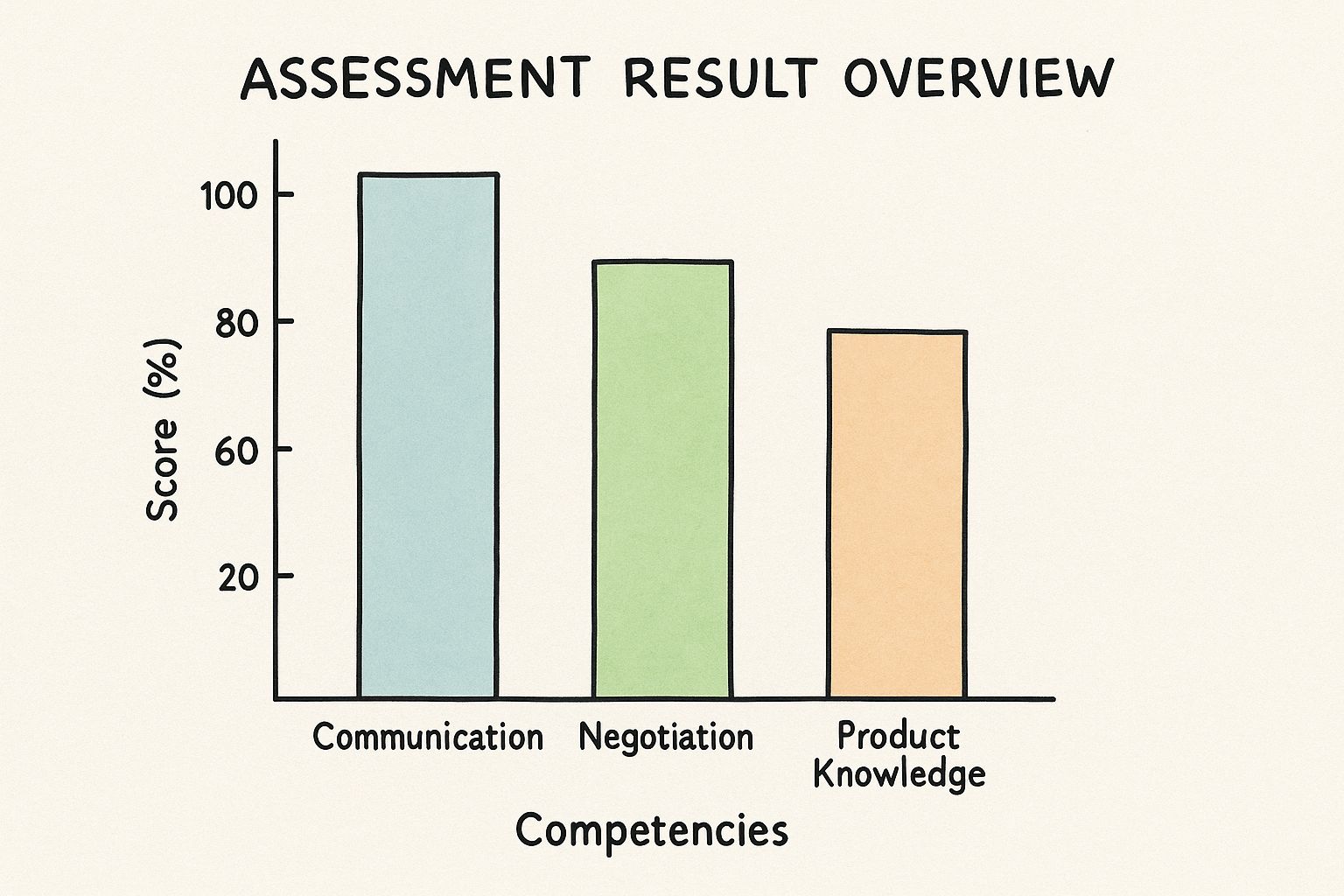
The infographic above visualizes average competency scores for Communication, Negotiation, and Product Knowledge. Communication scores highest at 85%, followed by Negotiation at 70% and Product Knowledge at 60%. This suggests a relative strength in communication skills within the sales team, while negotiation and product knowledge present opportunities for improvement.
Replicating Top Performer Characteristics
Assessments provide valuable data for identifying the qualities that distinguish top performers. This information helps develop training programs to replicate these traits across the sales team. This approach raises the overall skill level and drives consistent high performance, fostering a culture of excellence where everyone strives for their full potential.
For example, if top performers consistently excel at closing deals, assessments can help identify their specific behaviors and techniques. These insights can then be incorporated into training programs, equipping other sales reps with the same successful strategies.
Long-Term Benefits of Assessment
The advantages of sales skills assessments go beyond individual performance. They influence broader organizational outcomes, including better hiring decisions and a stronger sales culture. The emphasis on continuous improvement fosters sustainable sales excellence.
Recent statistics for 2025 show that companies investing in sales skills assessment and training see up to a 20% increase in win rates and a 10% improvement in quota attainment. This data highlights the strong correlation between investment in sales skills development and improved business outcomes, especially in competitive markets. Discover more insights about sales statistics.
Tracking Key Metrics
To effectively measure the ROI of a sales skills assessment program, focus on tracking these key metrics:
-
Revenue Growth: Track how assessment and training initiatives impact overall sales figures.
-
Conversion Rates: Measure the percentage of leads converting into customers.
-
Sales Cycle Length: A shorter sales cycle means quicker revenue realization. Assessments can help identify and remove bottlenecks in the sales process.
-
Employee Turnover: Track employee retention to gauge the impact of assessments and training on employee satisfaction.
The following table summarizes key ROI metrics and the improvements seen after implementing a sales skills assessment program.
Sales Skills Assessment ROI Metrics
| Metric | Before Assessment | After Assessment | Improvement % |
|---|---|---|---|
| Win Rate | 50% | 70% | 40% |
| Quota Attainment | 60% | 70% | 16.7% |
| Sales Cycle Length (days) | 45 | 35 | 22.2% |
| Employee Turnover Rate (annual) | 20% | 15% | 25% |
This table shows significant improvements across all measured metrics, demonstrating the positive impact of sales skills assessments on key performance indicators.
By consistently monitoring these metrics, organizations can demonstrate the value of their sales skills assessment programs and make data-driven decisions to optimize their sales strategies, creating a continuous feedback loop for ongoing refinement.
Getting Your Team On Board (Without The Resistance)
Even the best sales skills assessment program can fall flat without team buy-in. This section explores practical strategies for getting everyone on board, from leadership to sales representatives. It's essential to address any potential resistance and present the assessment as a tool for growth, not a performance judgment.
Positioning Assessment as a Development Opportunity
Many sales reps see assessments as a threat. It's important to reframe this perception and highlight the career development benefits. Explain how the assessment pinpoints individual strengths and weaknesses, offering a personalized roadmap for growth.
For example, you can illustrate how improved skills can result in increased commissions and open doors to career advancement. Above all, emphasize that the assessment is about improvement, not punishment.
Integrating Assessment With Existing Systems
For a sales skills assessment to be truly successful, integrate it with your current training and performance management systems. This creates a smooth transition and reinforces the value of the assessment.
It also builds a unified development experience for sales reps, demonstrating your investment in their growth and success. Plus, it strengthens the program's justification by aligning it with pre-existing objectives.
You might be interested in: How to master cost-effective recruitment.
A Step-by-Step Guide to Implementation
Rolling out a sales skills assessment program requires thoughtful planning and execution. Here’s a practical guide to help you navigate a successful implementation:
-
Establish a Clear Timeline: Create a realistic schedule that takes into account sales cycles and other business priorities. This minimizes disruptions to ongoing sales activities and allows for proper preparation.
-
Set Meaningful Baseline Measurements: Before starting the assessment, establish baseline performance metrics. This helps you accurately measure progress and showcase the program's effectiveness. Think about metrics like win rates, average deal size, and sales cycle length.
-
Communicate Regularly: Keep your team informed throughout the process. Explain the assessment process, its benefits, and the expected outcomes. Address any questions or concerns, and continually reinforce the program’s focus on individual and team development. This fosters trust and promotes participation.
-
Provide Ongoing Support: Make resources and coaching available to help reps understand and apply their assessment results. Regular feedback and support are key to translating these insights into tangible improvements and demonstrating your commitment to their growth.
Maintaining Momentum
Once the assessment is rolled out, consistent effort is essential for maintaining momentum. Schedule regular follow-up meetings to discuss progress, deliver feedback, and adjust training based on the assessment data.
This reminds everyone of the program's importance and keeps it at the forefront of sales reps’ minds. Don’t forget to celebrate individual and team wins to highlight the value of skill development.
Creating Assessment Schedules That Work
Design your assessment schedules to complement sales workflows, not disrupt them. Think about aligning assessments with natural breaks in the sales cycle or incorporating them into established training programs.
Flexibility is important. Be prepared to adjust schedules to accommodate unforeseen circumstances, while still maintaining the program’s consistency. For example, schedule assessments during slower periods or as part of quarterly performance reviews. This minimizes disruptions and ensures regular data collection. Also, consider that shorter, more frequent assessments can often be more effective than lengthy annual reviews.
By following these strategies, you can successfully implement sales skills assessments as a valuable tool for team growth and improved sales performance. This collaborative approach cultivates a culture of continuous development, which ultimately leads to greater success for individual reps and the organization as a whole.
Making Assessment Part Of Your Sales DNA
One-time sales skills assessments offer limited value. True sales excellence comes from weaving continuous evaluation into your company’s culture. This makes skill development as routine as reviewing your sales pipeline. This section explores how successful sales leaders cultivate these growth-focused assessment environments, using peer evaluations, self-assessments, and manager feedback to create a comprehensive picture of each team member's development.
Building a Culture of Continuous Improvement
Think of sales skills development like physical fitness. A single workout won’t suddenly transform you. However, consistent training builds strength and endurance over time. Similarly, ongoing sales skills assessment and development creates a team that's ready to adapt and excel in any market. This requires a shift in mindset—viewing assessment as a tool for growth, not punishment.
Successful sales leaders build a culture where feedback is expected and valued. This fosters open communication and a shared commitment to improvement. They recognize that regular, focused development is essential for maintaining peak performance.
Maintaining Momentum After Initial Implementation
After launching a sales skills assessment program, maintaining momentum is critical. This prevents the program from becoming a one-off event with diminishing returns. Here are a few practical strategies to keep the energy high:
-
Regular Calibration Sessions: Hold regular meetings to analyze assessment results and maintain consistent evaluation standards. This objectivity minimizes individual biases in feedback.
-
Skill-Building Challenges: Introduce friendly competitions that focus on specific sales skills. This gamifies learning and motivates reps to improve in targeted areas, such as objection handling or closing techniques.
-
Recognition Programs: Publicly acknowledge and reward improvement. Celebrating success reinforces positive behaviors and encourages continuous growth. It also builds a culture of appreciation.
These strategies maintain focus on growth, ensuring the assessment program remains a powerful tool for continuous improvement.
Adapting to Evolving Market Needs
The sales landscape is constantly changing, and your sales skills assessment program needs to keep up. As market dynamics shift, new skills become essential for success. Regularly review and update your assessment criteria to reflect these changes.
For example, the rise of digital selling requires assessing skills like social selling and virtual relationship building. This ensures your program stays relevant and prepares your team to excel in today's market.
By using these strategies, you can embed sales skills assessment into your company's DNA. This fosters a culture of continuous learning and development, ultimately leading to lasting sales success and increased revenue. Remember, the goal isn't simply to evaluate skills, but to develop a team that's dedicated to constant improvement. This approach transforms sales assessment from a periodic event to a crucial part of your team's daily work and long-term success.
Future-Proofing Your Assessment Strategy
The sales world is in constant motion. This means your sales skills assessment program needs to keep pace. This section explores important trends changing how we evaluate sales talent, from the growth of AI-powered assessment tools to the increasing demand for digital selling skills.
Balancing Traditional and Modern Sales Skills
While the fundamentals of selling remain critical, today's sales environment requires new competencies. This means taking a balanced approach to assessment. You need to evaluate both traditional sales skills, like negotiation and closing, as well as newer skills such as social selling and building relationships virtually. Technical proficiency is also key. For example, assessments should gauge a candidate's ability to use CRM systems like Salesforce and sales automation tools. This ensures your team has the diverse skill set needed to thrive.
Leveraging Data Analytics for Enhanced Accuracy
Leading organizations are using data analytics to enhance the precision of their sales skills assessments. By studying assessment data, companies can uncover patterns and insights that were previously invisible. This data-driven strategy allows for better identification of top performers and provides a deeper understanding of the elements that contribute to sales success. For example, data analysis can reveal connections between particular assessment scores and actual sales performance, enabling companies to refine their assessment criteria.
Building Adaptable Assessment Frameworks
Building an assessment strategy for the future means using a flexible framework. Your program needs to adapt to evolving buyer behaviors and new sales methodologies. However, it's crucial to stay focused on those core competencies that consistently deliver results, no matter the market trends. This approach balances the need for adaptability with the importance of essential sales skills. Check out our guide on Sales Team Outsourcing for additional insights.
Embracing AI-Enhanced Assessment Tools
Artificial intelligence (AI) is reshaping how we assess sales talent. AI-powered tools can process large amounts of data, detect trends, and offer objective insights into a candidate’s potential. This technology presents new ways to improve assessment accuracy, minimize bias, and streamline the evaluation process. For example, AI tools can analyze candidate responses in video interviews or simulated scenarios to evaluate communication style, empathy, and problem-solving skills. This reduces manual work and adds a layer of objective measurement.
By using these strategies, you can develop a sales skills assessment program that not only addresses the current sales landscape but also readies your team for the future. This proactive approach ensures your sales force remains agile, adaptable, and competitive, leading to sustainable growth and maximized revenue.
Ready to build a high-performing remote sales team quickly and efficiently? AboutHire connects you with top sales talent from Latin America and Europe. Our careful screening process, personalized training, and 90-day guarantee ensure you find the right sales professionals to reach your revenue goals.