Understanding The Real Cost Of Customer Acquisition
When you land a new customer, the feeling is electric. But once the initial excitement fades, a critical question remains: how much did that win actually cost you? It’s tempting to glance at your ad spend, do some quick math, and call it a day. The reality, however, is that most businesses are drastically underestimating their customer acquisition cost (CAC), focusing only on the most obvious expenses.
The true cost of acquiring a customer goes far beyond what you pay for a click or an impression. To effectively reduce customer acquisition cost, you first need an honest and complete picture of what you're truly spending. This means digging deeper into expenses that are often overlooked but contribute significantly to the final number.
Think about it: that new customer didn't just appear after seeing an ad. A sales development representative (SDR) might have spent hours on discovery calls, an account executive worked to close the deal, and your marketing team created the content that nurtured them. All of these touchpoints have associated costs that are frequently left out of the equation.
The Hidden Costs Hiding In Plain Sight
A surface-level CAC calculation gives you a false sense of security. I once spoke with a SaaS founder who was proud of his company’s “$250 CAC,” based solely on their digital ad spend. After we mapped out all their acquisition-related expenses, including a portion of their sales team's salaries and CRM subscription fees, they discovered their actual CAC was closer to $750—a staggering 300% higher than they thought.
This revelation wasn't a failure; it was an opportunity. By understanding the real number, they could finally make informed decisions about their growth strategy. Precise metric tracking is essential for this process. Merely focusing on cost per lead (CPL) is insufficient, as it ignores broader expenses like agent salaries, software systems, and overhead. As the experts at Trellus.ai point out, a true cost per acquisition (CPA) incorporates all these factors, providing a complete view of spending efficiency.
So, what are these hidden costs? They fall into several buckets that are easy to miss if you aren't looking for them.
Building An Accurate CAC Formula
To get to your genuine CAC, you need to account for every dollar that supports your sales and marketing efforts. This isn't just about better bookkeeping; it's about uncovering the levers you can pull to make your acquisition engine more efficient.
To help you see the full picture, I've put together a table that contrasts the costs businesses typically track with those that often slip through the cracks.
Hidden CAC Components Most Companies Miss
Comparison of commonly tracked vs. overlooked customer acquisition costs
| Cost Component | Usually Tracked | Often Missed | Impact on True CAC |
|---|---|---|---|
| Salaries & Commissions | Marketing team salaries | Pro-rated sales team salaries, commissions, and bonuses | Significant; often the largest hidden expense. |
| Software & Tools | Ad platform fees | CRM, analytics tools, email marketing, sales automation. | Moderate; can add 5-15% to your total costs. |
| Content & Creative | Freelance writer fees | In-house designer time, video production tools, stock photo subscriptions. | Moderate; quality content has a real, tangible cost. |
| Overhead & Operations | None | Pro-rated rent and utilities for sales/marketing departments. | Minor to moderate, depending on team size and office setup. |
As you can see, the gap between perceived and actual CAC can be huge. These "missed" costs aren't just minor details; they represent a significant portion of your acquisition budget.
Understanding these components transforms CAC from a simple vanity metric into a powerful diagnostic tool. When you see the full picture, you can stop wasting money on inefficient channels and start investing where it truly counts, paving the way for sustainable and profitable growth.
Industry Benchmarks That Actually Matter For Your Business
Knowing your precise customer acquisition cost is one thing; knowing how it stacks up against your competition is another. Without context, your CAC is just a number. Is your $100 CAC fantastic or a sign of trouble? The answer depends entirely on your industry. Context is everything when you want to strategically reduce customer acquisition cost.
It's tempting to chase a universal "good" CAC, but that's a fool's errand. A successful ecommerce brand in the food and beverage space might celebrate a $53 CAC, while a direct-to-consumer electronics company could be thriving with a $76 CAC. This variance shows why a one-size-fits-all approach to acquisition spending just doesn't work. For example, a fine jewelry retailer faces a much higher average CAC of around $91, driven by longer consideration periods and higher price points. Understanding these differences is the first step toward setting realistic goals and crafting an effective marketing strategy.
Interpreting Benchmarks for Your Unique Situation
Think of industry benchmarks not as rigid rules but as a compass. They tell you the general direction, but you still need to navigate the specific terrain of your own business. A company with a strong brand presence might naturally have a lower CAC than a newcomer, even in the same industry.
Your goal isn't just to meet the average; it's to understand why the average is what it is and find opportunities to outperform it. For instance, if your industry’s average CAC is $80, but your customer lifetime value (LTV) is exceptionally high, you might be able to spend $120 to acquire a customer and still be far more profitable than a competitor who is just hitting the average. The key is to analyze these benchmarks in relation to your own margins, sales cycle, and customer retention rates.
The real magic happens when you shift focus from just lowering costs to improving efficiency. This often comes down to conversion rate optimization (CRO). A small lift in your conversion rate can have a dramatic effect on your CAC, often more so than simply cutting your ad spend.
The infographic below shows how a focused CRO effort can simultaneously boost conversions and lower acquisition costs.
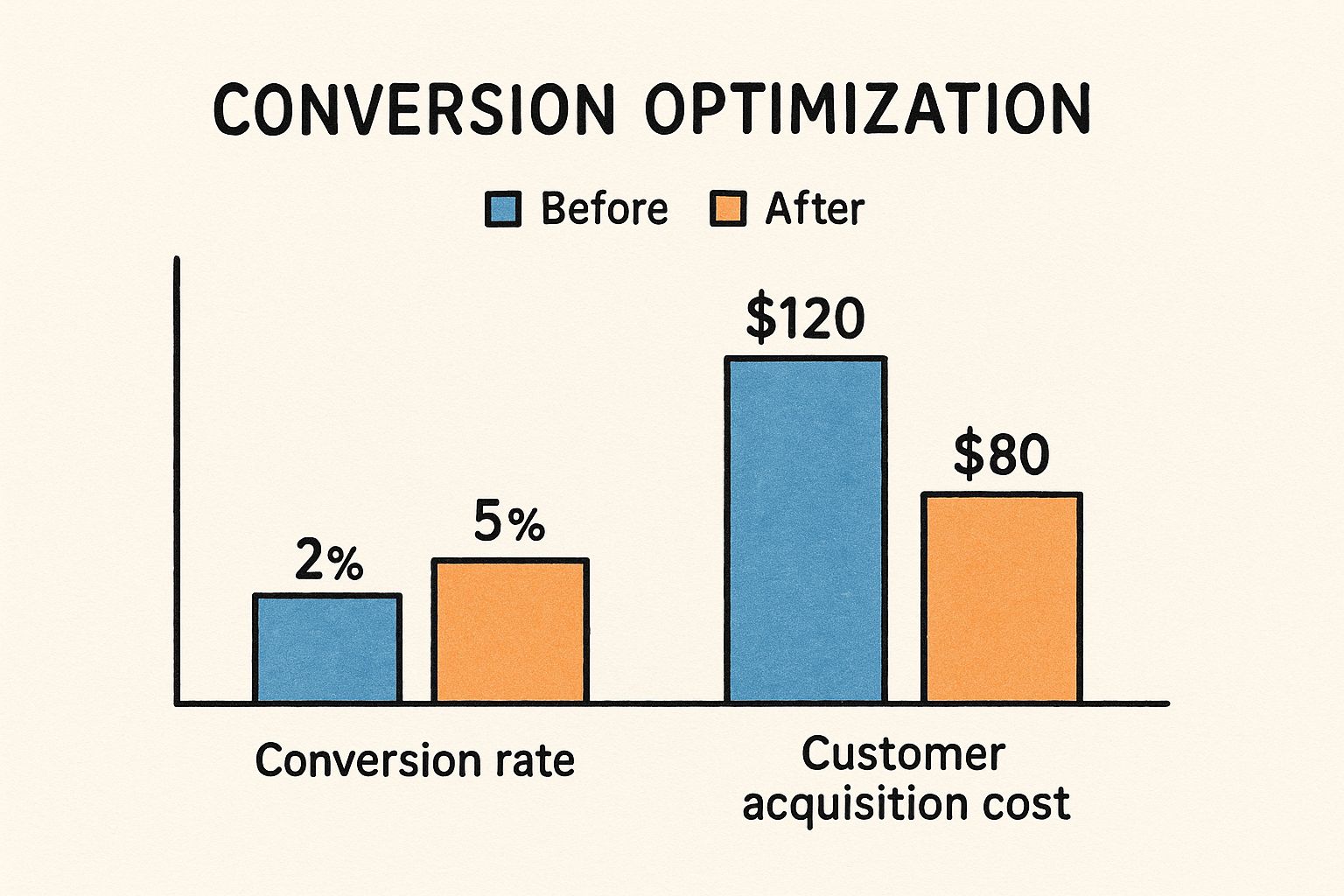
This visual powerfully illustrates that by more than doubling the conversion rate, the business was able to cut its CAC by a third.
Finding Your Competitive Edge
So, how can you use this information to find an edge? Start by breaking down your acquisition channels. Are you heavily reliant on paid search, where costs are high in your industry? Perhaps there's an untapped opportunity in content marketing or organic social media that your competitors are ignoring.
Here’s a practical way to approach this:
- Analyze the Top Performers: Look at the successful companies in your space, especially those known for their smart growth. What channels do they dominate? Are they building a community, creating stellar content, or have they perfected their referral program?
- Test Underutilized Channels: If everyone in your industry is battling it out on Google Ads, the cost-per-click will inevitably be high. Experiment with smaller, less saturated platforms where your ideal customer might be spending their time.
- Double Down on Conversion: Relentlessly A/B test your landing pages, checkout process, and ad copy. I’ve seen companies reduce customer acquisition cost by 20-30% just by rewriting a headline or removing a single form field. These incremental improvements add up to a significant competitive advantage over time, allowing you to acquire customers more profitably than the industry standard.
To help put these numbers into perspective, the table below provides a snapshot of acquisition costs and related metrics across different sectors. Use it to gauge where you stand and identify potential areas for improvement.
Customer Acquisition Cost by Industry
Comprehensive breakdown of average CAC, spending ranges, and LTV ratios across major industries
| Industry | Average CAC | Typical Spending Range | LTV:CAC Ratio | Key Optimization Opportunities |
|---|---|---|---|---|
| Retail | $50 – $120 | $1,000 – $15,000/mo | 3:1 to 5:1 | Loyalty programs, personalized email marketing, CRO on product pages |
| SaaS | $150 – $400 | $5,000 – $50,000/mo | 3:1 to 8:1 | Content marketing, free trials/freemium models, reducing churn |
| Finance/FinTech | $200 – $500+ | $10,000 – $100,000+/mo | 5:1 to 10:1 | Trust-building content, affiliate marketing, webinar funnels |
| Healthcare | $180 – $350 | $8,000 – $40,000/mo | 4:1 to 7:1 | Local SEO, patient testimonials, educational content on specific conditions |
| Travel & Hospitality | $60 – $150 | $3,000 – $25,000/mo | 4:1 to 6:1 | User-generated content, influencer partnerships, seasonal promotions |
| Education/EdTech | $100 – $250 | $4,000 – $30,000/mo | 3:1 to 6:1 | Free course previews, student success stories, targeted social media ads |
This table highlights the vast differences in acquisition costs and what's considered "healthy" from one industry to the next. A SaaS company can justify a higher CAC due to strong recurring revenue and a high LTV:CAC ratio, whereas a retail business needs to be more conservative. The key takeaway is to focus on the metrics and strategies most relevant to your specific business model and market.
Transforming Your Support Team Into A Growth Engine
When you’re trying to figure out how to reduce customer acquisition cost, where does your mind go first? Most leaders immediately start tweaking marketing funnels or adjusting sales commissions. That makes sense, but it overlooks a massive, often untapped resource right under your nose: your customer support team. It's easy to see support as a cost center—a necessary expense for putting out fires—but a well-run support operation can become your most effective growth engine.

The Shopify Help Center is a perfect example of a self-service system done right. It gives users multiple ways to find answers on their own, fast. This proactive setup doesn't just cut down the work for live agents; it empowers users, which boosts their experience and loyalty.
This shift from reactive problem-solving to proactive value creation is more important than ever. In the last five years alone, the average cost to acquire a customer has shot up by about 60%, putting a tight squeeze on profit margins everywhere. In this climate, rethinking your support function isn't just a clever move; it's a financial necessity. Since around 81% of customers try to solve their own issues first, a solid self-service system directly helps lower your CAC. You can dig deeper into this trend and its effect on acquisition costs by checking out the full analysis on DevRev.ai.
From Cost Center To Customer Advocate
The idea is simple: every interaction with your support team is a chance to build a stronger customer relationship and create a brand advocate. When a customer gets outstanding, quick help, their frustration melts away and turns into appreciation. That appreciation fosters loyalty, and loyal customers are far more likely to refer new business—giving you new leads for a tiny fraction of what traditional marketing costs.
Think about a typical situation in the SaaS world. A new user is fumbling with a key feature during their free trial.
- The Cost Center Approach: The user submits a ticket. They wait 24 hours for a generic reply that just links to a long, dense help article. They get frustrated and cancel. The money you spent to get that user is now a total loss.
- The Growth Engine Approach: The moment they sign up, the user is offered an interactive product tour. When they still hit a snag, they easily find a short, clear video tutorial in the knowledge base. If they still need help, a live chat agent quickly walks them through it, notices their goal, and points out another feature that could save them time.
In the second scenario, the user doesn't just fix their problem—they discover more value in the product. They're now much more likely to become a paying customer and tell their friends about the service. One SaaS company I know cut its CAC by 40% just by overhauling its onboarding and support experience to follow this model.
Building Your Support-Driven Growth System
Making this happen takes more than just telling your team to be "more helpful." It means building a system that empowers both your customers and your support agents. Here’s what that looks like in practice:
- Develop a World-Class Knowledge Base: This is your foundation. It needs to be thorough, easy to search, and filled with different types of content like articles, video tutorials, and GIFs. This deflects the most common tickets, freeing up your team to handle more complex problems.
- Implement Proactive Support: Use tools to see where users are getting stuck in your product and offer help before they even ask. This could be a pop-up chat invitation or an automated email with useful tips triggered by their behavior.
- Train for Growth, Not Just Resolution: Your support agents should be trained to understand what your customers are trying to achieve. Their job isn't just to close tickets; it's to make the customer successful. This involves teaching them to spot upsell opportunities, collect valuable product feedback, and identify potential customers for case studies.
By changing your mindset, customer support becomes a strategic asset. You’re not just saving money by reducing support tickets; you're creating a cycle where happy, successful customers become your most powerful and cost-effective sales team. This approach doesn't just trim your CAC—it builds a durable competitive advantage.
Optimizing Your Sales Process With Data-Driven Insights
Your sales team often represents one of the biggest variable costs in getting new customers, but that also makes it one of your greatest opportunities for improvement. To genuinely lower your customer acquisition cost, you need to stop relying on gut feelings. By using data-driven insights, businesses are figuring out what really drives conversions and cutting out expensive, inefficient habits from their sales cycle.
Imagine knowing for certain that specific conversation topics or follow-up sequences consistently bring in more revenue. That's the real power of sales analytics. Instead of giving vague advice, you can provide your team with concrete, actionable feedback based on what the numbers prove works. This turns coaching from a subjective guess into a precise practice, helping your whole team perform more like your top closers.
Identifying What Truly Works
The first move is to track sales activities with the goal of spotting patterns. This is about more than just logging calls and emails. You need to connect specific actions to actual outcomes. For example, do deals close faster when the first discovery call includes a product demo? Do conversations involving multiple stakeholders on the client's side have a better win rate?
By digging into this data, you can build a playbook based on proven success, not just old habits. This helps you pinpoint the exact behaviors that lead to closed deals and then scale them across your entire team. This is especially helpful for remote teams where you can't just walk the sales floor. If you're looking for ways to boost performance from a distance, check out this guide on how to manage a remote sales team. A data-first approach gives you the visibility you need to coach effectively, no matter where your team is.
Using Technology To Enhance Human Performance
Modern tools can put this whole process on steroids. AI-powered analytics can comb through hundreds of calls, pinpointing keywords, sentiment, and talk-to-listen ratios that correlate with successful outcomes. This isn't about replacing your salespeople; it's about giving them superpowers. Data shows that sales teams see huge benefits from this kind of analysis, which can highlight critical performance patterns. For instance, some studies show that reps who mention certain product benefits close 20% more deals, while calls lasting over eight minutes have a 50% higher conversion rate. You can read more about these insights into lowering acquisition costs on Trellus.ai.
When you put systems in place that offer this level of feedback, you kickstart a cycle of continuous improvement. Sales reps get almost immediate feedback on what's working, allowing them to adjust their approach on the fly. Here are a few practical ways to apply these insights:
- Create dynamic sales scripts: Ditch the static scripts. Instead, develop flexible talking-point guides based on the language and questions that have proven most effective in winning deals.
- Optimize call timing: If your data reveals that follow-up calls made on Tuesday mornings have the best connection rate, schedule your outreach accordingly.
- Refine your follow-up cadence: Analyze how many touchpoints are ideal for your sales cycle. You might discover that five follow-ups are perfect, and any more than that just wastes valuable time with diminishing returns.
By focusing on these data-backed strategies, you give your sales team the tools they need to be more effective and confident. This optimization directly leads to higher close rates and, ultimately, a significant drop in your customer acquisition cost, making every salesperson a more efficient engine for growth.
Conversion Rate Optimization That Actually Moves The Needle
Getting more customers doesn't always mean you have to spend more money. Often, the smartest way to reduce your customer acquisition cost is to make it easier for the people already visiting your site to buy something. This is the whole idea behind conversion rate optimization (CRO), and when you get it right, the impact is huge. A lot of people talk about A/B testing, but very few do it with enough consistency to see real results.
Strategic CRO isn't about throwing ideas at a wall and hoping something sticks. It’s about making small, data-backed changes that build on each other over time. This could be as simple as rewriting a landing page headline to connect with a visitor's biggest frustration or smoothing out a clunky checkout process that’s causing people to leave their carts behind. These adjustments might seem small, but they can be the difference between a visitor who leaves and a visitor who becomes a loyal customer.
The Psychology Behind High-Converting Pages
Great CRO is really about understanding people. You’re not just changing the color of a button; you’re making things less complicated, building trust, and showing the value of what you offer. A page that converts well anticipates what a user is thinking and answers their questions before they even have to ask. It makes the next step feel obvious and natural.
Put yourself in your user's shoes for a moment. Do they feel like their payment information is safe? Is it crystal clear what they get for the price? Is the call-to-action (CTA) button both clear and convincing? Every one of these moments is a chance to either move them forward or create hesitation. Getting rid of that hesitation is how you improve your conversion rate without touching your ad spend.
For a closer look at how your sales activities should line up with your marketing funnels, our guide on building a sales pipeline offers solid frameworks for connecting these two essential functions. This connection is key, as a smooth handoff from marketing to sales often depends on the clarity and trust you establish on your landing pages.
Prioritizing Your Optimization Efforts
With a never-ending list of things you could test, where do you even begin? Start with the highest-leverage spots in your funnel—the pages or steps where you see the most people drop off. For most businesses, these are the usual suspects:
- Landing Page Headlines & Copy: Does your headline instantly tell visitors they’re in the right place? Does the text clearly explain the benefits of your offer?
- Call-to-Action (CTA) Buttons: Experiment with the text, color, and placement of your CTAs. A simple switch from "Submit" to "Get My Free Quote" can dramatically increase conversions.
- Form Fields: Only ask for the information you absolutely need. Every extra field you ask someone to fill out is another opportunity for them to walk away.
- Checkout Process: Strip away all distractions from your checkout page. Offer a guest checkout option and show security badges clearly to build confidence.
The only way to unlock these improvements is through systematic testing. Tools like the now-sunsetted Google Optimize (or its alternatives) allow you to run experiments and see exactly how changes affect user behavior.
Here’s an example of what setting up an A/B test looked like in that platform.
This view shows how you can set up different versions of a page to test against the original, giving you hard data on what truly works. By running tests like these, you stop making assumptions and start making decisions based on real user actions—and that's the fastest path to finding what really moves the needle.
Building Sustainable Referral And Retention Systems
The best way to lower your customer acquisition cost is to stop the endless chase for new leads and instead focus on delighting the customers you already have. Think about it: the cheapest customer to get is one who comes to you through a trusted referral. And the most valuable thing you can do for your budget is keep the clients you’ve already won over. It sounds simple, but this is where most companies drop the ball, getting stuck on the expensive treadmill of paid acquisition.
This isn't just about adding a basic "refer a friend" button. It’s about crafting an experience so good that your customers naturally become your biggest fans. The goal is to make sharing feel like a genuine side effect of great service, not a forced transaction. This process starts the second a customer signs up, with an onboarding that isn't just about teaching them your product, but about helping them get their first "win" as fast as possible. That early success is what builds the groundwork for loyalty and keeps them from churning.
Turning Loyalty Into Your Acquisition Channel
A loyal customer base is your greatest defense against rising ad costs. Businesses that systematically focus on customer lifetime value (LTV) often see their CAC get cut in half over time. Why? Because retained customers don't just keep paying you; they also become a source of nearly free, high-quality leads through word-of-mouth. Since keeping customers is almost always cheaper than finding new ones, diving into effective customer retention strategies is a must for any business wanting to grow sustainably.
A solid retention strategy is more than just sending out generic email blasts. You could build a tiered loyalty program that rewards customers for more than just repeat business. Maybe you offer exclusive access to new features, one-on-one consultations, or an invitation to a private community forum. For instance, a software company could offer its top-tier users a free strategy session with a product expert. This not only provides immense value but also deepens the relationship, making them far less likely to leave and much more likely to recommend you to their network.
From Happy Customers To Active Referrers
Once you have a core group of loyal customers, you can build a referral system that doesn't feel forced. The secret is to pinpoint your most valuable customers—those with a high LTV and engagement level—and make it ridiculously easy for them to spread the word.
Here’s a practical way to set this up:
- Identify Your Champions: Use your data to find customers who use your product often, have left glowing reviews, or have a high Net Promoter Score (NPS). These are the people most likely to advocate for you.
- Arm Them with Tools: Create a simple, shareable link or a pre-written email they can quickly forward to colleagues. The less work they have to do, the higher the chance they'll actually do it.
- Reward Both Sides: Offer a real incentive for both the person referring and the new customer they bring in. This could be a discount, service credits, or a free upgrade. A dual-sided reward makes the referrer look good for sharing a valuable deal.
By connecting these systems, you shift retention from a defensive move to a powerful growth strategy. Every happy customer you keep becomes a potential new branch in your acquisition network, driving down costs and building a more resilient, profitable business.
Your Action Plan For Sustainable CAC Reduction
Putting all these strategies into motion can feel like a lot, but a focused plan makes it manageable. The real goal isn't to change everything at once but to make smart, high-impact adjustments that build on each other. A lasting effort to reduce customer acquisition cost begins with clear priorities and a commitment to tracking what works. This is your roadmap for turning ideas into real savings.
Where to Focus First: The Prioritization Framework
Figuring out where to start is often the biggest hurdle. The most effective approach is to find the area where you can get the biggest win with the least amount of heavy lifting. Ask yourself a few key questions:
- Which channel is eating up my budget with the worst conversion rate? This is your low-hanging fruit. Even a small improvement here can lead to major savings.
- Where is the biggest point of friction for my customers? Dig into your analytics and user feedback to see where people are dropping off. Is it a confusing landing page? A signup form that asks for too much? A clunky checkout process?
- What one change would make the biggest difference to our customer experience? Sometimes, the most significant gains come from improving your retention and referral programs. Happy customers are your most cost-effective marketing channel, period.
Setting Realistic Timelines and Tracking Success
You won't see results overnight. You need to give your strategies time to breathe, but you should also set clear checkpoints to see how you're doing. For marketing channel tweaks, you might see a difference within a quarter. For retention-focused changes, it could take six months before you see a real drop in your CAC.
Here are the key metrics you should be watching:
- CAC per channel: Check this weekly to spot any emerging trends.
- Lead-to-customer conversion rate: Monitor this next to CAC to make sure you're still bringing in high-quality customers.
- Customer Lifetime Value (LTV) to CAC ratio: The goal is to hit a healthy ratio, usually 3:1 or better, to ensure you’re running a profitable operation.
It's also essential to have a solid team in place to carry out these strategies. Many companies find success by adding to their in-house teams. For example, some businesses opt for SDR outsourcing to build a high-performing sales development team without the hefty overhead. This frees up internal resources to focus on other growth areas.
Ultimately, building a cost-effective way to get new customers is a continuous cycle of testing, learning, and refining. For a deeper look at specific actions you can take, this guide on proven strategies to reduce customer acquisition cost has some excellent insights. Don't get discouraged if progress feels slow at first; consistency is what drives success in the long run.
Ready to build a high-performing sales team that drives revenue without breaking your budget? Explore how AboutHire connects you with elite, cost-effective sales talent today.