Why Most Sales Onboarding Fails (And How To Fix It)

Let's be real, most sales onboarding programs just don't cut it. Too many new sales reps are drowning in product info and generic presentations, leaving them feeling lost and totally unprepared to actually, you know, sell. This isn't just a headache for the new hires; it's a drain on the company's resources. High turnover and slow ramp-up times are often the direct result of a weak onboarding process. So, how do you create a sales onboarding plan template that actually works?
The secret lies in treating onboarding as a strategic investment, not just another box to check on the HR to-do list. High-performing sales teams get this. They don't just tell new reps about the product; they cultivate confident, capable sellers through structured programs that reflect real-world selling. Forget death-by-PowerPoint! It's about creating engaging, hands-on experiences.
This shift in thinking has a big impact on the bottom line. A rep who's struggling for six months before hitting their quota is costing you money. On the other hand, a rep who's closing deals within weeks is generating revenue and boosting team performance. The difference? Often, it all boils down to the quality of their onboarding. Companies with structured sales onboarding see a huge improvement in ramp-up time. New reps hit full productivity 50% faster than those with less formal training.
Unstructured onboarding can mean a 6–12 month wait before reps become truly effective. A well-designed, template-based plan can cut that down to 3–6 months. That’s a massive difference! Learn more about effective sales onboarding here.
For those eager to get a head start, a virtual internship can offer invaluable practical experience. Check out this: Salesforce Supported Virtual Internship Program 2025. These programs can significantly shorten the learning curve when a rep officially joins the team. At the end of the day, investing in a well-structured sales onboarding plan template is an investment in the future of your sales team.
Essential Template Components That Actually Matter
So, you're building a sales onboarding plan template? Great! But let's be honest, some templates out there are about as exciting as watching paint dry. They overwhelm new hires with everything at once. Trust me, I've seen it firsthand – and it's not pretty. The key is to prioritize what truly matters. Let’s ditch the generic fluff and build a template that actually gets results.
Structuring Knowledge for Maximum Impact
Think about it: a sales onboarding plan isn't just about dumping product info on someone. It’s about structuring that knowledge so it actually sticks. It's like learning to ride a bike. You didn't crack open the physics textbook first, did you? You learned balance, pedaling, then steering – building up gradually.
Start with the foundational product knowledge. What are the core features and benefits? How does this product solve a customer's problems? Once your new hires have the basics down, then you can introduce more complex topics like competitive analysis and objection handling. This approach prevents information overload and helps build confidence.
Customer Personas: Beyond the Basics
Customer personas are vital. But generic descriptions just won't cut it. Instead, build personas based on real customer conversations. I've found that adding actual customer quotes and pain points brings these personas to life. I've even seen new reps use these detailed profiles to create personalized pitches that truly resonate with prospects, resulting in faster deals.
Competitive Intelligence: Make It Actionable
Competitive intelligence shouldn't be some dusty document gathering dust on a shelf. It needs to be a dynamic tool your reps actually use. Consider creating battle cards that highlight your key differentiators and address common competitor objections. This gives new hires the confidence to handle tricky questions and effectively position your product in the market.
To make this information truly actionable, I've found that incorporating real-world examples, win/loss analyses, and competitor pricing strategies is incredibly effective. You can even create interactive quizzes or role-playing scenarios to reinforce this knowledge and help reps apply it in practical situations.
Prioritizing the First 90 Days
Remember, the goal is to set your new reps up for success within those crucial first 90 days. Focus on the information they absolutely need during this period. What are the most common sales scenarios they’ll face? What objections will they hear most often? Prioritizing these practical elements can significantly impact early performance and set the stage for long-term success. You can track the effectiveness of your onboarding efforts by optimizing sales efficiency metrics.
Let's talk about what should be in your template. I've put together a table summarizing the key components, their priority level, a reasonable implementation timeline, and the metrics you can use to measure their effectiveness.
Essential Onboarding Template Components
| Component | Priority Level | Implementation Timeline | Success Metrics |
|---|---|---|---|
| Foundational Product Knowledge | High | Week 1 | Product knowledge assessments, initial sales calls |
| Customer Personas | High | Week 2 | Conversion rates, deal size, sales cycle length |
| Competitive Intelligence | Medium | Weeks 3-4 | Win/loss ratios, deal close rates, average deal value |
| Sales Playbook | High | Ongoing | Revenue generated, sales cycle length, customer churn |
| CRM Training | High | Week 1 | CRM adoption rate, data accuracy, sales pipeline growth |
This table provides a solid framework for what to include in your sales onboarding template. Prioritizing these components will ensure your new hires become confident, capable sellers. By focusing on these key elements, you’re not just building a template, you’re building a launchpad for sales success.
Creating Training Content That Mirrors Real Selling

The biggest mistake so many sales onboarding programs make? Treating product knowledge like it's some isolated island. New reps learn every bell and whistle, then completely blank when they finally face a real, live prospect. The key to bridging that gap between the classroom and the real world is immersive training that mirrors actual selling. Ditch the feature dumps and embrace dynamic role-play scenarios that truly prepare reps for the conversations they'll actually have.
Instead of just listing out features, get those new hires role-playing common sales situations. How would they handle a price objection? What about a prospect who brings up the competition? These kinds of exercises build confidence and give reps the practical skills they need to hit the ground running. A well-structured sales onboarding plan template can house all sorts of helpful resources, like objection-handling frameworks and competitive battlecards. Think of it as giving your new hires a handy toolkit for those crucial early days.
This also means going beyond the basics. Consider building a library of customer stories to make abstract concepts more concrete. Share recordings of actual sales calls, both the wins and the losses, to illustrate best practices and those all-too-common pitfalls. I once worked with a team that incorporated "failure analysis" into their onboarding. They'd review lost deals, dissecting where things went wrong and brainstorming how to avoid similar mistakes. It was incredibly helpful in getting new reps to understand the subtleties of the sales process.
Documenting these training exercises within a standard operating procedure template in Excel, for example, can be extremely helpful for streamlining workflows. Trust me, documented onboarding processes get results. A 2023 survey found that over 70% of sales organizations with a documented onboarding template saw higher quota attainment within the first 90 days. Companies that went digital with their templates, integrating product demos, sales plays, and customer case studies, saw 65-70% of new reps hitting or exceeding targets in their first quarter. Compare that to the 35-40% in organizations without standardized onboarding. Want to dive deeper? Check out more info on effective sales onboarding processes. The ultimate goal isn't just to transfer knowledge—it's to build reps who walk into their first sales meeting feeling prepared and confident, not like a deer in headlights.
Adapting Your Template For Different Sales Roles
Most sales onboarding plan templates make a critical mistake: they assume all sales roles are the same. Let's be real, a seasoned enterprise rep jumping ship to a new industry needs vastly different support than a fresh-faced grad landing their first sales gig. For impactful training, explore diverse use cases and strategies, such as those covered in this helpful piece on Uses – Training. Adapting your template is all about maintaining a consistent core structure while still catering to individual needs.
Scaling Content Complexity
Think about experience levels. A senior sales hire probably doesn’t need a Sales 101 refresher. Instead, focus their onboarding on the nitty-gritty product details, the competitive landscape, and your company's specific sales methodology. On the flip side, entry-level reps will benefit from foundational sales skills training alongside product knowledge. Scaling the complexity of your content ensures everyone gets exactly what they need without wasting precious time on redundant info. It’s like a choose-your-own-adventure book for onboarding – different paths, same successful destination.
Inside vs. Field Sales
Your sales onboarding plan template also needs to address the different day-to-day realities of inside vs. field sales roles. Inside sales reps, working primarily from their home office (or wherever their laptop roams), might need more training on virtual communication and maximizing the use of digital tools like Slack or Zoom. Field sales reps, who thrive in those face-to-face meetings, could benefit more from role-playing scenarios and travel best practices. Adapting your framework to the work environment makes the training truly relevant.
This image from Wikipedia illustrates the broad scope of sales management:
As the screenshot highlights, sales management covers a multitude of roles and responsibilities. All of these impact how a sales onboarding plan template should be structured and implemented. It’s definitely not one-size-fits-all!
Specialized Roles and Remote Teams
And what about those specialized roles like sales engineers or customer success reps? They’ll need highly targeted onboarding tailored to their unique responsibilities. You don’t need to create entirely separate programs, though. Instead, integrate role-specific modules within your core template. This approach keeps things consistent while addressing specialized needs. For remote team members, specifically, build in plenty of opportunities for virtual connection and collaboration to combat that feeling of isolation. Little things, like virtual coffee breaks or online team-building activities, can make a huge difference in fostering a sense of belonging. This creates a stronger team overall, which translates to better individual performance and a more unified sales organization. By adapting your sales onboarding plan template, you’re setting up every new hire to thrive, no matter their specific role.
Rolling Out Your Template Without Organizational Chaos

You've built a fantastic sales onboarding plan template. Great! But now comes the real challenge: getting your team to actually use it. This is where so many great ideas fall flat. Trust me, I’ve been there and talked to countless sales leaders about this. The successful ones know that implementation is all about navigating the realities of busy sales teams.
Phasing Your Rollout
Don't try to do everything at once. A phased rollout is essential for getting everyone on board. I recommend starting with a pilot group – a team that's open to trying new things and giving you honest feedback. This lets you work out any kinks in your template before launching it company-wide. Plus, early success with a pilot group builds momentum and helps convince the skeptics.
Managing Resistance
Let's be real. Some managers will push back. They might think their way is better, or they’re just too busy for "another new initiative." The key to overcoming resistance is demonstrating the value of your template. Show them the data. How does structured onboarding translate to faster ramp-up times and increased quota attainment? For example, data shows that with a solid onboarding program, reps often hit quota 50% faster. That's a compelling argument.
Maintaining Momentum
Initial excitement can fade fast. To keep the energy up, celebrate early wins and recognize those who are using the new process. This reinforces positive behavior and encourages continued adoption. Consistent communication is also vital. Keep everyone in the loop on progress, address any concerns, and remind them of the template's benefits.
Real-World Constraints
Limited resources and competing priorities are a fact of life. Be realistic about what’s achievable with the time and resources you have. Focus on the most impactful elements of your template first. For example, if recruiting is a bottleneck, check out our guide on the sales recruitment process. Streamlining recruitment can significantly impact your onboarding effectiveness. Remember, even small improvements can make a big difference.
To help you plan and manage the rollout effectively, I’ve put together a practical roadmap:
Here's a helpful table to guide your implementation:
Implementation Timeline and Milestones
A practical roadmap showing key implementation phases, timeline expectations, and success checkpoints for rolling out sales onboarding templates
| Phase | Duration | Key Activities | Success Indicators | Common Pitfalls |
|---|---|---|---|---|
| Pilot Program | 4-6 weeks | Train pilot group, gather feedback, revise template | Increased pilot group quota attainment, positive feedback, identified template improvements | Lack of pilot group engagement, insufficient feedback collection |
| Company-Wide Rollout | 8-12 weeks | Train sales teams, provide ongoing support, monitor progress | Increased overall quota attainment, consistent template usage, improved rep ramp-up time | Insufficient training resources, lack of management buy-in, resistance to change |
| Ongoing Optimization | Continuous | Gather data, analyze results, refine template based on performance | Sustained performance improvements, evolving template based on best practices, high user satisfaction | Neglecting ongoing data analysis, failing to adapt to changing needs |
This table provides a framework for a successful rollout. Adapt the timeline and activities to fit your specific organization.
By proactively addressing these challenges, you can transform your sales onboarding from a headache into a powerful engine for developing confident, successful reps. And that means higher revenue and a more thriving sales organization.
Tracking What Actually Predicts Sales Success
Too many sales teams get caught up tracking the wrong things during onboarding. Sure, completion rates and smiley-face feedback forms look nice, but they don't always translate into closed deals. So, what does predict long-term success and consistent quota crushing? Let's ditch the vanity metrics and dive into the stuff that actually moves the needle, drawing on my experience with data-driven sales organizations.
This infographic paints a picture of a typical onboarding flow and some common metrics:
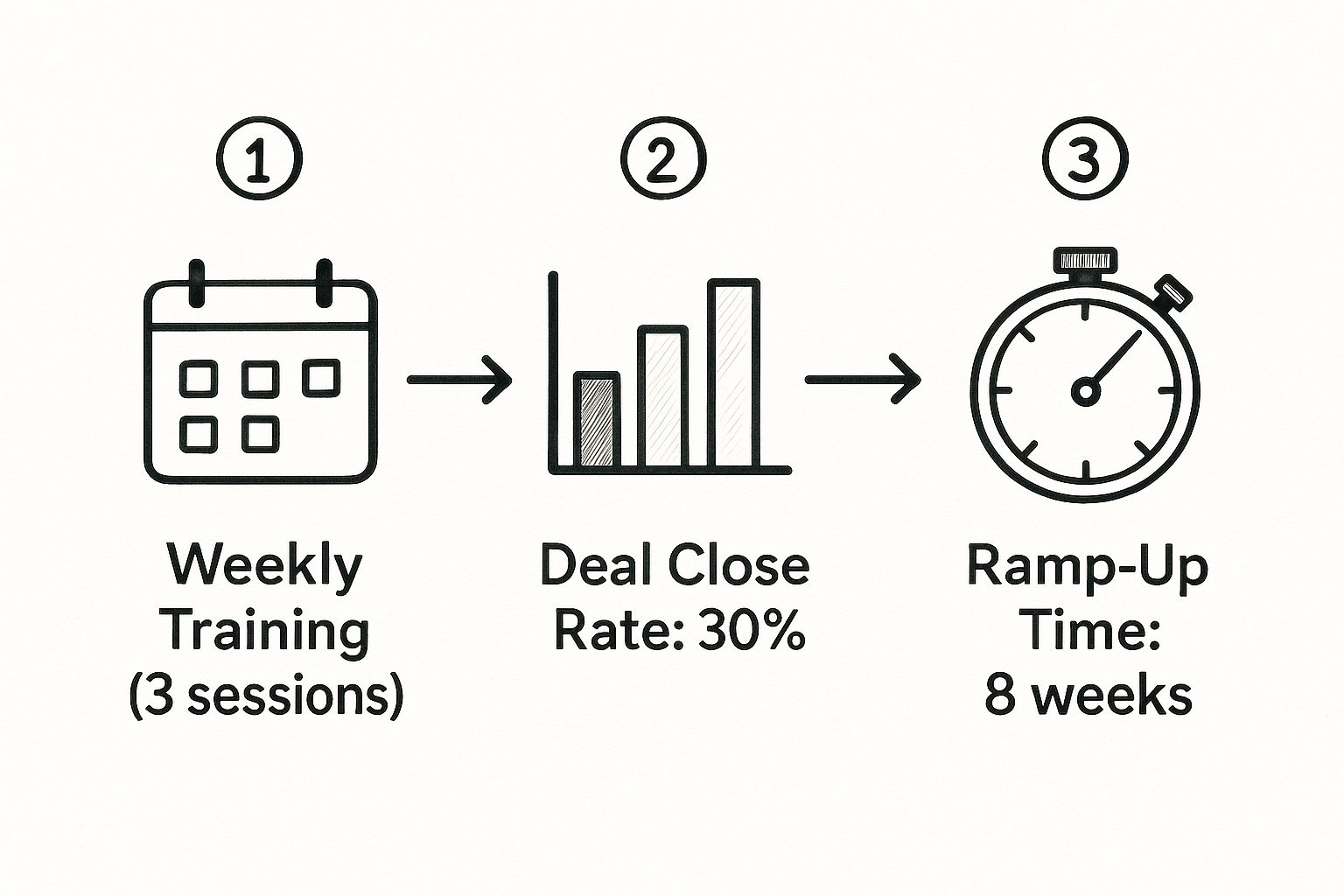
Notice the connection between training, deal close rate, and ramp-up time. Eight weeks to full productivity with a 30% close rate? That's a flashing neon sign pointing to areas for improvement. One of the biggest keys is setting meaningful benchmarks. Forget about how many training modules someone completes. Instead, ask yourself what really impacts revenue.
Is it the sheer number of calls made, or the quality of those conversations? Is it pure product knowledge, or the ability to build real rapport with a prospect? Once you pinpoint the behaviors driving success, build your metrics around those.
Measuring Progress Without the Burden
Tracking progress shouldn't feel like climbing Mount Everest. A mountain of paperwork only distracts your team from what they should be doing: selling. So, streamline the process. Integrate your key metrics directly into your CRM or use dedicated sales enablement tools to automate data collection.
This gives you easy monitoring without drowning your reps in admin tasks. Plus, it allows you to catch warning signs early and prevent costly turnover. Is a new hire consistently missing meetings? Are their deal close rates in the basement? These are red flags that need proactive attention. Maybe they need extra coaching, a different kind of support, or perhaps a different role altogether.
Gathering Useful Feedback
Formal reviews definitely have their place, but never underestimate the power of informal check-ins. A quick chat can give you invaluable insight into how your new hires are actually feeling. Are they confident? What challenges are they facing? Are they getting the support they need?
Use these opportunities to offer guidance, provide encouragement, and even tweak your sales onboarding plan template as needed. Remember, it’s a living document, not set in stone. For a deeper dive into assessing sales skills, you might find this resource on sales skills assessment helpful.
Using Data to Refine Your Process
This image from Wikipedia gives a good overview of key performance indicators (KPIs):
The key takeaway here is choosing the right metrics and understanding what they truly tell you. Successful sales organizations know that data isn't just for reporting; it's for constant improvement. Analyze your onboarding metrics to identify what’s working and what’s not. Are certain training modules more effective than others? Are your benchmarks realistic and achievable?
Use the data to refine your template, creating a feedback loop that benefits both the onboarding experience and your bottom line. At the end of the day, the most crucial metric is how onboarding performance translates into actual revenue. Are your newly onboard reps contributing to the company’s sales goals? Are they closing deals and generating revenue? Connecting onboarding to revenue demonstrates the value of your program and justifies continued investment in your sales team’s development.
Your Next Steps To Onboarding Excellence
So, you've built a fantastic sales onboarding plan template. Great! But that's just the first step. The real payoff comes when you implement it and see it flourish within your team. This section is your practical guide to making that happen, your personal roadmap to onboarding excellence.
Auditing Your Current Process
Before you revamp everything, let's take a critical look at your existing process. What's working? What's not? Where are the biggest opportunities for improvement? A simple spreadsheet can be incredibly helpful here. List out each stage of your current onboarding and honestly assess its effectiveness. And don't forget to talk to your current sales reps! Their onboarding experience is invaluable feedback. What worked for them? What could have been better? You might be surprised at the impact even small adjustments can make.
Identifying Quick Wins
Momentum is crucial. Don't try to change everything at once. What small, impactful changes can you implement this week to enhance your onboarding? Perhaps it's adding a few new role-playing scenarios or creating a cheat sheet for handling common sales objections. These quick wins not only benefit your new hires but also generate enthusiasm for more substantial changes down the line.
Securing Stakeholder Support
For larger overhauls, you'll need buy-in from leadership. This means clearly demonstrating the value of your new onboarding plan to key stakeholders. Focus on the return on investment. How will a better onboarding program lead to higher sales, faster ramp-up times, and lower employee turnover? Back up your claims with data. Numbers speak volumes! Clear communication is essential to getting everyone on board and securing the necessary resources.
Setting Realistic Timelines
Different implementation strategies require different timelines. Minor tweaks might take a week, while a complete overhaul could take months. Be realistic about what you can achieve given your timeframe and resources. Break down the implementation into smaller, manageable phases, each with its own milestones and metrics. This structured approach keeps everyone focused and prevents the initiative from getting bogged down.
Whether you're starting from scratch or refining an existing program, remember that onboarding is an ongoing journey. It's a continuous process of improvement and adaptation. By following these practical steps, you'll create a sales onboarding plan that consistently produces high-performing reps who not only exceed their quotas but also stay with your company for the long haul. Ready to elevate your sales team? AboutHire connects you with top-tier remote sales professionals from Latin America and Europe, offering a cost-effective and efficient way to build a world-class sales organization. Explore the possibilities with AboutHire.