Understanding Your Current Sales Reality
Before you can fix anything, you need a brutally honest look at where you stand. Most sales teams, even the successful ones, have a set of assumptions about how their process works. They think they know the path from lead to close, but the day-to-day reality is often much messier. Real sales process optimization doesn't kick off with a brand-new playbook; it begins with an audit that reveals the hidden truths of your current operations.
The mission here is to get past the "official" process collecting dust in a binder and map what actually happens. This means talking to your team, listening to sales calls, and digging into your CRM data. You might be shocked to find your top reps are skipping three "required" steps, or that most deals get stuck at a stage you thought was just a formality.
Mapping the Real Customer Journey
Your sales process should serve the customer's journey. If the two aren't aligned, you're just creating friction. Start by outlining the journey from your customer's point of view, not your team's.
- Awareness: How do they find out about you? What specific problem are they trying to fix?
- Consideration: What information are they looking for? Who are they comparing you to? What questions come up repeatedly in demos?
- Decision: What pushes them to make a final choice? Is it the price, a specific feature, or the level of service? What internal approvals do they have to get?
Once you have this map, lay it over your internal sales stages. Do your stages actually help the customer move forward, or are they just there for your internal reports? For example, a company I worked with found their "Technical Demo" stage was a major bottleneck. Prospects weren't ready for a deep technical dive; they just wanted to see if the product could solve their primary pain point. By splitting it into a "Problem-Solving Intro" and an optional "Technical Deep Dive," they started closing deals much faster.
Gathering Unfiltered Feedback
Data can show you the "what," but your people will tell you the "why." You need to get honest feedback from two crucial groups: your sales team and your prospects (both the ones you won and the ones you lost).
- Your Sales Team: Don't just ask, "What isn't working?" Get specific. Ask questions like, "Which part of the process feels like you're fighting the system?" or "Where do you waste the most time on tasks that don't involve talking to customers?" The people in the trenches know exactly where the friction points are. Building this team is crucial, and you can learn more about finding the right people in our guide to the sales recruitment process.
- Your Customers: For new clients, ask, "What was the most helpful part of our process, and what was the most frustrating?" For deals you lost, the question is direct: "At what point did you decide we weren't the right fit?" Their answers are pure gold.
To help you get started, here's a checklist to guide your audit. It will help you ask the right questions and spot areas for improvement.
| Process Area | Key Questions | Red Flags | Success Indicators |
|---|---|---|---|
| Lead Generation & Qualification | Where do our best leads come from? How quickly do we follow up? Is our Ideal Customer Profile (ICP) clear? | High volume of unqualified leads. Inconsistent follow-up times. Reps are confused about who to target. | High MQL-to-SQL conversion rate. Follow-up happens within an hour. ICP is well-defined and used by the team. |
| Needs Discovery & Demo | Are we asking insightful questions or just pitching features? Do we understand the customer's core problem? Is the demo personalized? | Demos are generic, one-size-fits-all. Reps do most of the talking. Deals stall immediately after the demo. | Reps can clearly state the customer's pain point. Demos focus on solutions, not just features. Prospects are highly engaged. |
| Proposal & Negotiation | Are proposals sent quickly? Do they clearly articulate value and ROI? Where do negotiations usually get stuck? | Proposals take days to create. Customers are surprised by the price. Frequent and heavy discounting is needed. | Proposals are standardized but customizable. Pricing is transparent and tied to value. Negotiations are focused on terms, not just price. |
| Closing & Onboarding | Is the closing process simple? Is the handoff to customer success smooth? What's the main reason for last-minute drop-offs? | Contract signing is complex and manual. New customers are confused about the next steps. High early-stage customer churn. | Closing is a simple, often digital, process. The handoff is seamless with clear communication. New customers are engaged and happy. |
This checklist is your starting point. The goal is to identify the specific friction points in your process so you can address them directly.
The results of this deep dive can be significant. Companies that actively fine-tune their sales process can see conversion rates jump by 30% or more. This happens because a smoother process shortens the sales cycle. Considering that reps can spend nearly 40% of their time on non-selling tasks, streamlining these workflows can boost sales productivity by 15-20% and improve forecast accuracy. You can dive deeper into how optimizing your sales process impacts key metrics to see the complete picture.
Turning Data Into Your Competitive Advantage
After taking an honest look at your current sales operations, it’s time to swap gut feelings for hard facts. Winning sales teams today aren’t just good at talking; they’re masters at listening to what their data tells them. The whole point of sales process optimization is to move from guesswork to predictable revenue, and data is the engine that gets you there.
This isn’t about burying your team in spreadsheets filled with vanity metrics, like the number of calls they make. It’s about zeroing in on the specific indicators that actually forecast success. For example, instead of just tracking your overall win rate, what if you analyzed the win rate by lead source? You might find that leads from webinars close at twice the rate of those from paid ads. That’s a game-changing insight telling you exactly where to put more resources.
The move toward data-driven sales is a massive shift. Investment in analytics is climbing as more companies see its power. The percentage of businesses investing in data analytics went from 87.8% in 2022 to 93.9% in 2023. This isn't just about buying new software; it’s a strategic decision to make smarter choices, cut out expensive waste, and align sales motions with what customers actually want. You can learn more about how data is reshaping sales performance on PredictableRevenue.com. This focus helps teams pivot fast, separating the top performers from those who get left behind.
From Metrics to Meaningful Action
Collecting data is the easy part. Turning it into real change is where the magic happens. Your goal is to build a simple dashboard that tells a story, not just shows a bunch of numbers. A key part of using data as a competitive edge is consistent measurement. By tracking essential campaign performance metrics, you get the insights needed to spot what's working and what needs fixing.
Imagine a software company notices its average sales cycle is 90 days, but deals from a specific marketing campaign are closing in just 60. Instead of just celebrating, they dig in. They discover that the campaign's messaging perfectly pre-qualified prospects, which meant the sales team spent less time on discovery calls and more on showing value. The action? They update their standard sales scripts to mimic the successful campaign, shortening the sales cycle for everyone.
To get the most out of your data, it's helpful to know which metrics to focus on. Here’s a table outlining some of the most important analytics for optimizing your sales process.
Table: Essential Sales Analytics Metrics
| Metric Category | Key Metrics | Why It Matters | Optimization Impact |
|---|---|---|---|
| Lead & Pipeline Health | Lead-to-Opportunity Conversion Rate, MQL-to-SQL Ratio | Measures the quality of your leads and the effectiveness of your initial qualification process. | Helps refine marketing campaigns and lead scoring to deliver higher-quality prospects to the sales team. |
| Sales Cycle Efficiency | Average Sales Cycle Length, Time in Each Sales Stage | Reveals how quickly deals move through your pipeline and highlights where they get stuck. | Points to bottlenecks (e.g., proposal stage) that need process improvements or better rep training. |
| Sales Performance | Quota Attainment, Win Rate by Rep/Product/Source | Shows who is hitting their targets and which deals are most likely to close. | Allows for targeted coaching for reps and strategic focus on the most profitable lead sources or products. |
| Customer Value | Customer Acquisition Cost (CAC), Customer Lifetime Value (LTV) | Determines the profitability of your sales efforts and the long-term value of your customers. | Guides decisions on where to invest sales and marketing resources for the highest return on investment. |
Looking at these metrics together gives you a complete picture. A low win rate might not just be a sales problem; it could be linked to a poor MQL-to-SQL ratio, meaning marketing and sales need to get on the same page about what a good lead looks like.
Here are some core areas where data can drive immediate improvements:
- Identify Your Best Customers: Look at the traits of your most profitable, long-term clients. Use this information to sharpen your Ideal Customer Profile (ICP) and direct your team’s energy toward prospects who fit that mold.
- Pinpoint Pipeline Bottlenecks: Monitor how long deals sit in each stage. If opportunities are consistently getting stuck at the proposal phase, it’s a red flag. Are your prices confusing? Is the value not coming across clearly? The data will point you to the problem.
- Optimize Rep Performance: Data isn’t for micromanaging; it’s for coaching. By analyzing conversion rates at each stage for individual reps, you can spot specific areas for targeted training, whether it's discovery calls or closing techniques.
Building a Data-Driven Culture
Getting your team to actually use data starts with making it simple and relevant to their day-to-day work. They don't need to see every metric you track. Give them a clean, straightforward view of the numbers that directly impact their success—like their personal conversion rate and pipeline velocity.
When reps see a clear connection between what they do and the results they get, they become active partners in the optimization process. This creates a powerful feedback loop where insights lead to action, and action leads to better results, reinforcing the value of putting data first.
Designing Sales Stages That Actually Convert
Once you've used data to get a clear picture of your sales operation, the next step is to redesign the journey itself. A clunky sales process feels like forcing customers through hoops that only make sense for your internal reports. The real goal is to design stages that reflect how people actually make buying decisions, guiding them naturally toward a purchase.
This screenshot shows a typical framework, moving from first contact to a closed deal. While it’s a decent starting point, real improvement comes from tailoring these stages to your customer's specific journey and cutting any step that doesn't add value or move the conversation forward.
From Funnel Stages to Buyer Milestones
The best sales processes are built around what the buyer does, not what the seller does. Instead of thinking "Send Proposal," reframe it as "Buyer Reviews Solution." This simple shift in perspective is powerful. It makes you think about what a prospect needs to see, learn, or feel at each point to move forward with confidence.
For instance, a traditional process might have a "Demo" stage. A buyer-focused process would call it "Solution Validation." This isn't just about changing words; it changes the entire goal. The objective isn't just to show the product; it's to help the buyer validate that it solves their exact problem. This empowers your reps to concentrate on the customer's needs, which leads to better conversations and stronger deal momentum.
To put this into practice, here’s how you can map it out:
- Awareness Stage: The buyer realizes they have a challenge. Your job is to provide educational content that helps them understand and define their problem.
- Consideration Stage: The buyer is looking at potential solutions. Your role is to show how your product or service directly fixes their problem, often through case studies or focused demos.
- Decision Stage: The buyer is weighing their final options. Your goal is to make choosing you the easy decision by providing clear ROI, transparent pricing, and a simple way to sign on.
Defining Clear Exit Criteria
One of the biggest mistakes I see is having fuzzy definitions for each sales stage. This creates a messy pipeline where deals get moved forward based on a rep's "gut feeling." To fix this, you need to establish concrete exit criteria for every stage. A deal can't advance until specific, verifiable actions have happened.
Here’s a comparison to show what I mean:
| Vague Stage Definition | Clear Exit Criteria |
|---|---|
| Qualified Lead | The rep has confirmed the prospect meets BANT criteria (Budget, Authority, Need, Timeline) and has scheduled a discovery call. |
| Demo Scheduled | The rep has finished the discovery call, confirmed the prospect's key pain points, and the prospect has agreed to a tailored demo. |
| Proposal Sent | All decision-makers have seen the demo, verbally confirmed they're interested, and asked for a formal proposal with pricing. |
These sharp criteria accomplish two things: they give your team a clear roadmap for what to do next, and they provide you with a much more accurate sales forecast. This kind of structure is essential for a healthy sales operation. If you're building from the ground up, our guide on building a sales pipeline offers great foundational advice.
Balancing Automation and the Human Touch
As you rethink your stages, technology can be a huge help, but it should never take the place of building real relationships. Smart automation can handle the repetitive work, freeing up your reps to do what people do best: listen, understand, and solve tricky problems. When designing these stages, keep conversions in mind; learning about strategies for effective landing pages can seriously improve performance at the top of your funnel.
- Automate: Scheduling links, follow-up email sequences after a demo, and initial lead nurturing.
- Personalize: The discovery call, the solution demo, negotiation talks, and the final check-in before signing.
A B2B software company I worked with did this perfectly. They automated the booking for their initial 15-minute "fit" calls. But the 45-minute solution demo was always delivered live by a rep who had done their homework on the prospect's company. This mix created efficiency without losing the personal connection needed to close a complex deal, leading to a 20% increase in their demo-to-close rate. By designing stages that serve the buyer, you create a smooth path to purchase that improves conversions and builds the groundwork for lasting customer relationships.
Choosing Technology That Accelerates Performance
Picking the right sales technology can feel overwhelming. Every vendor promises their tool is the next big thing, but let's be honest—many end up creating more busywork than they eliminate. The key to sales process optimization isn't about collecting the most impressive-sounding apps. It's about strategically choosing tech that actually helps your team sell better and faster. The goal is to find tools that fit into your existing workflow, not ones that force you to overhaul everything.
A good starting point is to pinpoint the exact areas where your team is struggling and then find a tool specifically designed to solve that problem. Looking at different business process automation examples can spark some great ideas for your own operations, whether it's automating lead assignments or streamlining how contracts get approved.
Moving Beyond Basic CRM Functionality
Your CRM is the command center of your sales operation, but it shouldn't be the only tool you rely on. Sales teams today are moving past simple contact management and using integrated platforms that allow for dynamic planning and quick adjustments. This is where many organizations are finding their biggest wins.
The growth of sales performance management (SPM) technology, particularly with AI-powered planning tools, is completely changing the game for sales process optimization. Sales planning software is no longer a "nice-to-have"; it's essential for companies wanting to ditch disconnected spreadsheets and siloed CRMs. This shift helps businesses fine-tune sales territories, set more realistic quotas, and align commission strategies with what the business actually needs to achieve. Check out some of these emerging sales performance management trends on Varicent.com to see where the industry is heading.
For instance, a company I worked with was having major issues with territory alignment. Their reps were constantly overlapping, and lead distribution felt completely random. By bringing in an AI-powered planning tool, they analyzed their historical sales data and market potential to create balanced territories. The outcome was a 15% increase in qualified opportunities within six months, simply because every rep had a clear and fair chance to succeed.
Ensuring Adoption and Measuring Real Impact
The most expensive tool you can buy is the one your team never uses. Getting your team on board is just as crucial as the technology itself. Before you even think about signing a contract, get your top-performing reps involved in the evaluation. Let them sit in on demos and participate in free trials. If they can see firsthand how a new tool will help them close more deals or cut down on boring admin tasks, they'll become its biggest advocates.
Once a tool is rolled out, measuring its success has to go beyond just looking at who's logging in. You need to connect its usage back to your main business goals.
To track the real return on your tech investment, ask yourself these questions:
- Efficiency Gains: Are we spending less time on manual data entry? Has the average time to create a proposal gone down?
- Pipeline Velocity: Are deals moving from one stage to the next faster since we started using the new tool?
- Revenue Impact: Can we draw a clear line between using this technology and achieving higher win rates or bigger deal sizes?
By focusing on tools that solve specific, painful problems and then carefully measuring their effect on performance, you can build a tech stack that works as a genuine engine for growth—not just another monthly subscription fee.
Building Team Buy-In For Lasting Change
Even the most data-driven, perfectly crafted sales process will fall flat if the people who need to use it aren't on board. Trying to introduce change to a sales team, especially one with seasoned pros, can feel like trying to turn a battleship with a canoe paddle. Resistance is a completely normal human reaction when you mess with established routines. The secret to successful sales process optimization is less about the process itself and more about mastering people-first change management.

First, understand that "buy-in" isn't something you achieve with a single kickoff meeting or a forceful memo. It's built through conversations that directly answer the "what's in it for me?" question for each team member. I remember a sales director at a fast-growing tech firm sharing her approach. Before she announced any changes, she held one-on-one meetings with her most influential reps—not just the top performers, but the most vocal skeptics, too.
She didn't present the new process as a done deal. Instead, she laid out the problems the data had revealed and asked for their thoughts on how to fix them. By including them in the design phase, she turned her loudest potential critics into the new system's biggest champions.
From Training Day to Daily Habit
A single training day might create a temporary buzz, but it almost never leads to real, lasting change in behavior. The "forgetting curve" is a real thing, and reps will quickly slide back into old habits unless the new ways of working are consistently reinforced. To make changes stick, training needs to be an ongoing effort, not a one-time event.
Here are a few practical methods that go beyond the usual slide deck presentation:
- Scenario-Based Learning: Don't just tell reps what to do; put them in situations that feel real. Role-play difficult discovery calls using the new framework or practice handling objections tied to a new pricing model. This builds muscle memory and gives them confidence for when it counts.
- Peer Coaching Pods: Group your reps into small teams of three or four. Have them review each other's calls and pipelines. This fosters a supportive space where they can share what’s working, offer helpful feedback, and hold each other accountable to the new process.
- Celebrate Small Wins Publicly: Did a rep use a new technique to move a stubborn deal forward? Did a client give positive feedback about the new process? Shout it out in your team's chat channel or weekly meeting. This provides powerful social proof that the new way actually works.
Measuring What Matters: Behavior Over Scores
Too many training programs measure success with a quiz score. But knowing the right answer on a test and executing the right behavior under pressure are two very different things. Instead of testing for knowledge, you need to measure the adoption of the new behaviors directly. This is where your sales analytics tools become critical again, but for a different reason.
Here’s a simple way to track training effectiveness through actual behavior change:
| Old Behavior (The Problem) | New Process (The Solution) | Behavioral KPI to Track |
|---|---|---|
| Reps send generic, one-size-fits-all proposals. | Use a new template that requires personalization for the prospect's key pain points. | Percentage of proposals sent that include at least three personalized value points. |
| Deals stall for weeks with no clear next steps. | Implement a Mutual Action Plan (MAP) with every qualified opportunity. | Percentage of deals in the pipeline that have an active and updated MAP. |
| Reps neglect post-demo follow-up. | Execute a standardized 3-step follow-up sequence after every demo. | Follow-up sequence completion rate for all demos conducted in a week. |
By focusing on these behavioral metrics, you change the conversation from, "Did you do the training?" to "Are you using what you learned to get better results?" This builds a culture of accountability and continuous improvement. When your team sees that sales process optimization isn't just about management hitting its numbers but about making their own work more effective and rewarding, you'll have unlocked the key to lasting change.
Creating Systems For Continuous Improvement
Getting your sales approach just right isn't a project with a clear finish line; it's a competitive edge you have to keep sharp. The most successful sales teams treat sales process optimization as a core part of their business, just like accounting or marketing. They build systems that let them constantly fine-tune their methods, adapting to new market trends and customer habits without throwing the team into a state of chaos. This dedication to constant improvement is what separates a temporary win from long-term growth.
The infographic below shows a simple but effective feedback loop for this ongoing refinement.
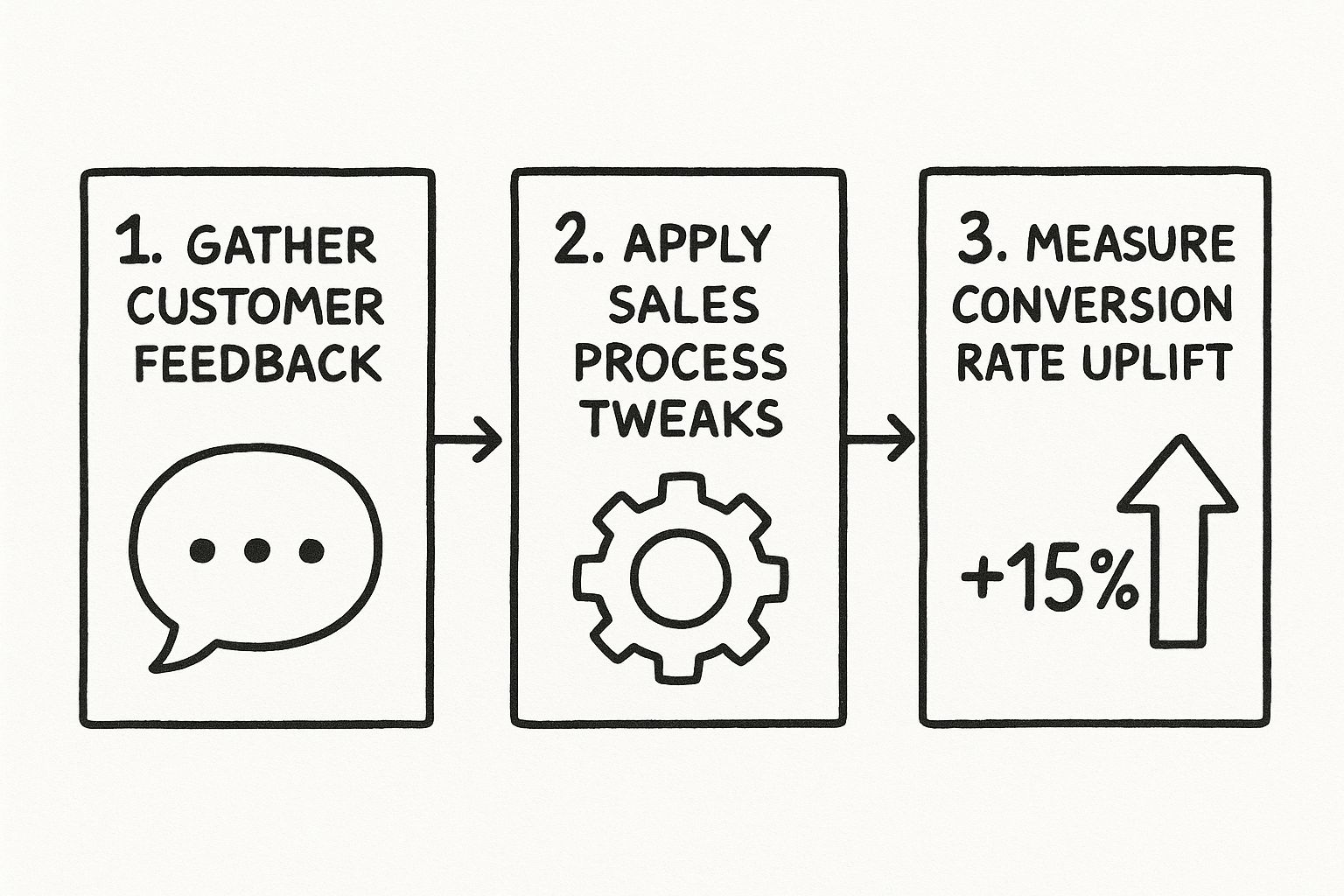
This visual drives home a key idea: improvements should come from real-world feedback and be proven with solid results, which creates a cycle of positive change.
Balancing Stability With Necessary Evolution
Endless change can be just as bad as no change at all. If your team feels like the goalposts are always moving, they'll lose confidence and drive. The secret is to find a rhythm for reviewing and tweaking your process. Many high-performing companies use a quarterly review cycle, which hits a sweet spot. It's often enough to stay agile but not so frequent that it makes things feel unstable.
These quarterly reviews shouldn't be stuffy, bureaucratic meetings. Think of them as collaborative problem-solving workshops. Here's a way to approach them:
- Focus on One Stage: Don't try to fix everything at once. Dedicate each quarterly review to one specific stage of your sales process. For instance, Q1 could be all about Discovery, and Q2 could focus on Proposals.
- Gather Data & Stories: Before the meeting, pull the numbers for that stage. What's the conversion rate? Where are deals getting stuck? Then, collect stories from the team. What are they hearing on calls? What kind of feedback are prospects giving them?
- Identify One or Two Tweaks: Based on the data and the stories, agree on one or two small, testable changes. For example, if discovery calls are falling flat, the adjustment might be to introduce a new open-ended question that gets to the heart of the prospect's problems.
This targeted method keeps you from getting stuck in "analysis paralysis" and makes the whole optimization process feel more achievable and empowering for your team.
Annual Strategy Updates and Early Warnings
While quarterly reviews handle the day-to-day adjustments, an annual strategy session is essential for the big-picture view. This is your chance to zoom out and ask the big questions. Has our Ideal Customer Profile (ICP) shifted? Are new competitors changing the conversation? Is our tech stack still working for us? This yearly check-in keeps your sales process lined up with your larger business goals.
It's just as important to recognize the early warning signs that tell you an adjustment is needed between your scheduled reviews. These signals often show up as small dips in your key metrics. Our guide on essential sales efficiency metrics can help you figure out which numbers to keep an eye on. A sudden drop in your demo-to-trial conversion rate or an increase in prospects "ghosting" you after you send a proposal are clear signs that something in the process is broken.
By creating these feedback loops—from scheduled reviews to listening for early warnings—you build a resilient sales organization. You develop a team that isn't scared of change but sees it as a way to win. This fosters a culture where sales process optimization is a shared goal, driving consistent results year after year.
Your Optimization Implementation Roadmap
Moving from analysis to action is where the real work begins. It’s one thing to spot the weak points in your sales process; it’s quite another to roll out changes that actually stick without throwing your team off their game. This isn't a quick fix. Meaningful changes don't happen overnight, and you'll likely need a full quarter to see real results in your key metrics. Patience and persistence are your best friends here.
Phase 1: The Foundation (Weeks 1-4)
The first month is all about laying the groundwork and getting everyone on the same page. A common mistake is to rush this part, which only leads to confusion down the road. Your main goal here is to build alignment and establish a solid baseline for what's to come.
- Finalize Your Process Map: Get that new, buyer-focused sales map locked in. Make sure every stage has clear exit criteria—the specific, non-negotiable things a rep must accomplish before moving a deal forward. Everyone needs to know exactly what "done" looks like for each stage.
- Communicate the "Why": Don't just send out a memo. Hold a team meeting to walk everyone through the audit findings. Use the data you gathered to explain why these changes are necessary and, most importantly, how the new process is designed to help each rep close more deals and hit their targets.
- Get Your Tech in Order: Your CRM needs to mirror your new reality. Update the stages and build the essential reports you'll use to track the new behavioral KPIs you've identified. This is your measurement foundation.
Success Milestone: By the end of week four, 100% of the sales team can clearly explain the new stages and the exit criteria for each one. Your CRM is now a perfect reflection of your redesigned process.
Phase 2: The Rollout (Weeks 5-8)
With your foundation solid, it's go-time. This phase is all about active coaching and reinforcing the new habits. Expect some friction; reps are adjusting to different ways of working. Supportive, consistent management is crucial to get through this.
- Launch with Real-World Training: Kick things off with hands-on, scenario-based training. Forget dry PowerPoints. Focus on the most critical changes, like role-playing a discovery call with your new framework or co-building a Mutual Action Plan with a "prospect."
- Revamp Your Deal Reviews: Your weekly pipeline meetings need a new focus. Instead of just asking, "What's the update?" start asking questions like, "What exit criteria have you met to move this deal to the next stage?" This forces a conversation around process, not just feelings.
- Spotlight Early Wins: Be on the lookout for reps who are nailing the new process. When you see it, celebrate it publicly. Share a specific example of how a new technique helped advance a real deal. This makes the value tangible for everyone.
Success Milestone: You observe a 10% increase in the adoption of a key new behavior, for instance, the percentage of deals in the pipeline that have a completed Mutual Action Plan.
Phase 3: The Refinement (Weeks 9-12)
After a month of working within the new system, you'll have a goldmine of data and feedback. This phase isn't about blowing things up again; it's about making small, smart adjustments to smooth out the rough edges.
- Run Your First Process Review: Get the team together to talk about what's working and what’s not. Dive into the data. Are deals consistently getting stuck at a new stage? Is a specific step causing more friction than it's worth?
- Make Small, Targeted Tweaks: Based on the feedback, make one or two minor adjustments. Maybe you'll refine a question in the discovery script or add a new case study to your proposal template. Small changes can have a big impact.
- Introduce a New Goal: Now that the core process is becoming second nature, you can layer in a secondary goal. This could be something like improving data hygiene in the CRM or increasing the use of video outreach.
Success Milestone: Your lead-to-opportunity conversion rate shows a measurable improvement, and your sales forecast accuracy increases by at least 5%. This is proof that the new process isn't just different—it's creating a healthier, more predictable pipeline.
Executing a successful sales process optimization project requires more than just a good plan; it demands the right people driving it forward. If you're looking to build or expand your sales team with top-tier talent who can thrive in a high-performance environment, AboutHire can help. We connect you with the top 0.5% of remote sales professionals ready to make an immediate impact.