Why Smart Companies Are Choosing Sales Team Outsourcing
The old way of doing things, building every single function in-house, is becoming a thing of the past. Companies looking towards the future understand that true growth isn’t about trying to do everything yourself. It’s about focusing on what you do best and doing it incredibly well. This means honestly assessing your core strengths and strategically using external resources to maximize your impact. For a growing number of businesses, this translates to sales team outsourcing. It's not about cutting costs; it's about strategically accelerating market expansion.
Accessing Specialized Talent and Scalability
A primary reason for this shift is the ability to access specialized sales talent. Outsourcing opens doors to experienced professionals with specific industry knowledge, cutting-edge sales methodologies, and established networks. Cultivating these resources internally can be both difficult and costly.
Outsourcing also offers businesses the power of scalability. Need to quickly break into a new market? An outsourced team can be deployed far faster than building an internal team from the ground up. This agility is invaluable in our competitive business environment.
Enhancing Focus and Driving Efficiency
Outsourcing also offers another key advantage: increased focus on your core business functions. By offloading the complexities of sales team management, your internal teams can focus on what truly matters – product development, customer service, and other strategic initiatives.
Think of it this way: instead of spreading your resources thin, you can concentrate on your strengths while your outsourced sales team focuses on driving revenue. One major trend fueling this shift is cost reduction. Using external sales resources can often be more budget-friendly than building an internal team, a benefit discussed further in articles about outsourcing.
Outsourcing sales teams has become a powerful strategy for businesses aiming for rapid growth and efficient market expansion. In fact, data shows that 79% of companies using outsourced sales services report faster expansion as a direct result. You can find more detailed statistics here.
Gaining a Competitive Edge
Ultimately, sales team outsourcing empowers companies to gain a real competitive edge. By tapping into the expertise and efficiency of an outsourced team, businesses can shorten their sales cycles, improve lead conversion, and ultimately, drive faster revenue growth.
This improved performance can be the deciding factor in a competitive market, enabling companies to seize opportunities and outmaneuver their rivals. This isn't just a tactical choice; it's a strategic move that separates market leaders from the rest. 
The Real Numbers Behind Sales Team Outsourcing
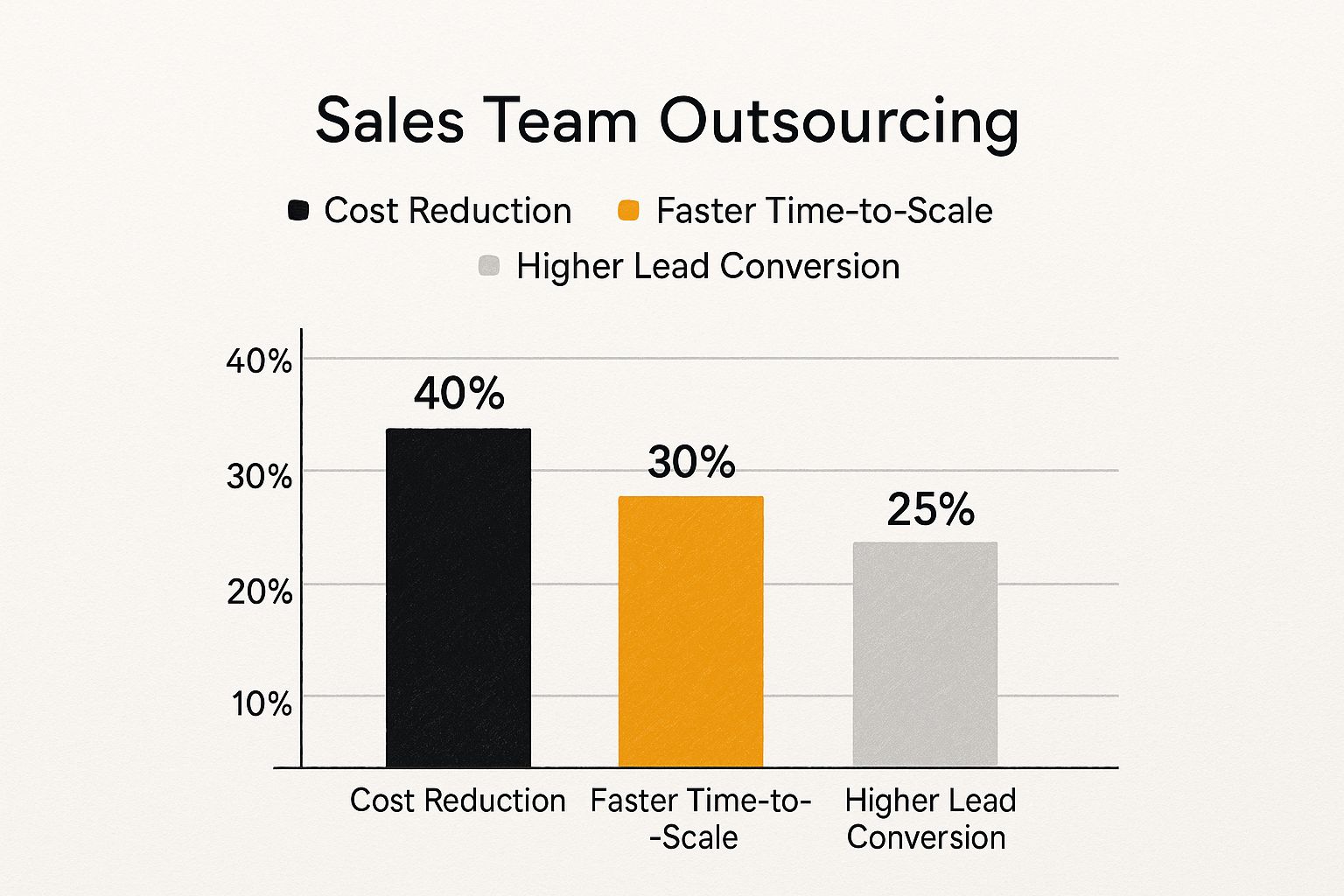
The infographic above illustrates the key benefits of outsourcing your sales team. It highlights cost savings, speed of scaling, and improvements in lead conversion. The data suggests outsourcing can cut costs by 40%, enable 30% faster scaling, and boost lead conversion by 25%. These impressive statistics point to the potential for increased efficiency and revenue growth.
Unveiling Hidden Costs and ROI
Many businesses focus on salary savings but miss the hidden costs of an in-house sales team. These can include expenses related to unsuccessful recruiting efforts, lost training investments when employees depart, technology infrastructure, and management overhead.
Consider the cost of a bad hire. Recruitment is expensive, and the lost productivity and potential revenue can be substantial. Ongoing training and development are also recurring costs that often aren't fully considered in initial budgets.
A thorough cost analysis needs to include both direct and indirect expenses. This gives a more accurate comparison of in-house versus outsourced options. By working with financial leaders to develop detailed cost models and evaluate ROI, businesses can set realistic expectations and align their outsourcing strategies with overall growth objectives. To boost productivity and efficiency within your outsourced sales team, consider implementing solid team collaboration best practices.
To help illustrate the cost differences, let's take a look at the following table:
In-House vs. Outsourced Sales Team Cost Comparison
Detailed breakdown of costs, timeframes, and ROI for both approaches
| Cost Factor | In-House Team | Outsourced Team | Savings Potential |
|---|---|---|---|
| Recruitment | $10,000 per hire | $2,000 per hire | 80% |
| Training | $5,000 per employee annually | Included in service fee | Potentially 100% |
| Software & Infrastructure | $2,000 per employee annually | Included in service fee | Potentially 100% |
| Management Overhead | $15,000 per manager annually | Included in service fee | Potentially 100% |
| Salaries | $60,000 per employee annually | $40,000 per employee annually | 33% |
| Total Annual Cost (per employee) | $82,000 | $42,000 | 49% |
As this table demonstrates, the potential cost savings from outsourcing can be significant, especially when factoring in often-overlooked expenses.
Exploring Pricing Models and Contracts
Understanding the various pricing models and contract structures is essential for informed decision-making in sales team outsourcing. Common models include fixed-fee pricing, performance-based pricing, and tiered pricing. Each has its pros and cons. Fixed-fee offers predictable costs, performance-based incentivizes results, and tiered pricing provides flexibility for scaling.
It’s also important to understand contract structures, including service level agreements (SLAs) and key performance indicators (KPIs). These help set clear expectations and ensure accountability. KPIs and SLAs are crucial for distinguishing successful outsourcing partnerships from costly mistakes and are essential for long-term success. By grasping the true financial implications of sales team outsourcing, businesses can unlock their growth potential and achieve a competitive edge.
Finding Your Perfect Sales Outsourcing Partner
Not all sales outsourcing providers are created equal. Choosing the wrong one can lead to wasted time and resources. This section will guide you through identifying the right providers to benefit your business. We'll cover key questions to ask, warning signs to look for, and indicators of a successful long-term partnership.
Key Questions to Ask Potential Partners
Starting your search for the right sales outsourcing partner requires asking the right questions. Go beyond the basics and delve into their expertise, processes, and overall strategy.
- What is your experience in our specific industry? Industry experience is invaluable. A provider familiar with your market will already understand your target audience and their specific needs.
- Can you provide case studies or testimonials from similar clients? A provider's past performance offers a glimpse into their potential future success. Look for proven results with businesses like yours.
- What is your process for onboarding and training your sales teams? A structured onboarding process is essential for a smooth transition and quick ramp-up time.
- How do you measure and report on performance? Clear metrics and regular reports are vital for tracking progress and maintaining accountability.
- What is your pricing model, and what does it include? Transparency in pricing is crucial. Ensure you understand all included services and any potential additional costs.
Red Flags to Watch Out for
A polished presentation is important, but don't be swayed by providers who over-promise or give vague answers. Watch out for these red flags:
- Lack of industry-specific experience: A generalist approach may not work effectively in your specific niche.
- Vague or evasive answers to your questions: Transparency is essential. A reputable provider will be upfront about their processes and pricing.
- No clear performance metrics or reporting: Tracking progress and holding the provider accountable becomes difficult without clear metrics.
- Pressure to sign a long-term contract before a pilot program: A reliable provider will be happy to prove their value with a smaller pilot program before a long-term commitment.
- Unrealistic promises or guarantees: If it sounds too good to be true, it probably is. Be wary of exaggerated claims not supported by data.
Indicators of a Strong Partnership
Successful outsourcing relies on trust, open communication, and aligned goals. Look for providers who demonstrate these qualities:
- A deep understanding of your business and target market: The provider should invest time in learning your specific needs and tailoring their approach.
- A proactive and collaborative approach: The best providers become an extension of your team, working closely with you towards shared objectives.
- Clear communication and regular reporting: Open communication is vital for staying aligned and addressing any issues that may arise.
- A commitment to continuous improvement: Look for providers dedicated to refining their processes and delivering better results.
- Flexibility and scalability: Your outsourcing needs will evolve as your business grows. Choose a provider who can adapt to these changing demands.
To help you further evaluate potential sales outsourcing partners, we've created a comparison table outlining key criteria and a scoring system.
Sales Outsourcing Provider Evaluation Matrix
Key criteria and scoring system for evaluating potential outsourcing partners
| Evaluation Criteria | Weight | Provider A Score | Provider B Score | Notes |
|---|---|---|---|---|
| Industry Experience | 20% | 9 | 7 | Provider A demonstrated a stronger understanding of our specific market. |
| Proven Track Record | 25% | 8 | 8 | Both providers had comparable case studies and client testimonials. |
| Onboarding Process | 15% | 7 | 9 | Provider B offered a more structured and comprehensive onboarding program. |
| Performance Reporting | 20% | 9 | 7 | Provider A's reporting system was more detailed and provided deeper insights. |
| Pricing & Transparency | 20% | 8 | 9 | Provider B offered slightly more competitive pricing for the services required. |
This matrix helps visualize the strengths and weaknesses of different providers based on weighted criteria important to your business. Provider A excels in industry experience and performance reporting, while Provider B offers a more structured onboarding process and competitive pricing. Consider your priorities when making your final decision.

Learn more in our article about How to master SDR outsourcing. By carefully evaluating potential partners, understanding the potential pitfalls, and recognizing the hallmarks of a strong relationship, you can greatly improve your odds of outsourcing success. You might be interested in: more insights into different sales outsourcing agencies.
Getting Your Outsourced Sales Team Off to a Strong Start
The first 90 days are crucial for the success of any outsourced sales team. This initial period sets the foundation for a long-term, productive partnership. Nailing this phase can lead to significant growth, while a poor start can mean wasted resources and missed opportunities. Here’s how successful companies launch their outsourced teams effectively.
Establishing Clear Communication Rhythms
Effective communication is essential for any successful collaboration, especially with a remote team. It's the backbone of a strong partnership. Start by establishing clear expectations for how often and through which channels the team will communicate.
-
Regular Check-in Calls: Schedule brief daily or weekly calls. Use these to discuss progress, address challenges, and outline upcoming priorities. This ensures everyone stays aligned and informed.
-
Shared Communication Platforms: Implement tools like Slack or Microsoft Teams for instant messaging and file sharing. This enables real-time communication and keeps everyone connected.
-
Progress Reporting: Set up a system for regular progress updates. This could be weekly reports, dashboards, or CRM updates. Consistent reporting creates transparency and allows for timely adjustments if needed.
Defining Success Metrics and Driving the Right Behaviors
Clearly defined metrics provide direction and keep the team focused. These metrics should align with your overall business goals and be easily measurable. For example, if your goal is increased market share, metrics might include the number of qualified leads or the lead-to-opportunity conversion rate.
-
Focus on Quality over Quantity: Prioritize metrics that reflect the quality of leads and customer interactions, not just the volume of activity. This ensures meaningful engagement.
-
Tie Metrics to Incentives: Consider performance-based incentives to motivate the team and drive the desired behaviors. This can significantly boost performance.
-
Regularly Review and Adjust: Be prepared to adjust metrics as needed. This flexibility is key to adapting to changing market conditions and performance data.
Creating Accountability Without Micromanaging
Accountability is crucial, but it shouldn't stifle autonomy. Empower your outsourced team to own their work while maintaining appropriate oversight. This balance builds trust and encourages proactive problem-solving.
-
Set Clear Expectations: Define roles, responsibilities, and performance standards from the start. This clarity establishes a shared understanding of individual contributions.
-
Provide Regular Feedback: Offer both positive and constructive feedback to guide performance and foster continuous improvement. A consistent feedback loop reinforces expectations.
-
Trust but Verify: Monitor performance against agreed-upon metrics. Provide support as needed, but avoid excessive oversight that can hinder creativity and initiative.
Addressing Integration Challenges
Integrating an outsourced team has its unique challenges. Addressing these proactively ensures a smoother transition and minimizes disruptions.
-
Brand Consistency: Provide clear guidelines on brand voice, messaging, and customer interaction protocols. This ensures the team accurately represents your brand.
-
Cultural Differences: Be mindful of potential cultural differences and communication styles. Open communication and mutual respect are vital for bridging any gaps.
-
Knowledge Transfer: Facilitate thorough knowledge transfer. This might involve training, access to documentation, or ongoing mentorship from your internal team.
Building a true partnership with your outsourced sales team requires ongoing effort and open communication. By following these strategies, you create a solid foundation for success, transforming your outsourced team into a valuable extension of your organization. This is essential for achieving high performance and building a sustainable competitive advantage. More tips on managing remote sales teams can be found on AboutHire's blog: Learn more about managing remote sales teams.
Keeping Performance High and Quality Consistent
Managing an outsourced sales team requires a different approach than managing an in-house team. It means establishing clear communication channels and performance metrics while fostering a collaborative environment. This section explores practical strategies for maintaining high standards and driving results with your outsourced sales team.
Establishing Meaningful KPIs
Key Performance Indicators (KPIs) are crucial for tracking progress and measuring the success of your sales team outsourcing strategy. It’s important to establish KPIs that go beyond surface-level metrics like the number of calls made. Focus on metrics that reflect the quality of interactions and progress toward your business objectives.
-
Lead Qualification Rate: This measures the percentage of leads that are actually qualified prospects. A high qualification rate suggests effective targeting and lead nurturing.
-
Opportunity Conversion Rate: This tracks how many qualified leads convert into actual sales opportunities. It highlights the effectiveness of the sales process in moving prospects through the pipeline.
-
Customer Lifetime Value (CLTV): Focusing on CLTV encourages a long-term perspective, prioritizing customer relationships and repeat business.
Creating Effective Feedback Systems
Regular feedback is essential for continuous improvement. Create feedback systems that are constructive and actionable. Simply pointing out shortcomings isn’t enough. Feedback should provide specific guidance and actionable steps for improvement.
-
Regular Performance Reviews: Conduct regular performance reviews to discuss progress, address concerns, and provide constructive feedback. These reviews create a structured opportunity for open communication.
-
Real-Time Coaching: Offer real-time coaching and mentorship to address challenges as they arise. This proactive approach can prevent small issues from becoming bigger problems.
-
Positive Reinforcement: Celebrate successes and acknowledge strong performance. Positive reinforcement boosts morale and motivates the team.
Handling Challenging Conversations
Addressing underperformance requires diplomacy and a focus on solutions. Frame challenging conversations as opportunities for growth and development. This helps maintain a positive relationship while addressing critical issues.
-
Focus on Specific Behaviors: Instead of criticizing the individual, focus on specific behaviors that need improvement. This objective approach minimizes defensiveness.
-
Offer Concrete Solutions: Provide clear and actionable steps for improvement. This empowers the team to take ownership of their performance and make positive changes.
-
Follow Up and Support: After a challenging conversation, follow up to provide support and monitor progress. This demonstrates your commitment to their success.

Learn more in our article about How to Master Managing a Remote Sales Team. By implementing these strategies, you can maintain high performance, ensure consistent quality, and maximize the return on your sales team outsourcing investment. This proactive approach builds a strong foundation for long-term success and sustainable growth.
Scaling Your Sales Outsourcing Operations
Once your outsourced sales team hits its stride and starts delivering positive results, it's time to think about expansion. Scaling these operations effectively means growing without sacrificing the momentum and efficiency you've worked hard to build. This requires careful planning, strategic decision-making, and transparent communication with your outsourcing partner.
Expanding Into New Markets and Increasing Capacity
Scaling your outsourced sales team can involve a number of different approaches, depending on your specific business goals. This might involve targeting new customer segments, boosting team capacity to handle increased sales volume, or enhancing the services you currently offer. For example, you might choose to expand into a new geographic territory. This requires a good understanding of the local market and perhaps even tweaking your current sales strategies.
Alternatively, expanding your product lines is another avenue for growth. This necessitates training your outsourced team on the new products and their unique value proposition. Increasing team capacity is another key aspect of scaling. This could involve adding more sales representatives with similar skillsets, or bringing in specialists for tasks like lead qualification or closing deals. Analyzing your sales pipeline and projected growth is crucial for determining the appropriate level of expansion.
As your operations grow, consider adding enhanced services, such as integrating customer support functions or implementing specialized sales training programs to boost overall performance.
Leveraging Data Analytics for Strategic Scaling
Data analytics plays a vital role in identifying scaling opportunities and making informed decisions. Analyzing sales data helps you identify high-performing market segments, pinpoint areas for improvement, and predict future market trends. This data-driven approach allows you to allocate resources efficiently and optimize your scaling strategy for maximum impact.
Data can answer key questions like: Which markets are showing the most promise? What are the common traits of our most successful leads? Are there any bottlenecks in our current sales process? Answering these questions allows you to prioritize your scaling efforts and focus on the areas with the highest potential return. You might be interested in: How to Hire a Remote Sales Team.
Building Long-Term Partnerships and Negotiating Improved Terms
As your outsourced sales operations expand, your relationship with your outsourcing partner should also evolve. Nurturing open communication and establishing a collaborative environment is essential. This foundation of trust allows you to work together effectively towards common goals and navigate the complexities of scaling.
This means regularly communicating your evolving needs and expectations, and being open to feedback from your partner. As your partnership matures and your volume increases, you're in a stronger position to negotiate improved terms. This could mean securing better pricing, enhanced service level agreements (SLAs), or more flexible contract terms. This natural progression in a successful outsourcing relationship benefits both parties. Ultimately, a well-managed and scalable sales outsourcing strategy can be a significant competitive advantage, helping you achieve sustainable growth and meet your revenue goals.
Building a Future-Ready Sales Outsourcing Strategy
The sales world is in constant flux, requiring a dynamic approach to outsourced sales teams. Anticipating trends and building a flexible strategy is key. This means understanding how factors like AI integration, evolving buyer behaviors, and new performance metrics will reshape the sales outsourcing landscape. How can you ensure your outsourced team remains a valuable asset in the face of these changes?
Adapting to Emerging Trends in Sales Outsourcing
Building adaptable relationships is essential. Contracts should be structured to accommodate future adjustments in strategies, enabling you to capitalize on new opportunities and respond effectively to market shifts. For example, the rise of AI in sales necessitates considering its integration into your outsourced team’s workflow. This could involve leveraging AI for lead qualification, personalized outreach, or sales forecasting.
Buyer behavior is also evolving. Customers are more informed and have heightened expectations. Your outsourced team must be equipped to engage these discerning buyers by providing personalized experiences and cultivating strong relationships. This might involve investing in training focused on consultative selling or implementing new communication platforms.
Maintaining a Competitive Advantage Through Outsourcing
Staying ahead of industry developments is paramount for maintaining a competitive edge. This requires continuous learning by monitoring industry publications and attending relevant conferences. Your outsourcing partner should also be actively engaged in these pursuits, bringing new insights and best practices to the table. This shared commitment to staying informed will ensure your sales strategy remains relevant and effective.
Another crucial element is building resilient relationships with your outsourcing partners. These relationships should be founded on trust, open communication, and shared objectives. Regular communication, performance reviews, and ongoing feedback are vital for cultivating strong partnerships. This collaborative approach ensures consistent value delivery regardless of market volatility or unexpected obstacles.
Ensuring Contractual Flexibility and Adaptability
Future-proofing your sales outsourcing strategy involves ensuring contractual flexibility. This might include provisions for adjusting team size, modifying service levels, or integrating new technologies. This adaptability is crucial for navigating an unpredictable future.
Furthermore, contracts should clearly define performance expectations and metrics. These metrics should be regularly reviewed and updated to reflect evolving business goals. This ensures alignment between your internal team and your outsourced partners, maximizing efficiency and driving results.
Ready to optimize your sales operations and achieve sustainable growth? AboutHire connects you with top-tier remote sales talent from Latin America and Europe, providing a cost-effective and efficient hiring solution. Learn more about how AboutHire can help you build a future-ready sales team.