
The New Reality: Why Remote Sales Teams Are Essential Now
The business world has changed dramatically. The move to remote work isn’t a passing fad; it’s the new normal. For sales teams, this means adapting and embracing the potential of a distributed workforce. This shift is fueled by several factors, including access to a global talent pool, allowing businesses to hire remote sales teams with specialized skills not readily available locally.
This new approach also offers substantial cost benefits. Companies can significantly reduce overhead costs like office space and utilities. This frees up resources for crucial investments in areas like training and technology.
Remote work frequently leads to higher employee satisfaction and better work-life balance. This can result in increased productivity and improved employee retention. However, managing a distributed team effectively requires adapted leadership strategies. Effective leadership is essential for remote sales teams. For more strategies, check out this helpful resource on Managing Remote Teams.
Accessing a Global Talent Pool
One of the biggest advantages of building a remote sales team is accessing a global network of talent. Instead of being confined to local talent, businesses can recruit specialists worldwide. This builds more diverse and highly skilled teams.
For instance, a company needing multilingual sales representatives can now assemble a team fluent in various languages, opening doors to new international markets. This global reach expands market penetration and provides a significant competitive advantage.
The Financial Benefits of Remote Sales Teams
The cost savings of remote teams are considerable. It’s not just about reducing office space, though that’s a major factor. It also includes lower utility costs, less travel, and potentially even lower salaries, depending on your team’s location.
These savings can be reinvested in vital areas like sales training, marketing, and technology upgrades, driving further growth. This financial flexibility allows businesses to adapt quickly to market changes.
The remote sales job market has boomed in the last five years, with compensation packages reaching new heights. Entry-level remote sales professionals now earn between $67,200 and $104,400 annually. Mid-market roles see on-target earnings (OTE) between $120,000 and $250,000. Enterprise positions offer OTEs ranging from $280,000 to $495,000. You can find detailed statistics here. This data highlights the growing demand for remote sales professionals.
Maintaining Culture in a Distributed Environment
Creating a strong company culture in a remote environment requires proactive effort. Regular virtual team-building activities, clear communication, and consistent recognition programs are key. These efforts foster a sense of belonging and shared purpose, even when team members are geographically dispersed.
This strengthens team cohesion and builds a supportive environment for individual and team success. Investing in virtual culture is vital for maintaining morale, productivity, and long-term success in a distributed work model.
Beyond Traditional Skills: What Makes Remote Sales Stars

When building a remote sales team, you’re not simply replicating an in-office setup. You’re seeking a different kind of sales professional altogether. Success in a remote environment demands a unique set of attributes. This section explores the key characteristics that set remote sales stars apart.
Self-Management: The Cornerstone of Remote Success
Self-discipline and motivation are paramount in remote work. Remote sales representatives must excel at time management, prioritization, and maintaining focus without direct oversight. This necessitates robust self-management skills.
Think of it as entrepreneurship within a company. Remote sales professionals effectively manage their own schedules and workloads, holding themselves accountable for performance.
Proactive communication with managers and teammates is also essential. This keeps everyone aligned with company objectives and fosters strong relationships within the distributed team.
Mastering Digital Communication
Technology is the lifeblood of remote sales. Proficiency in various digital communication platforms is crucial. This goes beyond basic email and phone calls.
Remote sales stars are fluent in tools like video conferencing software (Zoom), instant messaging apps (Slack), and CRM systems. They also possess the ability to convey information clearly and concisely in writing. A well-crafted email, anticipating customer needs, is far more effective than a hastily typed message.
Independent Problem-Solving: Navigating Challenges Remotely
Resourcefulness is a key trait of successful remote sales representatives. They often face challenges requiring quick thinking and independent problem-solving.
Troubleshooting technical issues, handling customer objections, and adapting to unexpected situations with minimal guidance are all part of the job. This often involves drawing on past experiences, conducting research, and taking initiative.
This proactive approach to problem-solving is a major factor in their overall success.
The following table summarizes the key differences in skills needed for traditional versus remote sales environments, as well as methods for assessing these skills.
Essential Skills for Remote Sales Professionals
A comprehensive comparison of traditional sales skills versus remote-specific capabilities
| Skill Category | Traditional Sales Environment | Remote Sales Environment | Assessment Methods |
|---|---|---|---|
| Communication | Face-to-face, phone calls | Digital platforms, written communication | Evaluate written communication samples, role-play scenarios using video conferencing |
| Self-Management | Structured work environment, direct supervision | Independent work, time management, self-motivation | Behavioral questions, time management exercises |
| Problem-Solving | Collaboration with team, access to immediate support | Independent problem-solving, resourcefulness | Scenario-based questions, assess past experiences |
| Technical Skills | Basic computer skills | Proficiency in CRM, communication platforms, other digital tools | Technical skills tests, software proficiency assessments |
This table highlights how crucial self-management and digital fluency are for remote sales success, and offers practical ways to evaluate these skills during the hiring process.
Assessing Remote Readiness: Finding the Right Fit
So, how can you identify these crucial qualities when hiring? Effective assessment is key. Go beyond standard interview questions and utilize scenario-based evaluations.
These exercises can simulate real-world remote sales challenges. Observe how candidates analyze problems, formulate solutions, and communicate their approach.
Explore specialized interview frameworks designed to evaluate self-management and digital communication skills. Ask about their experience working independently, their task prioritization methods, and their comfort level with various digital tools.
Finally, don’t overlook thorough reference checks. Previous employers can provide valuable insights into a candidate’s work ethic, communication style, and ability to thrive in a remote environment. A comprehensive assessment strategy increases your chances of hiring remote sales professionals poised for long-term success.
Building Your Remote Sales Talent Pipeline
Attracting top-tier remote sales talent demands a well-defined strategy. It’s more than simply posting a job ad; it’s about cultivating a robust pipeline of qualified candidates. This involves creating compelling job descriptions, strategically using online platforms like LinkedIn, and establishing an effective screening process.
Crafting Compelling Job Descriptions
Your job description is often the first interaction a potential candidate has with your company. It’s crucial to capture their attention and clearly present the advantages of joining your remote sales team. A compelling headline that emphasizes the remote work aspect is key.
Clearly define responsibilities and expectations, leaving no room for ambiguity. Highlight the unique perks of working remotely for your organization. Perhaps you offer flexible hours or a supportive and engaging company culture.
Leveraging Online Platforms and Networks
Reach a broader pool of remote sales professionals by utilizing specialized job boards and professional networking sites. Consider partnerships with remote staffing agencies, especially those focused on specific industries or geographic areas. Articles like Unlocking Success: Virtual Latinos—Your Gateway to Skilled Remote Professionals From Latin America offer insights into different talent pools.
Internal referrals can also be a powerful tool. Encourage your current team and broader network to recommend qualified individuals.
Effective Screening For Remote Sales Success
Screening for remote roles requires evaluating not only sales skills, but also crucial traits like self-motivation, strong communication, and technical proficiency. A multi-stage screening process is often beneficial.
This might include an initial phone screening, followed by a video interview, and potentially a skills assessment or test project. Use behavioral questions to understand a candidate’s experience with remote work and their ability to excel in a self-directed environment.
Compensation and Geographic Considerations
Creating competitive compensation packages for remote sales teams involves striking a balance: attracting top talent while managing costs across different geographic locations. The shift to remote sales has presented new challenges, with 67% of sales managers finding it more difficult than expected, according to LinkedIn’s State of Sales report.
Interestingly, this shift aligns with evolving buyer behavior: 75% of B2B buyers prefer a rep-free sales experience, and 70% of the buyer’s journey is complete before they even contact sales. More statistics on these trends can be found here.
Research salary benchmarks in your target candidate locations and be prepared to offer competitive salaries and benefits. Performance-based bonuses and incentives can motivate your team and drive success. Clearly communicate working hours and time zone expectations to ensure alignment with your business operations. Building a thriving remote sales team requires a proactive and structured approach, from engaging job descriptions to efficient screening and onboarding.
From Day One To Quota: Onboarding Remote Sales Talent
Onboarding new hires is essential for any organization, but it’s especially vital for remote sales teams. A well-structured onboarding process paves the way for long-term success. It equips new team members with the essential knowledge, tools, and support needed to excel in a virtual work environment. This includes developing effective virtual training, creating easily accessible digital resources, and setting clear performance expectations right from the start.
When building your remote sales talent pipeline, exploring different locations can help you efficiently find the right team. Consider researching regions known for strong sales and marketing talent. You can learn more about this in this helpful article: 13 Countries to Hire Remote Sales & Marketing Teams.
Structuring The First 90 Days
The first 90 days are often a critical period for new sales hires. A clearly defined 30-60-90 day plan provides a structured roadmap for success. This plan should outline specific learning objectives, activity benchmarks, and success indicators for each phase.
- First 30 Days: The initial month focuses on building a solid foundation. New hires should concentrate on gaining product knowledge, understanding the company culture, and completing initial sales process training.
- Days 30-60: The second month emphasizes practical application. New hires begin shadowing top performers and start taking on initial sales activities with defined targets. This period focuses on translating learned skills into real-world practice.
- Days 60-90: The third month marks a transition towards full productivity. Responsibilities and expectations gradually increase as new hires work towards achieving their full sales quota. Ongoing coaching and mentorship are provided to refine sales techniques and address any emerging challenges.
To provide a clearer picture of this process, the table below outlines a sample 30-60-90 day plan:
30-60-90 Day Remote Sales Onboarding Plan: This table provides a structured timeline and milestones for effectively integrating new remote sales team members.
| Timeframe | Knowledge Goals | Activity Benchmarks | Success Indicators | Support Resources |
|---|---|---|---|---|
| First 30 Days | Product knowledge, Company culture, Sales process fundamentals | Complete online training modules, Attend virtual team introductions, Shadow sales calls | Understanding of product features and benefits, Familiarity with company values, Ability to explain basic sales process | Onboarding portal, Training videos, Sales playbooks |
| Days 30-60 | Advanced sales techniques, CRM usage, Competitive landscape | Lead qualification practice, Initial sales presentations, Update CRM records | Consistent lead qualification, Effective sales presentations, Accurate CRM data entry | Sales mentors, CRM training guides, Competitive analysis reports |
| Days 60-90 | Negotiation skills, Closing strategies, Account management | Independent sales calls, Lead generation activities, Manage small accounts | Meeting sales targets, Generating qualified leads, Maintaining client relationships | Sales manager coaching, Lead generation tools, Account management best practices |
This plan is a guideline and can be adjusted based on individual needs and company specifics. Regular review and feedback are essential for ensuring the plan’s effectiveness.
Creating Engaging Virtual Training Programs
Forget long, passive training sessions. Instead, develop interactive, bite-sized learning modules that engage remote learners more effectively. Incorporate a variety of learning methods, such as video tutorials, quizzes, and role-playing scenarios, to reinforce learning and build practical sales skills.
A centralized digital knowledge repository is a crucial resource for remote sales teams. This central hub houses essential documents, training materials, and sales resources, including sales scripts, product demos, and competitive analysis documents, readily accessible to all team members.
Performance Tracking And Feedback
Regular feedback is essential for remote sales teams. Define key performance indicators (KPIs) such as average calls per day and conversion rate. Track these metrics using your CRM system and provide consistent, data-driven feedback. The infographic below visually represents this process.
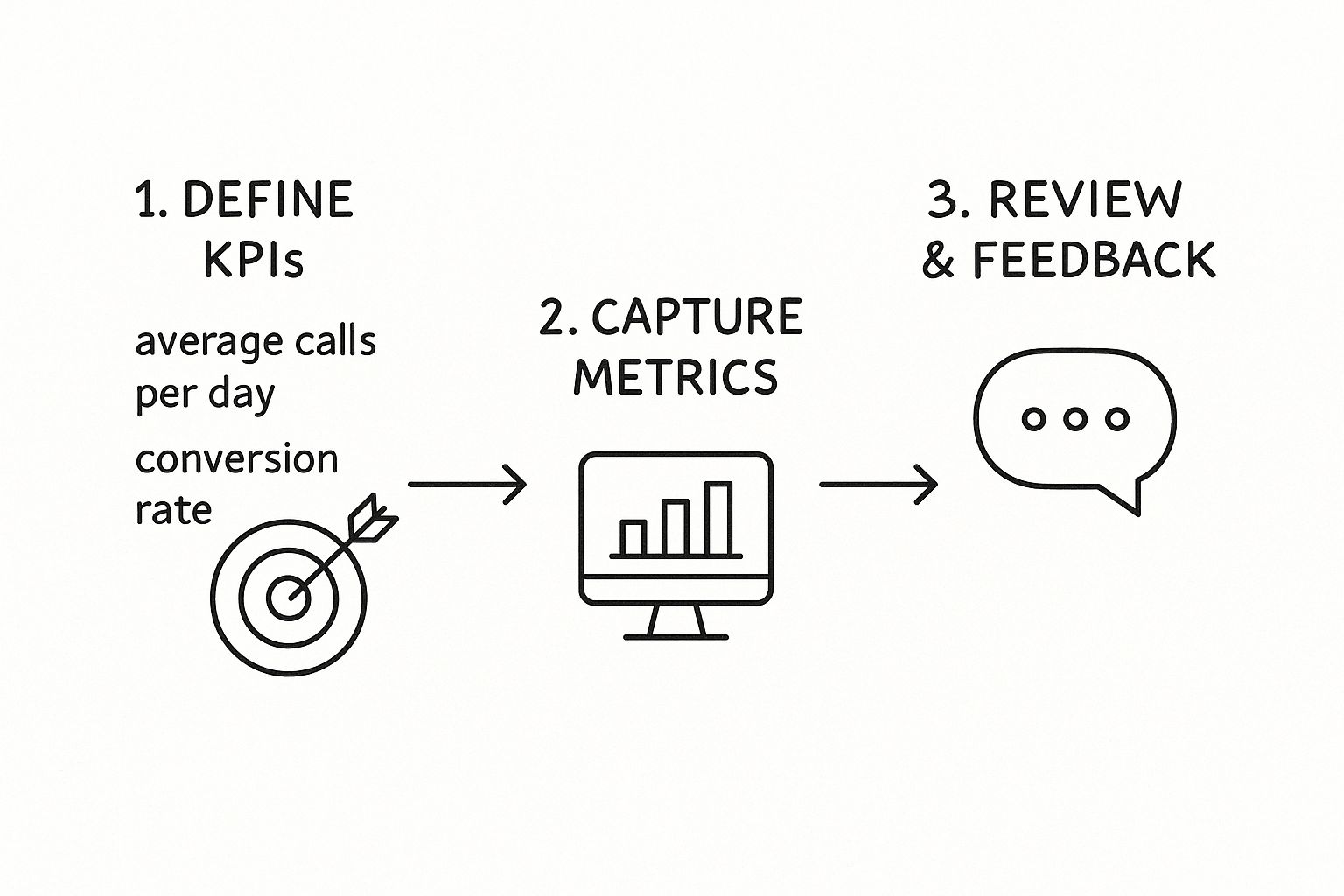
The infographic highlights the importance of a cyclical approach to performance management: defining KPIs, capturing data, reviewing performance, providing feedback, and continually refining the process. This continuous feedback loop fosters ongoing improvement and keeps remote sales representatives focused on their goals.
Regular one-on-one virtual meetings are crucial for providing personalized coaching, addressing individual challenges, and celebrating successes. Cultivating a supportive feedback culture is vital for maximizing performance and maintaining high morale within remote sales teams.
The Tech Stack That Powers Remote Sales Success
Technology forms the core of any successful remote sales team. The right tools empower your team to collaborate effectively, connect with customers meaningfully, and close deals consistently. This section explores the essential components of a high-performing remote sales tech stack.
CRM Systems: The Central Hub
A robust Customer Relationship Management (CRM) system is fundamental to any remote sales operation. It serves as a central hub for customer interactions, sales data, and team communication. A cloud-based CRM is particularly important for remote teams, providing access to information from anywhere.
- Contact Management: Organize and manage customer contacts, interaction history, and sales pipeline stages efficiently.
- Sales Automation: Automate repetitive tasks like email sequences and follow-ups, freeing up your team’s time to build relationships and close deals.
- Reporting and Analytics: Track key performance indicators (KPIs) and analyze sales data to pinpoint areas for improvement and optimize strategies.
Popular CRM options for remote teams include Salesforce, HubSpot, and Pipedrive. The best choice depends on your specific needs and budget.
Communication Platforms: Bridging the Distance
Effective communication is crucial for remote teams. A dedicated communication platform allows seamless interaction between team members, regardless of their location.
- Instant Messaging: Tools like Slack and Microsoft Teams enable quick communication, fostering team cohesion.
- Video Conferencing: Zoom and Google Meet facilitate virtual meetings, team briefings, and client presentations, creating a more personal connection.
- Project Management Tools: Asana and Trello help organize tasks, track progress, and ensure everyone stays aligned.
The right mix of communication platforms depends on your team’s size, communication style, and workflow. For further insights, check out this article: How to master….
Sales Enablement Tools: Empowering Your Team
Sales enablement tools equip your remote team with the resources they need to succeed. These tools include content libraries, training materials, sales playbooks, and competitive analysis reports.
- Content Management: Platforms like Highspot and Seismic help organize and share sales content, ensuring your team has the latest materials.
- Training Platforms: Lessonly and Mindtickle offer online training and coaching resources, enabling continuous skill development.
- Sales Intelligence: Tools like LinkedIn Sales Navigator offer insights into prospects and competitors, empowering your team to make informed decisions.
Performance Tracking Software: Data-Driven Insights
Tracking performance is essential for remote sales teams. Performance tracking software provides visibility into individual and team activity, offering valuable insights into sales progress and areas for improvement.
- Activity Tracking: Monitor metrics such as calls made, emails sent, and meetings scheduled to get a clear view of team activity.
- Pipeline Management: Track deals through the sales pipeline, identify bottlenecks, and forecast revenue for data-driven decision-making.
- Performance Dashboards: Visualize key metrics and progress towards goals, providing real-time feedback and motivating team members.
Building a successful remote sales team requires the right combination of tools to improve collaboration, communication, and sales performance. Assess your specific needs and choose technology that complements your sales process and team dynamics. This allows for efficient scaling, growth, and better overall performance. Prioritize tools that integrate seamlessly to avoid a fragmented and overwhelming tech stack.
Leading From Anywhere: Managing Remote Sales Teams
Managing a remote sales team presents unique leadership challenges. Unlike traditional in-office teams, remote sales leaders must navigate the complexities of distance, communication barriers, and varying time zones. This requires specific strategies to maintain high performance and engagement. Let’s explore some proven approaches for effectively managing distributed sales teams.
Establishing Clear Expectations and Accountability
Clearly defined expectations are the foundation of a successful remote sales team. This includes establishing clear Key Performance Indicators (KPIs), setting realistic targets, and outlining responsibilities. These metrics provide a framework for performance evaluation, offering tangible goals for both individual and team success.
Remote sales professionals often thrive in environments that offer autonomy and flexibility. However, this freedom requires a counterbalance of accountability. Regular check-ins and progress reviews help maintain focus and address any potential roadblocks.
Implementing a robust CRM system like Salesforce provides a centralized platform for tracking progress, monitoring activities, and providing data-driven feedback. This ensures everyone stays on the same page and contributes to overall team goals.
Fostering Autonomy While Maintaining Oversight
Remote sales professionals often value the autonomy that comes with working independently. This sense of ownership can be a powerful motivator, driving individuals to achieve their best results. However, maintaining appropriate oversight is crucial for ensuring alignment with the broader sales objectives.
This delicate balance requires fostering a culture of trust and open communication. Regular virtual meetings allow for team discussions, strategic updates, and opportunities for feedback. Implementing clear communication protocols, including preferred channels and expected response times, helps streamline workflows and minimizes delays.
Think of it as creating a virtual office environment – a space where everyone understands the rules of engagement and can collaborate effectively, even from different locations.
Virtual Coaching and Performance Feedback
Effective coaching is essential for maximizing performance in any sales team. In a remote setting, this takes on even greater importance. Virtual coaching requires a focus on clear, specific, and actionable feedback. Instead of general observations, provide concrete examples of areas for improvement, supported by data and specific instances.
Schedule regular one-on-one virtual meetings for personalized coaching sessions and mentorship. This dedicated time allows for addressing individual challenges, focusing on skill development, and celebrating successes. This personal touch is instrumental in building strong relationships and fostering trust, bridging the distance between team members. You might be interested in: Empowering Authors: Unleashing the Power of Reedsys Marketplace and Tools for Publishing Success.
Compensation and Incentive Structures
Motivating a remote sales team often involves creating compensation and incentive structures tailored to the unique challenges of a virtual work environment. Performance-based bonuses, commission structures, and recognition programs can drive desired behaviors and reward top performers.
Consider implementing tiered incentives that provide increasing rewards for achieving and exceeding sales goals. This competitive element can boost individual motivation and contribute to a positive team dynamic. Regular public acknowledgment of accomplishments, during virtual team meetings or via a dedicated communication platform like Slack, reinforces positive behaviors and creates a sense of shared success.
Building Team Cohesion and Culture
Maintaining a strong company culture within a distributed team requires proactive effort. Regular virtual team-building activities, ranging from virtual coffee breaks to online games, can foster camaraderie and connection.
Recognize and celebrate successes publicly. This reinforces a culture of achievement and strengthens team bonds. Small gestures, like sending virtual gift cards or personalized messages, can significantly contribute to a sense of belonging among remote team members. This creates a cohesive virtual environment, boosting morale, improving collaboration, and ultimately increasing overall team performance.
Ready to build a high-performing remote sales team? AboutHire connects you with the top 0.5% of remote sales talent from Latin America and Europe. Learn more about how AboutHire can help you scale your sales efforts.