
Understanding The New Reality Of SDR Outsourcing

The common way companies have built their internal Sales Development Representative (SDR) teams is increasingly running into problems. Many businesses are realizing that the old playbook for hiring in-house frequently means slow starts, high staff churn, and substantial overheads. This challenging picture is clearing the path for a fresh approach: SDR outsourcing.
Why Traditional SDR Hiring Models Are Evolving
Truth be told, finding, coaching, and holding onto top-notch SDR talent internally has turned into a major headache for many sales leaders. The talent scarcity for skilled SDRs, along with drawn-out and expensive hiring efforts, means companies can easily miss out on valuable time and market openings. Because of this, forward-thinking organizations are adjusting their strategies.
These companies are now exploring SDR outsourcing to create high-performing sales development initiatives without the usual headaches. By partnering with specialized agencies, businesses tap into a pool of pre-vetted, trained professionals ready to make an impact from day one. This, in turn, allows internal teams to zero in on their main job: closing deals.
The Quest for Specialized Expertise and Agility
A primary driver for this shift is the growing demand for specialized expertise. Just as other complex business operations are often handed to external partners, sales development benefits significantly from focused, expert attention. For instance, this outsourcing pattern is apparent elsewhere; the research and development (R&D) outsourcing services market was valued at roughly $8.89 billion in 2024. It's projected to climb to $9.64 billion by 2025, marking a compound annual growth rate (CAGR) of 8.4%, fueled by similar needs for cost efficiency and specialized skills. You can find more detailed statistics on this market trend here. This points to a wider acceptance of relying on external experts for key business functions.
Think of it like a professional sports team. Instead of attempting to scout and develop every player for every position from the ground up, a team might bring in a seasoned specialist for a critical role, like a placekicker or a specialized coach. Similarly, companies using SDR outsourcing are bringing in experts to build and manage their lead generation engine, often transforming their sales pipeline from a trickle to a steady flow.
Navigating the Landscape of Outsourced SDRs
However, the journey to successful SDR outsourcing isn't always smooth. The critical difference between a partnership that significantly boosts your pipeline and a costly misstep often comes down to understanding the specific details of picking and managing an external team. It’s not just about offloading work; it’s about strategic alignment and working towards shared goals. You might find this article helpful: How to Hire a Remote Sales Team and What to Look For.
This strategic mindset for team building is essential for adapting to today's business requirements. To better grasp the strategic importance of adaptable staffing models, consider learning more about the advantages of using fractional executive services. These models, much like effective SDR outsourcing, allow companies to access high-level expertise as needed, which promotes agility and efficient scaling.
Ultimately, the evolving world of SDR outsourcing offers a potent way for businesses to substantially improve their sales pipeline and gain an edge over competitors. Success in this domain relies on understanding these changing dynamics and making informed, strategic choices when choosing an SDR outsourcing partner.
Building Your SDR Outsourcing Foundation That Works

Jumping into SDR outsourcing without a solid plan is like trying to build a house without drawings; you're unlikely to get a sturdy, working result. A well-thought-out groundwork is crucial for turning an external team into a productive part of your own sales efforts. This setup involves more than just handing over a list of names; it’s about creating a shared understanding of goals, how you'll work, and the numbers that show success.
Defining Your Ideal Customer and Clear Objectives
The very first step in creating a successful SDR outsourcing structure is a clear definition of your Ideal Customer Profile (ICP). This detailed description, covering aspects like company size, industry, their specific problems, and common buying signals, acts as the main guide for your outsourced SDR team. When your partner fully understands exactly who they are trying to reach, their outreach becomes much more targeted and effective.
Following on from this, setting clear performance expectations is essential for any SDR outsourcing relationship. This means agreeing on Key Performance Indicators (KPIs) from the start, such as the desired number of qualified appointments, successful discovery meetings, or Sales Qualified Leads (SQLs) generated. These distinct metrics provide a concrete way to measure progress and ensure both your company and the outsourcing partner agree on what successful results look like.
Crafting Effective Onboarding and Documentation
Once your ICP and objectives are set, a well-planned onboarding process is the vital link to making your SDR outsourcing partner productive. Putting time and effort into a comprehensive onboarding program isn't just an expense; it's a smart investment. In fact, proven onboarding methodologies can reduce ramp-up time for new SDRs by as much as 60%. This large decrease means your outsourced team can start delivering real results much faster.
This important onboarding stage should aim to get the outsourced SDRs familiar with your company culture, give them deep product knowledge, and help them understand your specific sales approaches. Good documentation supports this entire process. Key documents include:
- Detailed sales playbooks that clearly describe different outreach methods.
- Regularly updated product information sheets and competitor reviews.
- Approved call scripts and email templates for consistent communication.
- Clear ways to escalate questions or operational problems.
Such materials help your SDR outsourcing team to work with confidence and consistency, allowing them to act as a true extension of your internal sales group.
Establishing Robust Communication and Accountability
A successful SDR outsourcing partnership relies on open, clear communication and a strong feeling of shared responsibility. This doesn't mean micromanaging; instead, it's about setting up definite, regular ways for your team and the outsourced SDRs to interact. Regular check-in meetings, performance review discussions, and shared dashboards showing real-time progress against KPIs are all important parts.
These set communication practices help build a truly cooperative atmosphere where feedback can be shared openly by everyone, leading to quick adjustments in strategy and ongoing improvements in operations. Furthermore, accountability systems should be based on the agreed-upon KPIs, actively encouraging the outsourced team to take ownership of their targets. This approach changes the relationship from a simple vendor-client deal to a strategic partnership focused on achieving shared business growth through effective SDR outsourcing.
Choosing SDR Partners Who Actually Deliver Results
Picking the right SDR outsourcing provider is a big deal. If you get this wrong, your sales pipeline growth can really suffer. It’s not just about handing off some tasks; you're looking for a true partnership to help drive your revenue. So, it's important to see past the shiny brochures and cheap prices to find someone who will actually get you results.
Beyond The Pitch: Key Evaluation Criteria
When you're looking at potential SDR outsourcing partners, you need to look further than what they initially promise. Industry expertise is really key. A provider who knows your specific field, who your customers are, and how your market works will get up to speed quicker and achieve more. For instance, an agency that focuses on B2B SaaS will grasp the unique challenges and buying habits of tech leaders much better than a jack-of-all-trades.
Just as vital is cultural alignment. Remember, these outsourced SDRs will be the voice of your brand. They need to fit in well with your company’s values and the way you communicate. Also, look for a proven track record with businesses like yours, supported by real case studies and client feedback – this shows what they can actually do. While you might save a good chunk of money, with some companies cutting costs by up to 60% compared to having their own SDRs, the real win is in getting quality leads and booked meetings.
This image helps map out important points when you're weighing whether to build your own SDR team or go with SDR outsourcing. It considers things like your current team's bandwidth and if you need very specific skills.
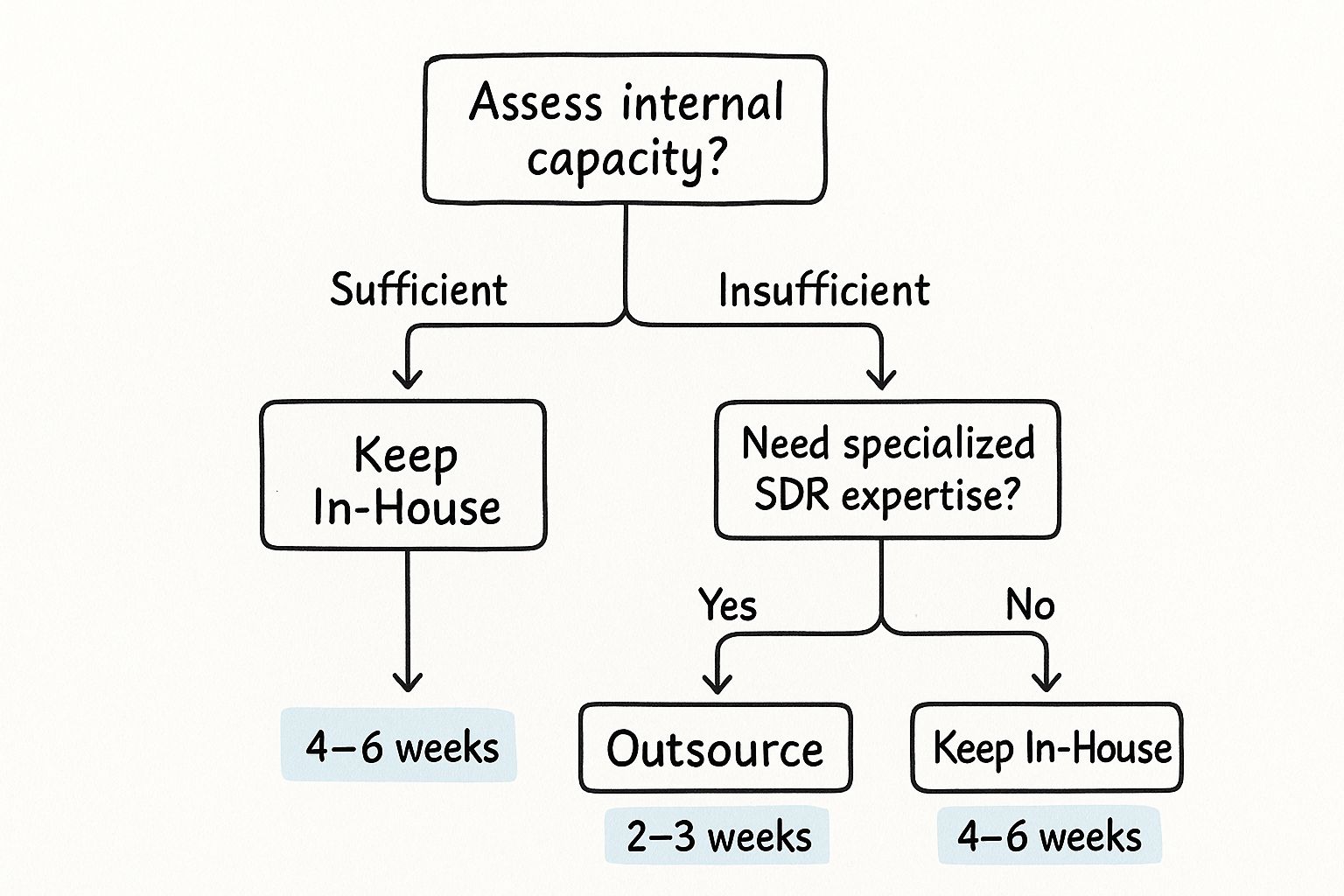
The graphic points out that SDR outsourcing is a strong choice if your internal team is stretched thin and you need specialized know-how. This can also reduce the SDR ramp-up period from the usual 4–6 weeks for internal teams down to just 2–3 weeks with outsourced experts.
Due Diligence: Uncovering Red Flags Early
Doing your homework thoroughly is the best way to avoid teaming up with an SDR outsourcing firm that doesn't perform. This means more than a quick glance at their website. Ask for detailed case studies and look for quantifiable results, such as "Boosted MQLs by 40% in three months," not just general claims of success.
Notice how they communicate while you're checking them out. Are they quick to respond? Do they ask smart questions about your company? Some warning signs to watch for include:
- Not being open about their methods or costs.
- Hesitation to share client contacts for references.
- Using a lot of technical terms without explaining them clearly.
- Offering a standard package that doesn't fit your specific requirements.
Making sure your outsourced team fits your company's way of doing things is crucial. You might find our guide on Remote Hiring Best Practices helpful for creating solid remote team relationships.
Smart Pilot Programs: Testing Capabilities With Minimized Risk
Before you sign a lengthy contract, think about setting up a pilot program. This lets you try out the SDR outsourcing provider's skills in a live setting, but with less risk. Set clear goals and key performance indicators (KPIs) for this trial, perhaps concentrating on one particular campaign or a specific group of potential customers.
A pilot program, usually running for 1-3 months, can give you very useful information about the provider's:
- Skill in finding good leads and setting appointments.
- How well they communicate and report back to you.
- Their capacity to take feedback and work with your existing team.
- General professionalism and grasp of what you're trying to achieve.
This test run is great for figuring out who the real pros are, and who just talks a good game.
SDR Outsourcing Provider Evaluation Framework
To fairly compare different potential partners, it's a good idea to use an evaluation framework. This helps make sure you're looking at all candidates using the same standards.
SDR Outsourcing Provider Evaluation Criteria
Comprehensive comparison framework for evaluating different SDR outsourcing providers across key performance and compatibility factors
| Evaluation Criteria | Weight | What To Look For | Red Flags |
|---|---|---|---|
| Industry Specialization | High | Demonstrated success in your field, deep knowledge of your ideal customers, and relevant examples of past work. | A general-fits-all style, little to no background in your particular market. |
| Technology & Tool Stack | Medium | Use of current CRM systems, tools for sales intelligence, data analysis, and ways to automate tasks. | Old software, relying on manual work, not being clear about the technology they use. |
| Reporting & Transparency | High | Consistent, thorough updates on performance, clear goals, access to progress charts, and forward-thinking updates. | Unclear or rare reports, not being able to follow important numbers, only reacting to issues. |
| Scalability & Flexibility | Medium | Options to grow or shrink the team, adjust to new requirements, and offer adaptable contract conditions. | Stiff contracts, trouble changing with market conditions, unchangeable team sizes. |
This structured approach ensures you're looking at each potential provider through the same lens, focusing on what truly matters for a successful partnership.
By carefully using these ways to check out providers, you greatly improve your odds of picking an SDR outsourcing partner who will truly add to your sales team and help your business grow. The goal is to find a partner, not just a vendor.
Calculating True ROI Beyond The Hourly Rate

Thinking about SDR outsourcing? That hourly or monthly quote you see is often just the starting point. To get a real sense of the financial picture, companies need to look closer and figure out the true Return on Investment (ROI). This means tallying up all the costs and benefits involved, because a quick glance at the numbers can lead you down the wrong path and leave you with results that don't match what you hoped for.
Unearthing the Hidden Costs in SDR Outsourcing
That number on the invoice from your SDR outsourcing provider? It usually doesn't tell the whole story of what you'll actually spend. There are quite a few extra costs that can pop up and change your total investment.
For instance, don't forget management overhead; your own team will still need to spend time overseeing the outsourced SDRs, giving them pointers, and making sure they're on the same page as your company.
Then there's technology integration. Getting your Customer Relationship Management system, or CRM, to work smoothly with the outsourced team's systems can mean setup charges or even paying for new software. And one more thing: the training investment. Even though outsourced SDRs are skilled, they'll still need to learn about your specific products, who your ideal customers are, and your particular way of selling. These less obvious expenses are really important for getting a clear view of your ROI.
How Pricing Models Influence Real SDR Outsourcing Costs
How an SDR outsourcing partner charges for their services really affects your total expenses and the return you get. You'll often see a few common ways they price things:
- Per-appointment pricing: With this, you pay for every qualified meeting the team books. It sounds simple, but the actual quality of these meetings and how often they turn into sales is what truly matters.
- Performance-based compensation: Here, the fees are directly linked to achieving specific results, like generating Sales Qualified Leads (SQLs) or even closing sales. This approach can line up everyone's goals nicely, though it might mean paying more for each successful outcome.
- Retainer or flat-fee models: This involves a set monthly payment for an agreed-upon range of services.
Getting familiar with these different pricing setups helps you look past just a basic hourly charge. For example, a low flat fee might look good at first. But if it doesn't bring in high-quality leads, your cost for each real opportunity could end up being much higher than with a performance-based option that seemed pricier initially. The main thing is to link the pricing model to the business results that are most important to you.
Total Cost of Ownership: Internal vs. External SDR Teams
Figuring out the Total Cost of Ownership (TCO) gives you a fuller financial picture when comparing an in-house SDR team versus SDR outsourcing. With an internal team, you're looking at direct salaries and benefits. You also have recruitment costs, which can be around 15-20% of a person's annual salary, plus ongoing training, software fees, and maybe even office rent.
On the other hand, SDR outsourcing moves many of these expenses over to the provider, which often means a lower initial cost for you. Lots of companies discover real savings this way. This lines up with what's happening in the wider global market. For instance, offshore software development, which is a lot like R&D outsourcing, plays a big part in global outsourcing. It's predicted that by 2028, offshore work will make up about 45.24% of the entire global outsourcing market, mainly because companies are looking for ways to save money and find specialized talent. Discover more insights about global outsourcing trends. This shows how SDR outsourcing can connect you with skilled people more affordably.
Aligning Incentives: Smart Compensation Structures for Better ROI
Companies getting the best results from SDR outsourcing know that how you pay the provider needs to match your own business goals. If an outsourced team only gets paid for the number of meetings they book, they might focus on quantity instead of quality. This could mean your account executives end up with a lot of unproductive appointments.
More effective payment setups often feature bonuses or different payment levels based on how far leads move through the sales process. This could mean bigger payouts for SQLs or for opportunities that get to a specific point in your pipeline. This approach makes sure the outsourced SDR team is driven to achieve outcomes that actually help grow your revenue, making your SDR outsourcing investment much more worthwhile. Thinking carefully about these detailed financial points helps you choose wisely and get the best possible ROI from your outsourcing relationship.
Managing Performance Without Micromanaging
Successful SDR outsourcing relies on a management approach that encourages top performance without the need for constant checking. This means trusting your selected partner and making sure they are working towards your main business goals, rather than just tracking call and email volumes. Such a method gives your external team the freedom to do their best work.
This involves concentrating on Key Performance Indicators (KPIs) that truly indicate sales success, instead of getting lost in superficial numbers. For instance, the quantity of Sales Qualified Leads (SQLs) produced or the rate at which appointments become opportunities usually offers much better insight than just raw activity counts.
Focusing on Impactful KPIs
Really meaningful KPIs for an SDR outsourcing arrangement cover metrics such as the lead-to-opportunity conversion rate, the average sales cycle length for leads handled by the outsourced team, and, most importantly, the revenue these leads bring in. These numbers paint a clear picture of the contribution your external team is making and help confirm the value of the partnership.
Keeping an eye on these results-driven metrics is central to grasping the actual return on your SDR outsourcing spending. To figure out the true ROI, you'll want to look at several figures, including Customer Acquisition Cost. You can learn more about the Customer Acquisition Cost Formula and mastering ROI strategy. This helps make sure the partnership is solid both in its operations and its financial payoff.
Implementing Effective Feedback and Accountability
More than just numbers, successful SDR outsourcing connections flourish with strong feedback systems. Consistent, organized talks—like weekly or bi-weekly meetings—pave the way for ongoing improvements and swift adjustments based on market responses or changes in your company's strategy.
These meetings are not for picking apart daily work; instead, they are for talking about difficulties, recognizing successes, and working together to improve methods. This joint effort helps outsourced SDRs feel truly part of your team, which boosts their involvement and performance. You can find more insights in our article on how to effectively manage a remote sales team and create a productive atmosphere.
Accountability systems should also be set up to inspire action, not to restrict it. When you outsource SDRs, having clear goals linked to those important KPIs we talked about gives them a sense of responsibility and fuels their drive. This usually includes open reporting that both you and your partner can see, promoting a common view of how things are going.
The general direction in outsourcing backs up this emphasis on know-how and outcomes. As an example, the worldwide market for software outsourcing hit a value of $430 billion by 2023. This impressive expansion is partly because businesses are looking for specific talents and ways to manage costs better—ideas that fit perfectly with effective SDR outsourcing arrangements. Discover more on this subject to grasp the worldwide outsourcing picture.
Leveraging Tools for Visibility and Alignment
To keep everyone on the same page without constantly looking over their shoulders, useful tools that offer real-time updates are very important in SDR outsourcing. These tools give key information about current tasks and how progress is being made towards common objectives, which helps in making smart choices.
Important features or kinds of tools that improve this visibility are:
- Shared CRM Dashboards: These provide a single view of how leads are moving, activities recorded, and the current state of the sales pipeline.
- Sales Engagement Platforms: These keep track of email open rates, reply rates, call results, and how well overall outreach sequences are doing.
- Reporting Automation: This automatically creates regular performance reports based on the KPIs you’ve agreed on, saving time and making sure reports are consistent.
- Dedicated Communication Channels: Using platforms like Slack or Microsoft Teams for quick questions, fast updates, and building a team spirit.
These technologies help both your internal managers and the SDR outsourcing team to monitor progress, spot potential issues early on, and make changes based on data. This openness is key for ensuring the outsourced team stays closely connected to your main revenue targets, making sure everyone is working towards the same goal. In the end, managing SDR outsourcing well comes down to setting clear expectations, giving your partners the ability to succeed, and concentrating on the outcomes that are genuinely important.
Technology Integration That Actually Works
Getting your technology to play nicely together is a huge part of making your SDR outsourcing strategy work. It's true that linking external Sales Development Representative (SDR) teams with your internal systems can be tricky, but it's absolutely necessary for keeping things secure and running smoothly.
Companies that do this well usually set up clear rules and pick the right tools right from the start. This groundwork helps avoid a lot of headaches down the road.
At the heart of this connection is often your Customer Relationship Management (CRM) system. If your CRM isn't well-connected with your outsourced SDR team's work, you risk losing precious lead data, missing follow-ups, and seeing your sales pipeline take a serious hit.
Most dependable SDR outsourcing providers know their way around common CRMs like Salesforce or HubSpot. This connection means lead details, activity records, and status changes move back and forth, so a lead qualified by an outsourced SDR pops up for your internal sales team right away.
Optimizing Data Sharing and Communication Channels
Beyond the CRM, setting up solid data sharing protocols is key for successful SDR outsourcing. This means giving your external team secure access to what they need for effective outreach, such as:
- Updated product information
- Marketing materials
- Carefully chosen target account lists
To handle this, businesses often turn to secure cloud storage with specific permission settings or create special partner portals. It’s like giving your outsourced SDRs a key to only the rooms they need in your operational 'house,' keeping the rest of your company’s sensitive information safe.
Having the right communication channels is just as important. Tools like Slack or Microsoft Teams often become the main spots for daily chats. These platforms allow for quick feedback, fast answers to questions, and easy sharing of market insights from your SDR outsourcing partner.
This kind of instant connection helps build a team spirit, making the external SDRs feel like a genuine part of your internal sales group. This, in turn, helps your campaigns adapt and respond more quickly.
Ensuring Security, Compliance, and Data Integrity
When you bring in an SDR outsourcing partner, setting up the right user permissions is fundamental for security. Always stick to the principle of least privilege: outsourced SDRs should only get access to the specific tools, data, and system features they absolutely need to do their jobs.
This simple step greatly reduces potential security threats.
Then there's compliance management. Dealing with data protection rules like GDPR in Europe or CCPA in California isn't optional. Your SDR outsourcing partner absolutely must show they understand and follow these laws.
This makes sure all their prospecting and data handling is done by the book, saving your business from possible fines.
Keeping your data integrity high is also a top priority. This means making sure all the information your outsourced SDRs gather, update, and manage is correct, consistent, and tidy. Regular data checks, clear data entry rules, and validation steps help keep your sales data in good shape, which is vital for making smart decisions and running strong campaigns.
These thorough security and compliance habits don't just look after your business; they also support your outsourced teams by giving them clear ways to work. This builds a trusting and effective relationship for your SDR outsourcing efforts.
The Essential Technology Stack for SDR Outsourcing Success
A carefully selected and well-connected set of technologies is the backbone of any successful SDR outsourcing program. The tools you choose should help workflows run smoothly, give you clear insight into what's happening, and boost productivity.
Here's a look at the key technology pieces and what they need to do for a successful SDR outsourcing setup:
Technology Stack Requirements for SDR Outsourcing
Essential technology components and integration requirements for successful SDR outsourcing implementation
| Technology Category | Core Requirements | Integration Level | Security Considerations |
|---|---|---|---|
| CRM System | Lead management, activity tracking, robust reporting | Deep, bi-directional synchronization | Role-based access controls, data encryption at rest & transit |
| Sales Engagement Platform | Email/call automation, sequence management, A/B testing, analytics | Native or API-based CRM integration | Activity logging, compliance with outreach regulations (e.g., CAN-SPAM) |
| Data Enrichment Tools | Accurate B2B contact/company data, list building features | Integration with CRM & Sales Engagement | Data privacy compliance (e.g., GDPR), usage monitoring |
| Communication Tools | Real-time messaging, file sharing, video conferencing | Standalone or integrated with project management tools | Secure channels, guest access controls, audit trails |
| Analytics & Reporting Tools | Performance dashboards, KPI tracking, trend analysis | Pulls data from CRM, Sales Engagement, and other sources | Data aggregation security, user-specific access controls |
Putting this tech stack in place, or connecting your current tools with an SDR outsourcing partner, needs careful planning to minimize disruption to your daily work. Some good practices to follow include:
- Rolling out changes in phases.
- Testing everything thoroughly in a safe (sandbox) environment before going live.
- Providing good training for both your internal staff and the external SDRs.
This planned approach makes for a smoother switch, helping your SDR outsourcing efforts quickly start adding to your sales pipeline. In the end, a well-connected technology setup is a key ingredient for SDR outsourcing success, helping everything run efficiently and with clear oversight.
Key Takeaways
This guide for successful SDR outsourcing comes from the real-world experiences of companies that have made it work. It offers practical advice and standards to help you at every step of your journey.
Laying a Solid Groundwork for SDR Outsourcing
- Define with Precision: Before you start working with any partner, it's crucial to clearly outline your Ideal Customer Profile (ICP). At the same time, set up specific, measurable Key Performance Indicators (KPIs). These will be your markers for success in your SDR outsourcing project.
- Warning Sign: If your goals are fuzzy or your ICP isn't well-defined, your outsourced team will likely spread their efforts too thin. This means wasted money and results that miss the mark.
- Success Indicator: Your outsourced SDRs quickly get who they need to target. They consistently bring in leads that perfectly match the detailed profile you’ve provided.
Selecting the Right SDR Outsourcing Partner
- Investigate Thoroughly: Don't just look at flashy promises or low prices. Make it a priority to find providers with solid experience in your specific industry. Be sure to check their references carefully, and if you can, talk to their current clients to get honest feedback.
- Pilot Before Committing: Seriously think about running a short-term pilot program, usually for 1-3 months. This gives you a chance to test how the provider works, their communication methods, and if they fit your company culture, all with less risk.
- Warning Sign: Be careful with providers who are reluctant to do a pilot program. Also, be wary if they can't show you clear case studies with real numbers, like "achieved a 30% increase in SQLs."
- Success Indicator: The pilot program hits or goes beyond the targets you set. The outsourced team fits in well with your current ways of working and your company's atmosphere.
Managing for Performance and Continuous Improvement
- Focus on Impactful Metrics: Change your focus from just tracking activities (like the total number of calls made) to KPIs that truly show the health and progress of your sales pipeline. Good examples include lead-to-opportunity conversion rates and the real quality of the appointments being set.
- Establish Robust Communication Loops: Set up regular, structured meetings for feedback and performance reviews. Use shared dashboards to keep things open, making sure your team and your SDR outsourcing partner are always on the same page about progress and goals.
- Warning Sign: Relying too much on activity reports without digging into the actual results is a red flag. So are ongoing communication problems that lead to mismatched efforts and lost chances.
- Success Indicator: You see steady gains in lead quality and conversion numbers. Your SDR outsourcing partner also proactively communicates with you about strategies, feedback from the market, and any needed changes.
Understanding the Full Financial Picture
- Calculate True ROI: To really know if it's financially sound, look past the monthly or hourly rate they quote. You need to include all possible costs, such as your own team's time for management, fees for technology hookups, and the initial training costs for your SDR outsourcing team.
- Warning Sign: If you greatly underestimate these "hidden" costs, you might get a wrong idea about how profitable it is. This can lead to a misjudgment of the real financial advantages.
- Success Indicator: You can see a clear, positive return on your investment. This means the money coming in and the value of the sales pipeline built are much greater than the total expense of outsourcing.
Integrating Technology Seamlessly and Securely
- Prioritize System Compatibility: Make sure the SDR outsourcing partner you pick can connect smoothly and well with your current Customer Relationship Management (CRM) system and other key sales tools. This is vital for keeping your data consistent.
- Implement Strong Security Protocols: Create clear, enforceable rules for sharing data. Set up user permissions carefully, always using the principle of least privilege. Also, ensure strict adherence to all data protection laws that apply to you (like GDPR or CCPA).
- Warning Sign: Systems that don't talk to each other create isolated data and make operations inefficient. Weak security habits can also put your company or customer information at risk.
- Success Indicator: Data flows efficiently and securely in both directions between your internal systems and the outsourced team. This setup supports smooth operations and helps you make well-informed decisions.
Scaling Strategically for Long-Term Growth
- Plan for Growth and Flexibility: Pick an SDR outsourcing partner that shows they can and will adjust their services—making them larger or smaller—as your business needs and market conditions change.
- Build a True Partnership: Work on creating a relationship based on shared trust, open communication, and goals that you both agree on. This turns the arrangement from just hiring a vendor into a strategic team-up that helps grow revenue steadily over time.
- Warning Sign: Thinking of SDR outsourcing as just a quick fix or a way to temporarily hand off tasks, instead of as a long-term, strategic part of your sales efforts.
- Success Indicator: The outsourced SDR team not only meets your current goals but also adapts and becomes more capable as your business grows. They consistently help you reach your main sales objectives.
Ready to expand your sales team with skilled remote talent and see real growth in your revenue? Find out how AboutHire can link you with the ideal SDRs to help your business thrive. Learn more and get started with AboutHire today!