Understanding Today's Sales Recruitment Reality

The sales recruitment landscape has changed dramatically. Tried-and-true methods are becoming less effective. This requires a new approach to the entire sales recruitment process. We need to understand the current market and adjust our strategies.
The Changing Dynamics of Sales Hiring
Candidate expectations are evolving. Today's sales professionals want more than just a high salary. They value companies with positive cultures, growth opportunities, and work-life balance. The increase in remote work has also expanded the talent pool, creating both advantages and difficulties for recruiters. Finding the best candidates in this larger pool requires more refined sourcing strategies.
For example, companies now use social media platforms like LinkedIn, online communities, and specialized job boards to connect with a broader audience. This increased competition demands a strong employer brand to attract the best talent. It also requires a streamlined recruitment process to ensure a positive candidate experience from the first interaction to the job offer.
Economic Influences on Sales Recruitment
The economy also shapes sales recruitment trends. Over the past year, sales hiring, often sensitive to economic shifts, has reflected broader recruitment trends of caution. Data from 2025 shows a 5.8% decrease in US job volume for recruitment and sales roles in major markets over the previous three months compared to the same period the year before. This indicates that companies are hesitant to hire permanently, and candidates are less willing to change jobs due to economic uncertainty. Learn more here. This situation calls for a data-driven approach to sales recruitment, emphasizing efficiency and ROI for each hire.
Adapting to the New Normal
To thrive in today's sales recruitment market, companies need a proactive and strategic plan. This includes developing strong talent pipelines, using technology to improve processes, and prioritizing quality over quantity. Understanding the specifics of different sales roles and adapting recruitment strategies is also vital. Success in sales recruitment comes from creating a process that responds to market conditions while attracting and keeping top sales talent.
Navigating Modern Sales Hiring Challenges
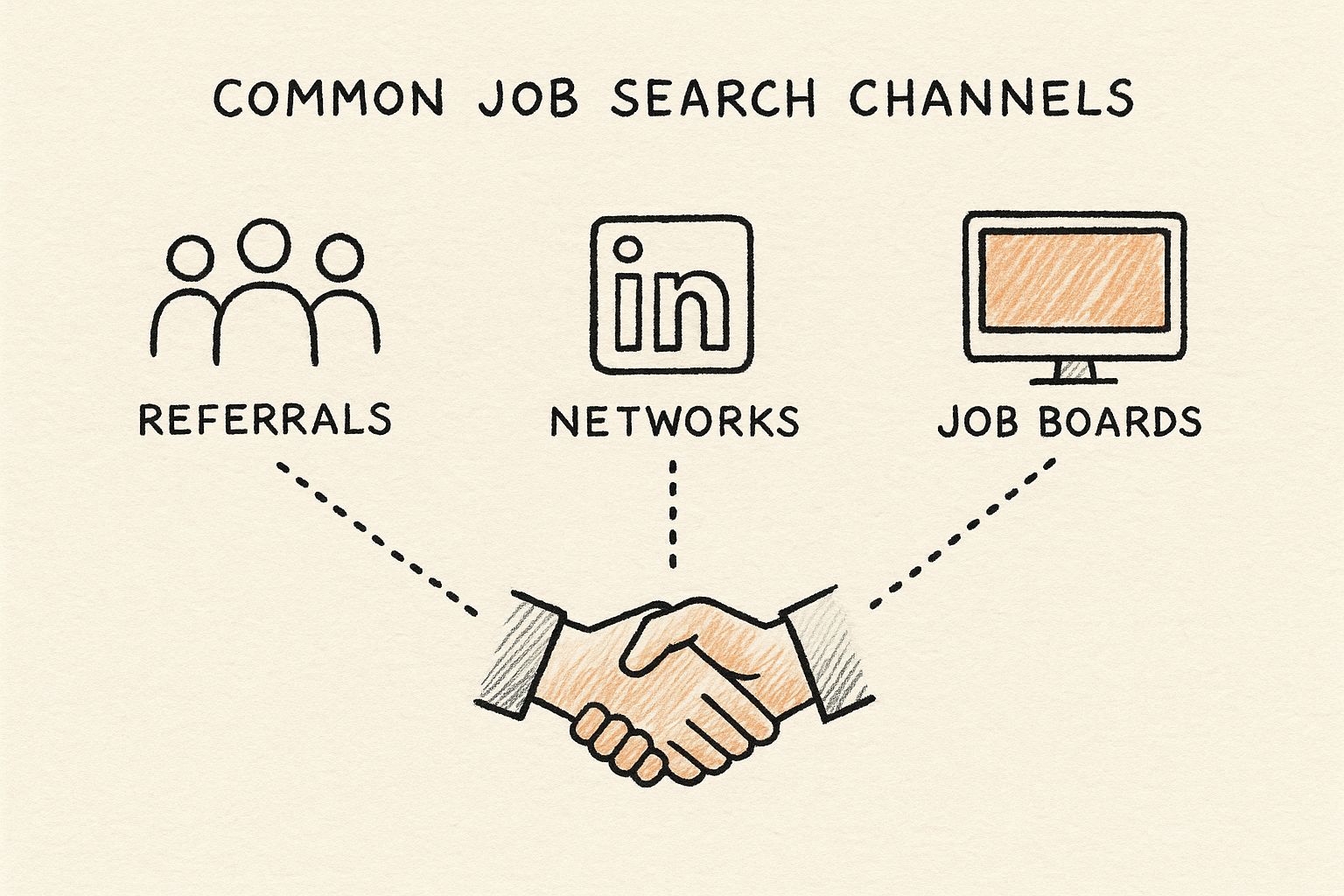
The infographic above illustrates the journey from candidate sourcing to a successful hire. It highlights the interconnectedness of referrals, professional networks like LinkedIn, and job boards, culminating in the final handshake. This visual emphasizes the need for a diversified approach to sales recruitment. Relying solely on job postings won't cut it; networking and employee referrals are vital.
Even with a solid strategy, obstacles often arise. The competition for top talent is intense. Candidate "ghosting" disrupts the hiring process, leaving companies scrambling. Many applicants also lack the experience required for today's intricate sales roles. Understanding this complex landscape necessitates considering the role of external partners, such as a Recruitment Agency.
Addressing the Talent Gap
One of the biggest hurdles is finding candidates with the right skills. The demand for specialized sales roles often surpasses the available pool of qualified professionals. This necessitates creative solutions for bridging experience gaps.
Investing in training programs and mentorship initiatives can develop internal talent and upskill current employees. However, these strategies take time. For companies needing immediate results, exploring alternative talent pools, like international remote sales professionals, can offer a faster solution. For instance, AboutHire connects businesses with seasoned sales professionals from Latin America and Europe. This helps companies scale their sales teams quickly while cutting hiring costs compared to traditional domestic recruitment.
Overcoming Competition and Candidate Ghosting
Looking ahead, 51% of organizations predicted high recruitment team turnover as their primary challenge in 2025, while 42% cited increased competition for skilled sales candidates. The most frequently cited issues include insufficient applicants (60%), competition (55%), ghosting (46%), lack of experience (40%), and uncompetitive salaries (39%). More detailed statistics are available here. This data emphasizes the need for a strong and efficient sales recruitment process to attract and retain top performers.
This competitive landscape makes candidate engagement crucial. Clear communication, a streamlined interview process, and a positive candidate experience can minimize ghosting and boost your chances of securing top sales talent. Building relationships with potential candidates and treating them with the same level of care and attention you would give your best customers is key.
By showcasing your company culture and values throughout the hiring process, you can attract professionals who align with your vision and are more likely to stay engaged.
The following table provides a summary of the key challenges discussed and potential solutions to implement.
Top Sales Recruitment Challenges and Solutions
| Challenge | Impact Level | Solution Strategy | Implementation Timeline |
|---|---|---|---|
| Insufficient Applicants | High | Expand sourcing channels (e.g., international talent pools, referrals) | Immediate – Long Term |
| Intense Competition | High | Enhance employer branding, offer competitive compensation & benefits | Ongoing |
| Candidate Ghosting | Medium | Streamlined communication & efficient interview process | Immediate – Short Term |
| Lack of Candidate Experience | Medium | Invest in training & upskilling programs, consider alternative pools | Short – Long Term |
| Uncompetitive Salaries | Medium | Conduct market research & adjust compensation accordingly | Short Term |
This table summarizes the significant challenges companies face in sales recruitment, along with practical strategies and timelines for implementation to address them effectively. By proactively addressing these obstacles, businesses can improve their chances of attracting and hiring top-performing sales professionals.
Building Your Sales Talent Pipeline Strategically

Building a high-performing sales team isn't something you do overnight. It requires a proactive, long-term strategy, much like nurturing a sales funnel. Think of your sales talent pipeline as that funnel: a constant flow of potential candidates ensures you’re prepared to hire when a position opens. This strategic approach to the sales recruitment process helps avoid hasty hiring decisions and maintains a consistently strong team.
Proactive Prospecting for Sales Talent
Instead of waiting for applications to roll in, actively seek out promising sales professionals. Just as your sales team cultivates leads, you should cultivate relationships with individuals who demonstrate the potential to thrive within your organization, even if they aren’t actively job hunting.
This could involve attending industry conferences, networking on platforms like LinkedIn, or tapping into existing networks for referrals. Reaching out to top performers at other companies or engaging with sales experts in online communities can build valuable relationships for future hiring needs.
Engaging and Cultivating Potential Candidates
Once you've identified potential candidates, nurturing those relationships is key. Regular communication keeps your company top-of-mind. Sharing insightful content, industry updates, and company news positions you as a thought leader and builds a sense of connection.
Personalized outreach is crucial. It shows potential candidates that you recognize their individual skills and value their experience. Consider inviting them to webinars, online networking events, or even informal virtual coffee chats. These interactions help build rapport and maintain engagement. Check out this helpful resource: How to master building a sales team through sales recruitment agencies. This consistent engagement transforms potential candidates into warm leads, ready to be approached when a position opens up.
Employer Branding: Attracting Top Sales Professionals
Your employer branding is a powerful magnet for attracting the best sales talent. A strong employer brand clearly communicates your company’s values, culture, and what it’s truly like to work for your organization.
This involves showcasing employee testimonials, highlighting career development opportunities, and emphasizing your company’s unique value proposition. A compelling employer brand resonates with sales professionals motivated by achievement, recognition, and a positive work environment. It positions your company as a desirable place to work, providing a competitive edge in the talent market and ensuring a robust pipeline of high-quality candidates.
Designing Interviews That Predict Sales Success
Your interview process is a cornerstone of successful sales recruitment. Traditional interviews often fail to uncover a candidate's true sales potential. Instead of generic questions, concentrate on techniques that evaluate real-world sales skills. This means moving beyond the standard "tell me about yourself" and delving into the qualities that make a successful salesperson.
Behavioral Scenarios: Unveiling True Potential
Behavioral interviews explore how candidates handled past situations. These questions help evaluate critical sales skills like problem-solving, communication, and resilience. For instance, asking "Tell me about a time you lost a deal and what you learned from it" offers insight into their self-awareness and ability to learn from setbacks. This provides a glimpse into their actual sales performance, not just theoretical knowledge.
Performance Simulations: Predicting Future Success
Simulating real-world sales scenarios is a powerful evaluation tool. Have candidates role-play a sales call, manage a customer objection, or deliver a product demo. This allows direct observation of their sales skills in action. These simulations can be adapted to your specific industry and sales process.
Structured Evaluations: Removing Bias and Ensuring Consistency
Structured interviews, where every candidate receives the same predetermined questions, are essential for fair and objective evaluation. This format reduces unconscious bias and ensures consistent evaluation criteria. Structured interviews also make comparing candidates easier. Once you have a robust interview process, consider your candidate sourcing strategy, including efficiently building a startup team.
Multi-Stage Interviews: A Comprehensive Assessment
A multi-stage interview process facilitates thorough evaluation while maintaining candidate engagement. Begin with a phone screen to assess basic qualifications. Follow this with in-depth interviews focusing on behavioral questions, performance simulations, and cultural fit. This phased approach narrows the candidate pool, focusing time and resources on the most promising individuals.
Team Involvement: Leveraging Diverse Perspectives
Including other team members in the interview process provides valuable insights and fosters team buy-in. Diverse perspectives can reveal strengths and weaknesses that a single interviewer might overlook. Team involvement also allows candidates to experience team dynamics, contributing to more informed hiring decisions.
Reducing Bias and Making Confident Decisions
Unconscious bias can significantly influence hiring. Strategies like blind resume reviews and diverse interview panels improve objectivity. Consistently applying structured evaluation criteria and involving multiple stakeholders helps reduce bias and promote data-driven hiring decisions. A well-designed interview process avoids costly hiring mistakes and sets the stage for long-term sales success.
Optimizing Your Sales Recruitment Timeline
In today's competitive job market, a slow sales recruitment process can cost you top-tier candidates. Optimizing your timeline is essential, but not at the expense of finding the right fit. Let's explore how to balance speed and thoroughness in your sales recruitment process.
Streamlining Without Sacrificing Quality
Every step, from initial contact to offer, has room for improvement. This could involve using technology to automate tasks, improving communication, and faster decision-making without cutting corners. For instance, an Applicant Tracking System (ATS) can automate resume screening and scheduling, freeing up recruiters for candidate engagement.
Clear communication keeps candidates engaged and reduces the chances of them pursuing other opportunities. This means setting clear expectations about the timeline upfront and providing regular updates throughout the process.
Leveraging Technology and Coordination
Technology can remove administrative roadblocks. Video conferencing platforms enable faster initial interviews and virtual team introductions, eliminating geographical barriers and scheduling delays. For more insights into building and managing remote teams, you might find this resource helpful: How to master sales team outsourcing.
Coordination among HR, hiring managers, and team members is crucial. Regular meetings, shared dashboards, and clear communication channels ensure everyone is aligned and decisions are made quickly.
Creating Urgency Without Pressure
While speed is key, excessive pressure can deter strong candidates. Instead of aggressive follow-up, focus on building rapport and genuine excitement about the role. Consider sharing positive employee testimonials or showcasing company culture and values.
This balanced approach respects the candidate's time while demonstrating the company’s commitment to finding the right fit. This positive experience increases your chances of securing top talent.
Optimizing Each Stage of the Process
To help you visualize an efficient recruitment process, the table below outlines optimal timeframes and key activities for each stage:
To help you visualize an efficient recruitment process, the following table outlines the optimal timeframe and key activities for each stage, along with efficiency tips.
Sales Recruitment Timeline Optimization: Stage-by-stage breakdown of optimal timeframes and efficiency strategies
| Recruitment Stage | Optimal Duration | Key Activities | Efficiency Tips |
|---|---|---|---|
| Application Review | 1-2 business days | Screening resumes, initial contact | Use an ATS for automated screening, prioritize qualified candidates |
| Initial Interview | 1 week | Phone or video screening | Prepare interview questions in advance, use structured interviews |
| Secondary Interviews | 1-2 weeks | In-depth interviews, skills assessment | Involve team members, use simulations and behavioral questions |
| Decision & Offer | 1 week | Final discussions, offer extension | Communicate decisions promptly, provide clear offer details |
This table provides a clear framework for optimizing your sales recruitment timeline. By adhering to these guidelines, you can significantly reduce the time-to-hire without compromising the quality of your hires.
By implementing these strategies, you can create a sales recruitment process that is both efficient and effective, allowing you to attract and secure top sales professionals.
Measuring Sales Recruitment Effectiveness
What gets measured gets improved. This certainly applies to the sales recruitment process. Instead of focusing solely on basic metrics like time-to-hire, let's delve into the key performance indicators (KPIs) that truly reflect the effectiveness of your hiring strategies. This involves understanding which metrics are most important and how to leverage them to refine your approach.
Establishing Meaningful Baselines and Tracking Progress
First, establish clear benchmarks. It's essential to understand your current process. Tracking metrics like cost-per-hire and quality-of-hire helps create a baseline for measuring future improvements. These initial measurements give you a starting point for assessing progress.
Additionally, connect your recruitment metrics to business outcomes. How does a new hire’s performance correlate with revenue generation or customer satisfaction? By linking hiring success to tangible business results, you can demonstrate the return on investment (ROI) of an effective sales recruitment process. This connection highlights the strategic value of hiring the right sales professionals.
Gathering Actionable Feedback and Continuous Improvement
Regularly gather feedback from both candidates and hiring managers. Candidate feedback can reveal areas for improvement in the interview process, such as communication or clarity of expectations. Hiring manager feedback provides valuable insights into a new hire's on-the-job performance, reflecting the effectiveness of your selection criteria. This two-way feedback loop helps fine-tune every stage of the recruitment cycle.
You might be interested in this article: How to master managing a remote sales team. Analyzing recruitment data identifies trends and patterns. Are certain sourcing channels, such as LinkedIn, yielding better results? Are specific interview techniques more predictive of future success? Data-driven insights reveal what’s working and where adjustments are needed. This ongoing analysis informs continuous improvement strategies, ensuring your sales recruitment process remains effective and adapts to your business needs.
Balancing Quantitative Metrics With Qualitative Assessments
While numerical data is crucial, don't underestimate the importance of qualitative factors. Cultural fit and team dynamics significantly impact a new hire’s long-term success within the organization. Assessing these less tangible aspects through interviews and team interactions provides a more complete picture of a candidate’s potential. This holistic approach ensures you’re not just filling a position, but finding someone who contributes positively to the team.
By combining data analysis with qualitative assessments, you gain a comprehensive view of your sales recruitment process effectiveness. This allows you to identify and address potential problems proactively, refine your strategies, and consistently attract and hire top-performing sales professionals. This proactive approach positions recruitment as a strategic driver of growth for your business.
Future-Proofing Your Sales Recruitment Strategy
The sales world is constantly changing. To keep your company competitive, your sales recruitment process needs to be adaptable and forward-thinking. This means anticipating market shifts, being ready for possible talent shortages, and using new technologies. This proactive approach is key to building a sustainable talent acquisition strategy.
Adapting to the Evolving Sales Landscape
The increase in remote work, improvements in sales technology, and evolving candidate expectations are reshaping sales recruitment. Adaptability is crucial.
This could mean using new communication platforms like Slack, adding virtual assessments, or changing your employer value proposition to attract remote talent. Offering flexible work arrangements or professional development opportunities, for example, can attract a wider range of candidates. Adapting to these changes keeps your sales recruitment process effective in a dynamic market.
Preparing for Talent Scarcity and Market Fluctuations
Talent shortages can significantly impact your ability to build a strong sales team. Proactive planning is key. This includes developing internal talent pipelines, building relationships with potential candidates, and considering alternative talent pools like international remote sales professionals.
Also, be ready for market changes. Economic downturns or industry shifts can significantly impact hiring needs. A flexible sales recruitment process that can scale up or down is crucial for staying competitive. This foresight ensures your organization is prepared for anything.
Leveraging Technology for Enhanced Recruitment
Technology is changing sales recruitment. AI-powered screening tools can automate tasks like resume screening and candidate matching, saving time and resources. Virtual assessment platforms can evaluate candidate skills in real-world situations.
However, technology should support, not replace, human interaction. Personal connections throughout the process are essential for building relationships with candidates and creating a positive candidate experience. This balanced approach combines the efficiency of technology with the human side of recruitment.
Building a Sustainable Talent Strategy for Long-Term Success
Developing strong internal recruitment capabilities is key for long-term success. This means investing in your recruitment team, providing continuous training, and giving them the tools they need to succeed.
Creating scalable processes that can grow with your company is equally important. As your business grows, your recruitment strategy needs to handle a higher volume of hiring without compromising quality. This scalability ensures your sales recruitment process remains efficient and effective.
Finally, build a strong employer brand that makes your company a desirable place to work. This involves showing off your company culture, highlighting career growth opportunities, and demonstrating your commitment to employee well-being. A strong employer brand attracts top talent and reduces recruitment costs. This sustainable approach builds a strong foundation for attracting and keeping high-performing sales professionals.
Ready to build a world-class remote sales team quickly and cost-effectively? Learn more about AboutHire and discover how we can help you achieve your sales goals with top-tier talent from Latin America and Europe.