Getting Started
Building a high-performing sales team isn't just about hiring talented individuals; it's about structuring them effectively. This listicle dives deep into nine distinct sales team structures, offering practical guidance for choosing the best fit for your business. We'll explore the advantages and disadvantages of each model, offering actionable insights and real-world examples to help you make informed decisions. Whether you're a startup looking to scale, a mid-sized business aiming to optimize resources, or an enterprise seeking remote expertise, understanding these structures is crucial for maximizing revenue.
Choosing the right structure impacts everything from individual sales rep performance to overall team efficiency. An ill-fitting structure can lead to confusion, missed opportunities, and ultimately, lost revenue. Conversely, a well-designed structure can streamline communication, improve accountability, and drive significant growth. This listicle provides the clarity you need to avoid common pitfalls and build a winning sales organization.
What You’ll Learn
This comprehensive guide covers the following sales team structures:
- The Island Model
- The Assembly Line Model
- The Pod Model
- Geographic Territory Model
- Market-Based Structure
- Product-Based Structure
- Hybrid/Matrix Structure
- Account-Based Structure
- Channel Sales Structure
For each structure, we'll explore:
- Key characteristics and operating principles
- Benefits and drawbacks for different business types
- Real-world examples of successful implementation
- Guidance on when to choose each specific model
Effective communication is key to any successful sales strategy. When getting started with building effective sales teams, maintaining good data practices can lead to more effective campaigns; for instance, strong email hygiene is crucial. Clean data and a targeted approach can dramatically improve your chances of connecting with potential clients and closing deals. By implementing the right sales team structure and maintaining efficient communication, you'll be well-positioned to achieve your revenue goals and build a sustainable, high-performing sales organization.
1. The Island Model
The Island Model is a sales team structure where each sales representative operates independently. They manage their own territories, leads, and customers, effectively acting as their own "island." This traditional model gives salespeople complete ownership and control over the entire sales process, from initial prospecting to closing the deal. This autonomy can be highly motivating for driven individuals. It also simplifies performance tracking, as each salesperson's contributions are easily measurable.
This structure works well in industries with clearly definable territories or where clients require specialized product knowledge. Consider this model if your product or service requires a high degree of personalized selling. However, this approach can lead to inconsistencies in sales strategies and potential knowledge silos.
Examples of the Island Model
- Traditional real estate agencies
- Insurance sales teams
- Pharmaceutical sales representatives
- Many small B2B service companies
Tips for Implementing the Island Model
- Establish clear territory boundaries upfront: This prevents conflicts and ensures balanced lead distribution.
- Implement regular team meetings for knowledge sharing: Combat potential knowledge silos by encouraging collaboration and shared best practices. To effectively lead any sales team structure, continual training is vital. Consider resources like these sales training tips from DocsBot's Top Sales Training Tips to Boost Your Wins in 2025.
- Create standardized processes and tools: This ensures consistent messaging and branding across all sales efforts.
- Set up mentorship programs for new hires: Pair experienced salespeople with new recruits to accelerate learning and improve onboarding.
- Use CRM systems to maintain visibility: Track individual performance, manage leads, and gain insights into customer interactions.
The infographic below summarizes the key features of the Island Model sales team structure, highlighting territory ownership, full sales-cycle responsibility, and autonomous decision-making.
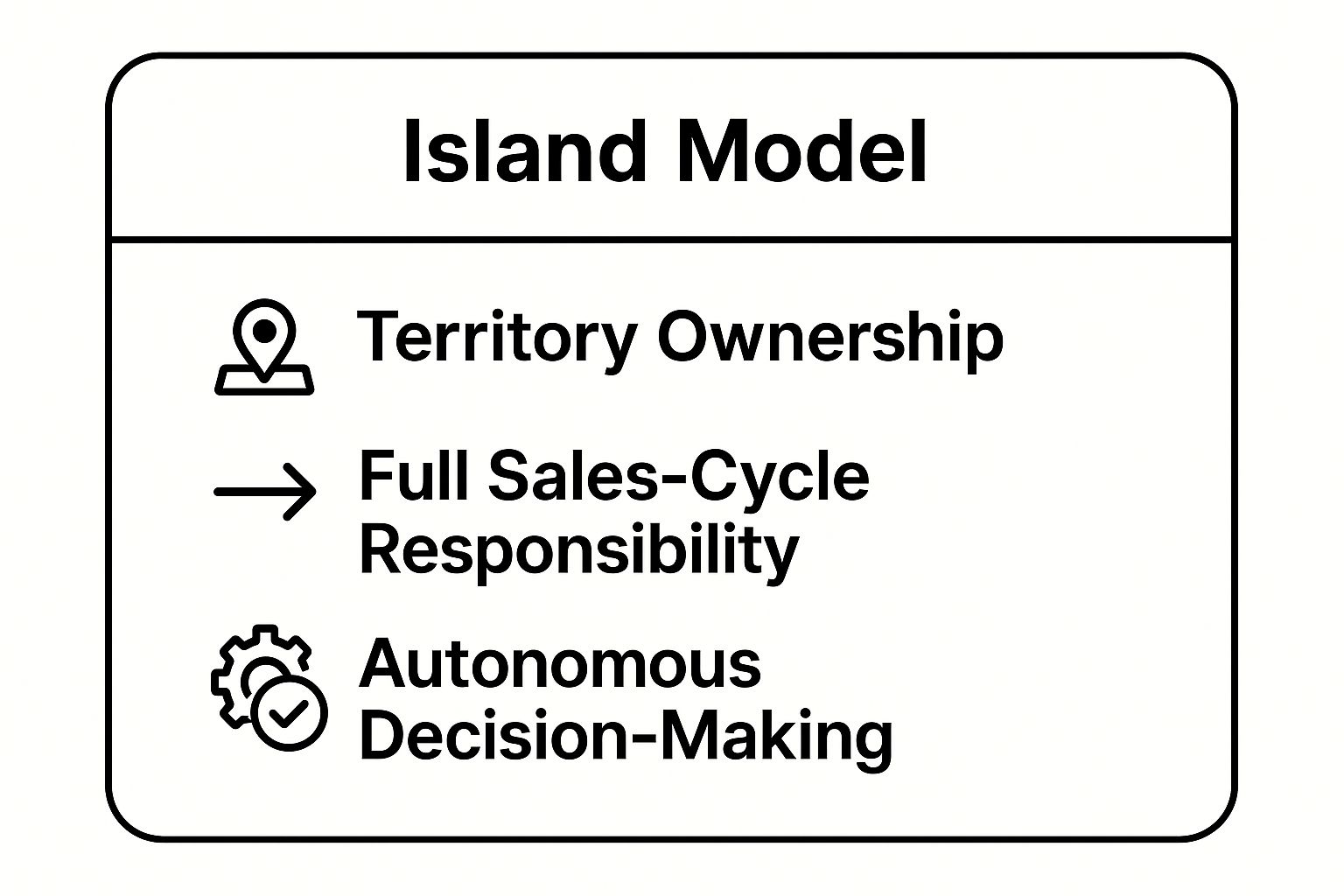
As the infographic illustrates, the Island Model empowers individual salespeople with significant ownership and control. This structure can be particularly effective for companies with established sales processes and highly motivated, independent sales representatives. However, companies considering this model should be prepared to invest in robust training and communication systems to mitigate the risks of isolated working.
2. The Assembly Line Model
The Assembly Line Model is a specialized sales team structure that breaks the sales process into distinct stages. Different team members handle each phase, maximizing efficiency through specialization. Similar to a manufacturing assembly line, prospects move through various specialists, including lead generators, qualifiers, closers, and account managers. This structured approach allows each team member to focus on their area of expertise, leading to higher conversion rates at each stage.

This model works exceptionally well for companies with complex sales processes or high-volume sales environments. Consider this sales team structure if your product requires significant education or a multi-step sales cycle. The Assembly Line Model also allows for efficient scaling of sales teams as you can easily add more specialists at any stage to increase capacity. However, potential drawbacks include communication breakdowns between stages and a less personalized customer experience.
Examples of the Assembly Line Model
- Salesforce's sales development model
- HubSpot's inbound sales process
- Many SaaS companies like Zoom and Slack
- Large enterprise software vendors
Tips for Implementing the Assembly Line Model
- Invest heavily in handoff processes and documentation: Clearly defined procedures ensure seamless transitions between stages, minimizing lost leads and confusion.
- Use shared dashboards for visibility across stages: This provides transparency and allows all team members to track progress and identify bottlenecks.
- Implement service level agreements (SLAs) between teams: SLAs establish clear expectations and timelines, promoting accountability and efficiency.
- Regular cross-training to improve collaboration: Exposing team members to different stages fosters a better understanding of the entire sales process and enhances teamwork.
- Align incentives across all stages: A unified incentive structure ensures that everyone is working towards the same goals, promoting overall sales success and aligning with company objectives. This is essential for optimizing your sales team structures.
3. The Pod Model
The Pod Model is a collaborative sales team structure that organizes small, cross-functional teams ("pods") of 3-8 people with complementary skills. Each pod typically includes sales development reps (SDRs), account executives (AEs), sales engineers, and customer success representatives working together to serve a specific market segment or customer base. This structure fosters deep collaboration and allows for specialized expertise to be applied throughout the sales process. By centralizing relevant skills within a dedicated group, the Pod Model accelerates deal flow and improves customer experience.

This structure works particularly well for companies with complex products or services that require specialized knowledge throughout the sales cycle. The collaborative nature of pods enables quick problem-solving and ensures that customers receive tailored support. When compared to traditional sales team structures, the pod approach promotes greater efficiency and agility by aligning diverse skill sets around specific customer needs. This reduces handoff friction and ensures that every stage of the sales process benefits from relevant expertise. It is also an effective structure for companies employing various sales team structures.
Examples of the Pod Model
- Atlassian's sales pod structure: Atlassian utilizes pods to align sales, marketing, and engineering around specific product lines.
- Spotify's squad model adapted for sales: Inspired by Spotify's agile development teams, many organizations adapt the squad concept to create cross-functional sales pods.
- Many modern SaaS companies: This model is popular among SaaS companies, particularly those selling complex software solutions.
- Technology startups scaling their sales operations: Pods allow startups to maximize the impact of a small team by leveraging specialized skills effectively.
Tips for Implementing the Pod Model
- Keep pod sizes small (3-8 people maximum): This ensures efficient communication and collaboration within the team.
- Ensure clear role definitions within pods: Defined roles prevent overlap and clarify individual responsibilities.
- Implement shared metrics and incentives: Align pod members towards common goals by establishing shared metrics and incentives.
- Regular inter-pod knowledge sharing sessions: Promote cross-pod learning and collaboration.
- Establish pod leadership rotation: Develop leadership skills and encourage a shared sense of ownership.
4. Geographic Territory Model
The Geographic Territory Model is a sales team structure that divides markets based on geographical boundaries. Sales representatives are assigned to specific regions, states, cities, or even zip codes. This model ensures comprehensive market coverage and allows sales reps to develop localized expertise and build strong relationships within their assigned areas. This targeted approach fosters deeper understanding of regional market nuances, customer needs, and competitive landscapes.
This structure works well for businesses selling products or services with geographically defined markets or where localized customer relationships are crucial. Consider this model if your sales process benefits from face-to-face interaction or requires in-depth knowledge of regional regulations and cultural contexts. However, be mindful of potential imbalances in territory size and potential revenue generation. Some territories might be significantly more lucrative than others, potentially impacting salesperson morale.
Examples of the Geographic Territory Model
- Coca-Cola's regional sales structure
- Most pharmaceutical companies
- Industrial equipment manufacturers
- Traditional consumer goods companies
Tips for Implementing the Geographic Territory Model
- Use data analytics to balance territory potential: Analyze market size, customer density, and potential revenue to create equitable territories. This ensures fair opportunities for all sales representatives and reduces potential conflicts. Learn more about building a remote sales team with this model, which can be a highly effective strategy. Learn more about building effective remote sales teams.
- Regular territory reviews and adjustments: Markets evolve, so regularly review and adjust territories to maintain balance and reflect changing market dynamics. This prevents stagnation and ensures optimal coverage over time.
- Provide strong remote support and training: Equipping sales representatives with the resources and training they need to succeed is crucial, especially in remote areas. This includes ongoing sales training, access to product information, and technical support.
- Implement territory mapping software: Utilize software to visualize territories, track customer locations, and optimize travel routes. This improves efficiency and reduces travel time for sales representatives.
- Create fair territory redistribution policies: Establish clear and transparent policies for redistributing territories due to growth, downsizing, or personnel changes. This minimizes disruption and maintains fairness within the sales team.
5. Market-Based Structure
The Market-Based Structure organizes sales teams around specific market segments, customer types, or buyer personas. Instead of focusing on geography or products, this structure prioritizes deep expertise in understanding and serving particular customer groups. This could be based on industries, company size (SMB, mid-market, enterprise), or even specific buyer needs. This specialized approach allows sales representatives to develop a nuanced understanding of their target market, leading to more effective communication and stronger customer relationships.
This structure excels when your customer base is diverse and requires tailored sales strategies. By focusing on specific market niches, your teams can develop specialized knowledge and messaging. This targeted approach leads to higher conversion rates and improved customer satisfaction. However, it can require significant upfront investment in market research and team training.
Examples of the Market-Based Structure
- Microsoft's SMB, mid-market, and enterprise divisions
- Oracle's industry-specific sales teams
- Salesforce's market segment approach
- Adobe's customer size-based structure
Tips for Implementing the Market-Based Structure
- Clearly define market segment criteria: Establish clear parameters for each segment to avoid overlap and confusion. This ensures leads are routed to the appropriate specialized team.
- Implement robust lead qualification processes: Develop a system to effectively qualify leads and assign them to the correct market segment team. This maximizes efficiency and ensures targeted outreach.
- Create segment-specific sales tools and content: Equip your teams with tailored resources, like presentations and case studies, relevant to their target market. This enhances their ability to connect with potential clients.
- Regular market analysis and segment reviews: Continuously analyze market trends and reassess your segmentation strategy. Staying informed about market shifts helps maintain relevance and effectiveness.
- Cross-segment collaboration for large opportunities: Facilitate communication between different market segment teams to effectively address complex or large-scale sales opportunities that may span multiple segments.
6. Product-Based Structure
The Product-Based Structure organizes sales teams around specific products, product lines, or solutions. Each team develops deep expertise in their designated offering, including technical specifications, competitive advantages, and ideal customer profiles. This specialized knowledge allows for highly effective selling, particularly for complex or technical products. This structure is prevalent in companies with diverse or extensive product portfolios, allowing them to effectively address the unique needs of various market segments.
This specialized structure thrives when a company offers a wide range of complex products requiring in-depth knowledge. Consider this model if your sales process demands technical expertise or if your product line caters to niche markets. This approach ensures customers receive expert guidance and tailored solutions. However, it can sometimes lead to internal competition and challenges in cross-selling other company products.
Examples of the Product-Based Structure
- IBM's product-focused sales divisions
- General Electric's business unit structure
- Cisco's technology-specific sales teams
- 3M's diverse product line approach
Tips for Implementing the Product-Based Structure
- Establish clear customer engagement protocols: Define how different product teams interact with shared customers to prevent confusion and ensure a seamless experience. Clear communication is crucial for successful implementation.
- Implement cross-product collaboration incentives: Encourage teamwork and cross-selling by rewarding collaborative efforts and shared successes. This motivates teams to promote the entire product portfolio.
- Create a unified customer view across products: Implement systems that provide a holistic view of customer interactions across all product lines. This ensures consistent messaging and improves customer relationship management.
- Regular cross-training on complementary products: Equip sales teams with knowledge of related products to facilitate cross-selling and upselling opportunities. Expanding product knowledge enhances sales effectiveness.
- Designate account coordinators for major customers: Assign dedicated account managers to handle large or complex accounts that involve multiple product lines. This streamlines communication and strengthens client relationships.
This structure allows for highly specialized sales expertise, leading to effective product positioning and customer satisfaction. By focusing on specific products, sales teams can develop deep knowledge and address complex customer needs. However, companies using this model should actively work to foster collaboration and prevent inter-team competition. This will ensure a unified sales approach and maximize overall revenue potential.
7. Hybrid/Matrix Structure
The Hybrid/Matrix Structure offers a flexible approach to sales team organization by combining elements from various models. This structure often blends geographic territories with product specialization or market segments with functional roles. Team members may report to multiple managers, working across different dimensions simultaneously. This cross-functional collaboration provides maximum flexibility and market coverage, allowing companies to adapt quickly to changing market conditions and customer needs. This adaptable structure is particularly beneficial for companies with diverse product lines or operating in complex markets.
This structure excels in situations requiring specialized knowledge and coordinated efforts. It allows sales teams to leverage expertise across different areas, leading to more effective selling and better customer relationships. Consider this model if your business offers a complex suite of products or serves diverse customer segments. Learn more about the Hybrid/Matrix Structure at AboutHire. However, the complexity of reporting structures can sometimes lead to confusion and potential conflicts.
Examples of the Hybrid/Matrix Structure
- Procter & Gamble's matrix organization
- Johnson & Johnson's hybrid approach
- Many large consulting firms
- Global technology companies like HP
Tips for Implementing the Hybrid/Matrix Structure
- Clearly define roles and responsibilities: Prevent confusion by outlining each team member's responsibilities and reporting lines.
- Implement strong communication systems: Facilitate seamless information flow and collaboration across different teams and managers.
- Regular coordination meetings and updates: Ensure everyone is aligned on goals, strategies, and progress. This fosters a collaborative environment.
- Flexible performance management systems: Adapt performance metrics to reflect the multifaceted nature of roles and responsibilities.
- Strong leadership to resolve conflicts: Equip managers with the skills and authority to effectively address any conflicts arising from the matrix structure. This promotes healthy team dynamics.
8. Account-Based Structure
The Account-Based Structure organizes sales teams around specific high-value accounts or customer relationships. Teams are assigned to particular accounts, or account portfolios, becoming experts in those customers' businesses, industries, and decision-making processes. This model prioritizes deep customer relationships and personalized service over broad market coverage. It allows for highly tailored sales strategies and often leads to increased customer lifetime value. This structure is particularly effective for complex sales with longer sales cycles. Companies utilizing this model often see improved customer retention and higher deal closing rates.
This structure works exceptionally well when dealing with key accounts that represent a significant portion of your revenue. Focusing resources on nurturing these relationships can yield substantial returns. Consider this model if your business relies on a smaller number of high-value clients. However, this approach requires significant upfront investment in research and relationship building.
Examples of the Account-Based Structure
- Enterprise software vendors serving Fortune 500 companies
- Management consulting firms
- Investment banking client teams
- Industrial equipment manufacturers
Tips for Implementing the Account-Based Structure
- Select accounts based on strategic value: Prioritize accounts with high growth potential and long-term value.
- Implement account planning processes: Develop detailed plans for each account, outlining specific objectives, strategies, and timelines.
- Schedule regular customer business reviews: Conduct regular reviews to assess progress, identify new opportunities, and strengthen relationships.
- Utilize a cross-functional account team approach: Involve representatives from various departments (e.g., sales, marketing, customer success) to provide comprehensive support.
- Establish succession planning for key account managers: Ensure continuity and maintain strong relationships even with personnel changes. This helps to mitigate the risk of losing valuable institutional knowledge. Developing robust internal training programs helps to ensure the consistent execution of your sales team structure.
9. Channel Sales Structure
The Channel Sales Structure relies on indirect sales channels, like partners, resellers, distributors, or affiliates, instead of a direct sales force. The internal sales team focuses on recruiting, enabling, and supporting these channel partners, who then handle most customer interactions. This model leverages existing networks and market expertise to expand reach and penetrate new markets more quickly. It also offers scalability, allowing businesses to grow sales without proportional increases in internal sales staff.
This structure works exceptionally well for companies with complex products or services that require specialized local knowledge or established distribution networks. Consider this model if your product requires significant pre-sales support or post-sales service, which partners can effectively provide. However, managing channel partners requires careful planning and ongoing relationship management.
Examples of the Channel Sales Structure
- Microsoft's partner ecosystem
- Cisco's channel partner program
- Oracle's reseller network
- Many software and technology companies
Tips for Implementing the Channel Sales Structure
- Invest heavily in partner training and enablement: Equip your partners with the product knowledge and sales skills they need to succeed. Consider exploring options like those found in this article about Channel Sales Structure.
- Implement clear channel conflict policies: Define territories and customer segments to prevent competition between partners and your internal sales team.
- Conduct regular partner performance reviews: Monitor partner activities, provide feedback, and identify areas for improvement.
- Provide strong marketing support to partners: Co-branded materials, lead generation programs, and joint marketing campaigns can boost partner success.
- Create tiered partner programs with incentives: Reward top-performing partners with exclusive benefits and recognition. This motivates partners and drives further sales growth.
This model proves particularly effective for established companies with strong brand recognition looking to expand their market reach rapidly. However, businesses adopting this structure should be prepared to invest significant resources in partner management and support to ensure long-term success and maintain control over brand messaging.
Sales Team Structures: Comparative Overview of 9 Models
| Sales Structure | Implementation Complexity 🔄 | Resource Requirements ⚡ | Expected Outcomes 📊 | Ideal Use Cases 💡 | Key Advantages ⭐ |
|---|---|---|---|---|---|
| The Island Model | Low – Simple, autonomous roles | Low – Individual reps manage cycles | Strong ownership, clear accountability, fast decisions | Small to medium companies, simple products, experienced sales professionals | Clear accountability, strong customer ties |
| The Assembly Line Model | High – Coordinated specialized roles | Medium – Requires role-specific staff | High efficiency, better conversion, scalable training | High-volume, complex B2B sales, companies supporting specialization | Efficiency through specialization |
| The Pod Model | Medium – Cross-functional team setup | Medium – Diverse skill sets needed | Enhanced collaboration, faster adaptation, team engagement | Mid-size companies, complex solution selling, collaborative cultures | Strong collaboration, coordinated customer care |
| Geographic Territory Model | Low-Medium – Regional division setup | Low – Local reps per territory | Strong local knowledge, efficient travel, clear ownership | Location-dependent products, established markets, local presence critical | Local expertise, clear ownership |
| Market-Based Structure | Medium – Segment-focused specialization | Medium – Segment experts required | Deep segment knowledge, tailored sales, higher satisfaction | Diverse customer segments, complex products, companies with scale | Deep customer understanding, tailored approaches |
| Product-Based Structure | Medium – Product-aligned teams | Medium – Product experts needed | Strong product expertise, credible customer interactions | Diverse/complex products, B2B requiring technical depth | Deep product knowledge, technical support |
| Hybrid/Matrix Structure | High – Multiple reporting and dimensions | High – Complex coordination | Maximum flexibility, comprehensive coverage | Large complex orgs, diverse markets/products, multi-region operations | Flexibility, adaptive resource use |
| Account-Based Structure | Medium – Focused on key accounts | Medium – Dedicated account teams | Strong loyalty, higher lifetime value, better retention | B2B with high-value accounts, long sales cycles, relationship-driven sales | Deep customer relationships, high retention |
| Channel Sales Structure | Medium – Partner management focus | Medium – Partner enablement required | Expanded market reach, scalable growth | Rapid scaling, new markets, products suited for indirect sales | Scalable growth, partner-driven reach |
Final Thoughts
Choosing the right sales team structure is a critical decision that significantly impacts revenue generation and overall business success. We've explored nine distinct models, each with its own advantages and disadvantages tailored for specific business needs and growth stages. From the specialized focus of the Product-Based Structure to the collaborative approach of the Pod Model, understanding the nuances of each is key. Remember that there’s no one-size-fits-all solution. The optimal structure for your organization depends on factors like your target market, product complexity, and overall business goals.
Key Takeaways for Structuring Your Sales Team
- Alignment is Crucial: Ensure your chosen structure aligns with your overall business strategy. A mismatched structure can lead to inefficiencies and missed opportunities. Consider your current resources, future projections, and the specific demands of your industry.
- Flexibility is Key: The business landscape is constantly evolving. Choose a structure that allows for adaptability and change as your business grows and market conditions shift. Be prepared to adjust and refine your structure over time.
- Empowerment Leads to Success: Regardless of the chosen structure, empowering your sales team with the right tools and resources is paramount. This includes providing adequate training, clear communication channels, and access to relevant data.
Implementing Your Chosen Sales Team Structure
Putting your chosen structure into action requires careful planning and execution. Here's a simplified approach:
- Assessment: Thoroughly assess your current sales process, resources, and market dynamics. Identify areas for improvement and potential bottlenecks.
- Selection: Based on your assessment, select the structure that best aligns with your specific needs and goals. Consider factors such as team size, product complexity, and target market.
- Implementation: Roll out the new structure gradually, ensuring clear communication with your sales team. Provide comprehensive training and support to facilitate a smooth transition.
- Evaluation: Continuously monitor the effectiveness of the new structure and make adjustments as needed. Track key metrics and gather feedback from your sales team to identify areas for optimization.
Leveraging Technology and Communication Channels
In today's interconnected world, leveraging technology and communication channels is essential for sales success. For example, channel sales structures can leverage different communication platforms. When exploring options, consider tools like WhatsApp for efficient communication and customer engagement. Source: Channel – Whatsapp from FlowGent AI. Choosing the right tools can significantly enhance team collaboration and improve sales performance.
Mastering the art of sales team structuring is essential for achieving sustainable growth and maximizing revenue potential. By carefully considering the different models and choosing the one that best aligns with your business objectives, you can create a high-performing sales team that drives consistent results. A well-structured sales team isn’t just about organization; it's about creating a cohesive unit that collaborates effectively, adapts to change, and consistently exceeds expectations. Building the right structure is an investment in your future success.
Optimizing your sales team structure for peak performance is crucial for sustainable growth. Looking for a tool to help you build and manage your high-performing sales team? AboutHire can help you find and assess top talent, streamline your hiring process, and ultimately build the perfect sales team structure for your needs. Visit AboutHire to learn more.