What Really Makes Sales Department Structure Work
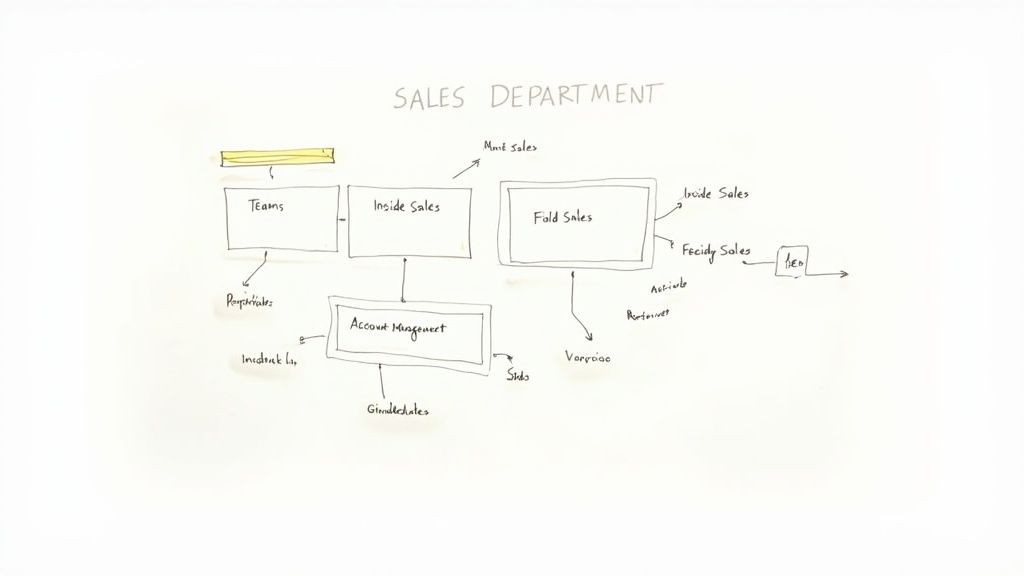
This screenshot from Wikipedia's Sales Management page gives you a visual idea of how many moving parts there are in managing a sales team. Strategy, operations, analysis – it’s all connected. It highlights how sales department structure isn't just about who reports to whom, but about building a whole system. Think of it as understanding the individual components of your sales engine and how they work together to deliver predictable results.
What's the secret sauce that makes some sales departments thrive while others just limp along? In my experience working with dozens of sales teams, the real winners aren't focused on complicated org charts. They're focused on giving their sales reps the tools and support they need to actually sell. Old-school, top-down hierarchies just can’t keep up with today's complex buyer journeys. Think about it: how many times does a customer interact with your brand before they even talk to a salesperson?
The shift is real. Sales department structures have changed dramatically, thanks to new digital tools and evolving buyer behavior. Especially in B2B sales, the buyer's journey is more complex than ever, with multiple decision-makers involved. On average, 7.4 decision-makers are involved in a typical B2B purchase, with almost 70% of the buying process completed before they even reach out to sales. Discover more insights. Your sales department structure needs to keep up with this new reality. You might even consider sales team outsourcing to quickly adjust to these changes.
Focus On Enabling, Not Micromanaging
The best sales departments prioritize empowering their reps, giving them the freedom to adapt to individual customer needs. This isn't about getting rid of accountability; it's about striking the right balance. Each part works independently, but they all contribute to the overall goal. Like a well-oiled machine.
Knowing a bit about different sales methodologies can help you figure out your overall structure. For instance, Leadflow Manager has some good info on door-to-door sales techniques. Even if that's not your focus, exploring different approaches can give you valuable insights into how to structure your team for specific customer interactions. Clearly defined roles and responsibilities also prevent those annoying “territory wars” that suck the energy out of your team.
Let's talk about how traditional and modern sales departments are structured. The table below illustrates the key differences and their impact:
To help visualize these differences, I’ve put together a comparison table:
| Traditional vs. Modern Sales Department Elements | Traditional Approach | Modern Approach | Impact on Results |
|---|---|---|---|
| Structure | Hierarchical, siloed | Flat, collaborative | Improved communication, faster decision-making |
| Focus | Sales volume | Customer lifetime value | Increased customer retention, higher profitability |
| Technology | Limited use of CRM and automation | Integrated tech stack, data-driven insights | Improved efficiency, better forecasting |
| Roles | Clearly defined, specialized | Fluid, cross-functional | Increased agility, better customer experience |
| Metrics | Number of calls, deals closed | Revenue generated, customer satisfaction | More meaningful performance measurement |
This table highlights the key shifts. Modern sales departments are more agile, data-driven, and focused on the long-term customer relationship.
Building a sales department isn't about rigid hierarchies. It’s about creating a support system that empowers your reps to do their best work. It’s about fostering a collaborative environment where everyone feels valued. This sets you up for sustainable growth, letting your team adapt and thrive in the ever-changing world of sales.
Designing Roles That Eliminate Territory Wars

Let's be honest, too many sales departments build roles around fancy titles instead of what actually moves the needle. I've seen this mess create confusion about who owns what, ultimately torpedoing team performance. A solid sales department structure is the foundation of any sales success. It's not just about headcount, it's about the right people in the right seats.
Essential Roles Within a Sales Department Structure
Let's break down the key players, starting with the usual suspects:
-
Account Executives (AEs): Your closers. These folks turn leads into paying customers. Strong negotiation and relationship-building skills are essential here.
-
Sales Development Representatives (SDRs): The lead qualification pros. SDRs are the front line, engaging prospects and filtering out those unlikely to buy. This lets your AEs focus on sealing the deal.
-
Customer Success Managers (CSMs): The post-sale champions. CSMs keep customers happy, spot upsell opportunities, and build those all-important long-term relationships. They're vital for maximizing customer lifetime value.
These three roles often form the core of a sales team, but let's not forget the specialists who can supercharge your results:
-
Sales Engineers: The technical wizards. They handle complex product questions and demonstrate value, especially in B2B sales where deep product knowledge is crucial.
-
Sales Operations: The efficiency experts. These folks optimize sales processes, analyze data, and find ways to improve. They're the behind-the-scenes heroes keeping the sales engine humming.
Designing roles means thinking carefully about workload. Learn how to optimize distribution of workload. It's not just assigning tasks; it's understanding each role's contribution to the big picture and defining responsibilities clearly. For example, SDRs might handle initial outreach, while AEs own the later stages like negotiations and closing. This clear division prevents overlaps and lets everyone focus on their strengths. Time management is also key. Sales professionals spend only about 35% of their time on revenue-generating activities. The rest often gets eaten up by non-revenue-generating tasks. Find more insights here.
Adapting Roles to Modern Buying Behaviors
Buyer behavior is changing how we build sales teams. With so much online research and self-service available, buyers are often well-informed before talking to a salesperson. This makes roles like SDRs even more important for efficient lead qualification. CSMs are also crucial. They build those lasting customer relationships, nurturing them post-sale and ensuring they get the most from your product. Adapting your sales department structure to these modern realities creates a leaner, more effective sales process.
Defining Roles Based on Market Dynamics and Company Size
The ideal team structure depends on your market and company size. A startup might rely on a few generalists wearing many hats, while a large enterprise might have specialists for every stage of the customer lifecycle. For example, a company selling to small businesses may not need dedicated sales engineers, but a complex software company might find them indispensable. A small company might combine Account Executive and Customer Success Manager roles, while a larger one might have separate teams. This flexibility is key to building a structure that fits your needs and resources. It's not about copying a template, it's about building a system that works for you. Remember, your sales department structure should be fluid, adapting as your business and the market change.
Building Reporting Lines That Support Instead Of Suffocate
Forget rigid, top-down hierarchies. The best sales departments operate more like support networks, empowering reps to crush their quotas. Think of it this way: your sales team isn't an army, it's a winning sports team. Everyone has their role, but they work together, supporting and learning from each other. Let's dive into how to build reporting relationships that actually fuel performance.
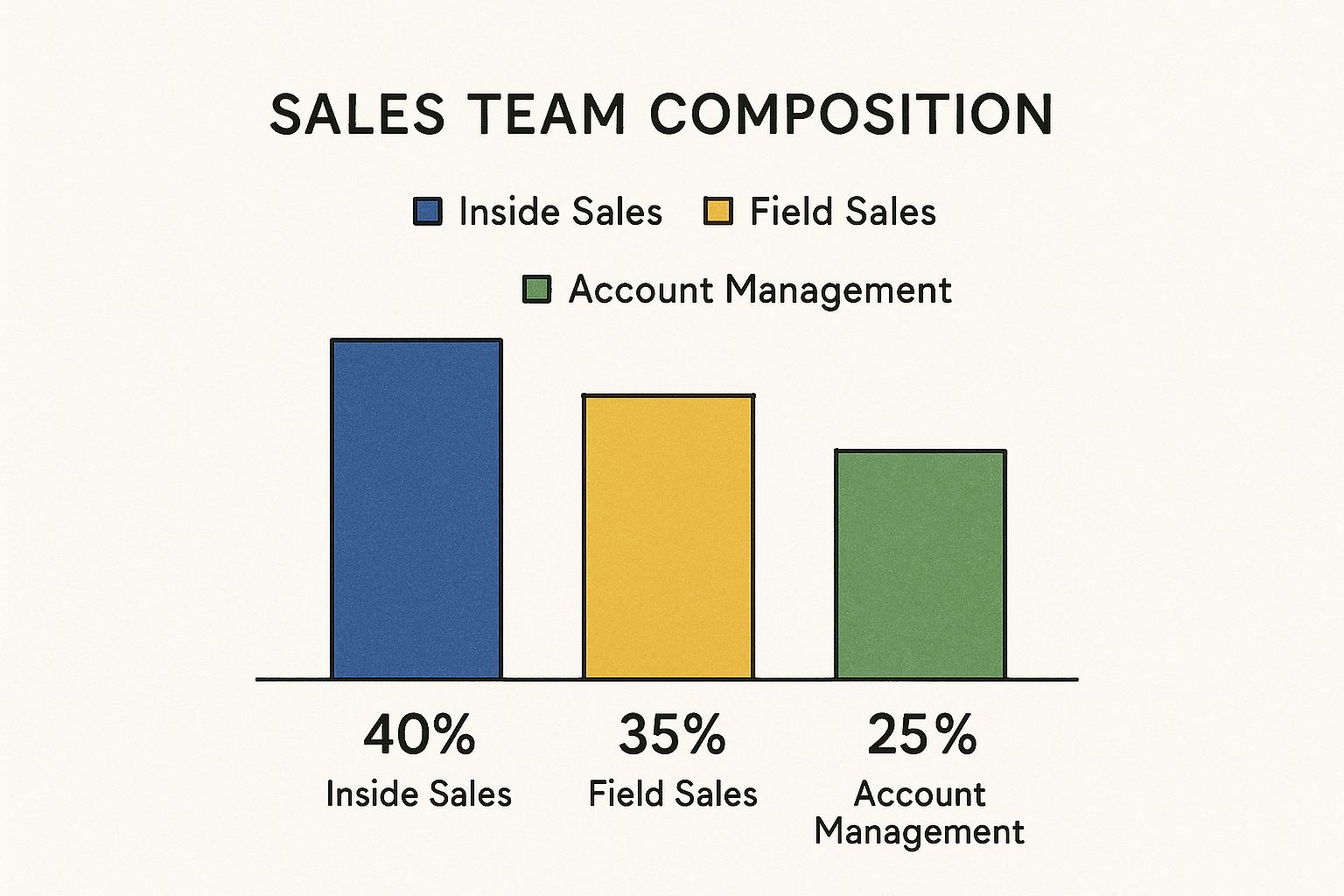
This infographic shows a potential breakdown of a sales team, with 40% Inside Sales, 35% Field Sales, and 25% Account Management. It's a good example of a balanced approach that recognizes the value of both landing new clients and nurturing existing ones. That balance is key for long-term growth.
Finding the Right Span of Control
Figuring out the right number of direct reports per manager is a real balancing act. Too many, and your managers become firefighters, constantly putting out small fires and unable to provide real coaching. Too few, and you're wasting their potential and probably overspending on management overhead. I've seen this firsthand: a manager with 15 direct reports was constantly drowning in admin, while a manager with only three was bored and looking for more strategic work. The sweet spot really depends on things like the complexity of your sales process, how experienced your reps are, and the support they get from sales ops.
Geographic vs. Vertical Market Structures: Choosing the Right Approach
Another big decision is how you structure your teams: by geography or by industry (vertical market). A geographic structure makes sense if you have a local customer base or rely on face-to-face sales. But, it can create inconsistencies in your messaging and even duplicate efforts if you're not careful. A vertical market structure lets reps specialize in a specific industry. For example, a software company might have separate teams for healthcare, finance, and education. This lets reps become experts in their niche, but can create silos if communication isn’t prioritized. It's all about finding the right balance for your specific business.
Flattening Hierarchies for Greater Agility
Lots of successful sales teams are ditching the traditional, multi-layered org chart in favor of flatter structures. This gives reps more autonomy and lets them make decisions faster, which is crucial in today's fast-paced environment. I've seen this work wonders – cutting out a layer of middle management let one company respond to customer needs much faster and dramatically improve their close rate. It's about empowering your reps, not micromanaging them. Of course, you still need clear accountability, which you can achieve through transparent goals, regular reviews, and data-driven feedback.
Avoiding Silos and Fostering Collaboration
No matter how you structure your teams, breaking down silos and fostering collaboration is essential. If your inside sales, field sales, and account management teams aren't talking, you're missing opportunities. Think about it: if leads aren't passed smoothly between SDRs and AEs, or if account managers are in the dark about ongoing sales efforts, your customer experience (and your revenue) will suffer. Shared goals, regular cross-functional meetings, and the right tech tools like Slack or Microsoft Teams can make a huge difference.
Let's take a look at a few different reporting structure options to help you decide what's best for your team.
Sales Department Reporting Structure Options
Analysis of different reporting structures with their advantages and ideal use cases
| Structure Type | Best For | Advantages | Potential Challenges | Team Size |
|---|---|---|---|---|
| Geographic | Businesses with localized customer bases or field sales | Clear territories, local expertise | Inconsistency, duplication of efforts | Varies based on territory |
| Vertical Market | Companies selling to specific industries | Specialized expertise, targeted messaging | Silos between teams | Varies based on industry size |
| Flat | Fast-paced, dynamic markets | Empowered reps, faster decision-making | Requires strong accountability systems | Can range from small to very large |
| Matrix | Complex sales cycles requiring cross-functional collaboration | Leverages diverse skills, flexible resource allocation | Can be confusing if not managed well | Medium to large |
This table gives you a quick overview of different reporting structures, their pros, cons, and ideal scenarios. Keep in mind, there's no one-size-fits-all answer. The best structure for your sales department depends on your specific needs and goals. Choose the one that allows for the most efficient flow of information, empowers your reps, and ultimately, drives sales growth.
Creating Processes Your Team Will Actually Use

Let's be honest, most sales processes end up ignored. Why? They're often created by people far removed from the day-to-day reality of selling. They look good in theory, but fall apart in practice. The best sales processes I've used were built with the sales team, not handed down from management. Let's dive into how to build a sales department structure with processes your team will actually want to use.
Mapping Processes to the Customer Journey
Effective sales processes reflect the customer’s buying process. Forget rigid, one-size-fits-all approaches. Think about how your customers really buy. Do they do online research, attend webinars, or rely on word-of-mouth? Your sales process should mirror these behaviors.
For example, if your customers are active on social media, your process needs to include social selling tactics. If they prefer in-person demos, prioritize those. This customer-focused approach makes the process feel more natural and helps your reps connect with buyers at each step.
Getting Buy-In From Your Team
Rolling out a new process isn’t about telling people what to do; it's about working together. Involve your sales reps from the very beginning. Get their feedback, address their concerns, and incorporate their suggestions. This not only creates a better process, it builds ownership.
When reps feel valued and heard, they're much more likely to use the process. Also, consider a pilot program with a small group of reps before a company-wide launch. This allows for real-world testing and tweaking. Check out this guide on the sales recruitment process for tips on building a great team.
Scaling Processes With Growth
Your processes must evolve as your company grows. Build in flexibility from day one. Rigid structures can't handle increased sales volume or new market segments.
A simple spreadsheet might work for tracking leads early on, but you'll need a robust CRM like Salesforce as your customer base expands. Being proactive prevents your processes from slowing you down as you scale. Regularly review and update your processes to reflect changes in the market, customer behavior, and your sales team.
Building in Flexibility for Real-World Selling
Sales is unpredictable. Your processes need to account for the unexpected turns in the customer journey. Give your reps the power to go off-script when needed, while still adhering to core principles and tracking key metrics.
This balance of structure and flexibility is essential. Your process may outline a typical sales cycle, but reps should be able to adjust based on individual customer needs. This allows them to build genuine relationships and personalize their approach.
Implementing Process Changes Smoothly
New processes can be disruptive. Ease the transition by introducing changes gradually and providing training and support. This prevents reps from feeling overwhelmed and allows them to adapt at their own pace.
Clearly communicate the why behind the changes. Highlight the benefits for both the team and individual reps. Transparency builds understanding and encourages adoption. Celebrate early wins and recognize reps who embrace the new processes. Positive reinforcement goes a long way. A well-designed sales department structure, including effective processes, is the foundation of a high-performing sales team.
Setting Quotas That Motivate Instead Of Demoralize
Setting sales quotas is a balancing act. Do it wrong, and you'll kill morale and stifle growth. Do it right, and you'll unlock your team's true potential. It's not about picking a random number; it’s about building a system that encourages achievement without crushing your team. I’ve seen seemingly unstoppable teams reduced to going through the motions simply because of a poorly designed quota system. So, let's talk about how to set quotas that inspire, not deflate.
Frameworks for Balancing Individual and Team Quotas
The most successful sales departments I've worked with use a mix of individual and team quotas. Individual quotas create personal accountability – everyone knows what they’re responsible for. Team quotas, on the other hand, encourage collaboration and a sense of shared accomplishment.
Think about it like a basketball team: individual players have their points and assists, but ultimately the goal is to win together. You might set individual quotas for closed deals and team quotas for overall revenue or bringing in new customers. This balanced approach recognizes individual contributions within a larger team effort.
How you weight individual versus team quotas should reflect your company culture and overall sales strategy. Some companies are very individually focused, while others prioritize team performance above all else.
Adjusting Targets Based on Market Conditions and Territory Potential
Setting fixed quotas ignores the realities of shifting markets and the different potentials of various territories. Imagine two sales reps: one covers a booming metro area, the other a less developed rural territory. Giving them the same quota wouldn't make sense.
Regularly review and adjust quotas to reflect what’s actually happening in the market. If the economy dips or a new competitor enters the playing field, be ready to adjust. Territories with greater potential should have higher quotas, while those with less potential should have achievable targets. Also, consider the growth potential of building a strong sales pipeline—something like what's discussed in this article on Building a Sales Pipeline.
Sales team quotas and performance metrics are crucial to the structure of your sales department. A study of 67,722 sales leaders highlighted the importance of having realistic targets that match market conditions and customer needs. For more info, discover more about team quotas.
Tracking Leading and Lagging Indicators
Many sales departments get fixated on lagging indicators—things like revenue and closed deals. These are the results, what’s already happened. Important? Absolutely. The whole picture? Not quite.
Leading indicators – things like the number of qualified leads or sales presentations delivered – give you a peek into future performance. Tracking these provides early warning signs. For example, a drop in qualified leads might signal a future dip in revenue. This gives you time to react before it affects your bottom line. This is particularly important in long sales cycles, where it can take a while to see the results of your efforts.
Aligning Compensation With Quotas
Your compensation plan should encourage the right behaviors. If you want reps to prioritize customer relationships, reward them for things like customer retention and satisfaction, not just closing deals. Offer bonuses for hitting customer satisfaction targets or for repeat business. This ties individual incentives to overall company goals. Think of it like a feedback loop: you're rewarding the actions that drive success for everyone.
There are several different compensation models to consider: commission-only, base salary plus commission, or tiered commission structures. The best option depends on your specific industry, the length of your sales cycle, and the behavior you want to see from your sales team.
Choosing Tools That Enable Rather Than Overwhelm
The right tools can seriously boost your sales department's performance. The wrong ones? Let's just say I've seen teams practically buried under a pile of mismatched systems, wrestling with outdated tech that turns simple tasks into epic struggles. You want tools that help your team, not hinder them.
This screenshot shows Salesforce's platform, with features like sales dashboards, reporting, and contact management. Salesforce is a good example of a tool that can bring different parts of the sales process together, giving you one central hub for managing customer interactions. But remember, even with a powerful tool like Salesforce, the focus should be on how it fits into your specific setup, not the other way around.
Evaluating Sales Technology Based on Your Team's Needs
Don't get dazzled by fancy vendor demos. The best sales tech solves your team's real problems. Before you even consider a demo, talk to your reps. Ask them: What's slowing you down? What's frustrating you? What information do you need at your fingertips? This helps you pinpoint essential features and avoid paying for bells and whistles you won't use.
CRM Selection and Implementation for Real Adoption
Your CRM is the core of your sales department. Choosing the right one is crucial, but implementation is where many teams fall short. Don't just drop the software on your team's lap and expect miracles. Provide solid training, clear documentation, and ongoing support. The best sales departments prioritize user adoption above all else. They understand that even the best CRM is worthless if no one uses it.
When you're implementing a new CRM, start small with a pilot group. Get their feedback and use it to refine your training and rollout. Choosing the right tools is paramount, and a CRM for call center operations requires extra thought. Make sure your team is comfortable with the CRM before going company-wide. Early success builds momentum and makes wider adoption much smoother.
Integrating Tools Without Creating Data Silos
Too many tools can create information silos. Your sales data is in your CRM, marketing data is somewhere else, and customer success data is off in its own corner. This makes it almost impossible to see the complete customer journey. The answer? Integrations. Make sure your tools can “talk” to each other. This allows information to flow smoothly and prevents data discrepancies that can lead to missed opportunities. Centralized data access helps your team make better decisions and deliver a consistent customer experience.
Prioritizing Adoption Before Adding New Technology
It's easy to get caught up in the latest and greatest tech, but resist that urge. Before adding a new tool, ask: Are we even using our current tech to its full potential? Does this new tool actually solve a problem, or is it just a shiny new toy? Successful sales departments focus intensely on adoption. They know that piling on more tools before mastering existing ones just adds complexity and reduces productivity.
Integrating Sales, Marketing, and Customer Success Tools
Your sales department isn't a standalone unit. It needs to work hand-in-glove with other departments, particularly marketing and customer success. Integrating these tools provides a smooth handoff of leads, gives valuable customer insights, and creates a unified customer experience. For example, if marketing is running a campaign, your sales team should have access to that information immediately. This alignment creates a powerful synergy that fuels revenue growth.
Bringing It All Together For Real Results
Implementing a new sales department structure isn’t like flipping a switch. It’s more like remodeling a house. You wouldn’t tear down every wall at once, right? You’d work in phases, minimizing disruption while making steady progress. That’s exactly how we'll approach this, ensuring a smooth and effective transition.
Practical Implementation Strategies for Minimal Disruption
Rolling out a new structure shouldn’t feel like an earthquake. Begin by identifying quick wins – those immediate changes with a noticeable positive impact. This might be as simple as streamlining a clunky reporting process or adopting a new communication tool like Slack. These early victories build momentum and demonstrate the value of the new structure.
Next, prioritize changes based on impact and complexity. Tackle the high-impact, low-complexity items first. This generates early results and provides valuable experience before tackling tougher challenges. For example, if clarifying roles will dramatically improve team efficiency, focus on that before implementing a complex new CRM system. And remember, choosing the right tools is crucial. A CRM for call center operations, for instance, requires specific considerations.
Getting Team Buy-In and Fostering Adoption
Change can be unsettling, even when it's positive. Get your team on board by involving them in the process from the start. Ask for their input, address their concerns, and celebrate their successes. This fosters a sense of ownership and smooths the transition. I’ve personally seen how much more readily teams embrace new structures when they've helped create them.
Transparent communication is essential. Clearly explain the why behind the changes and highlight the benefits for both the team and individual reps.
Measuring Success and Continuous Optimization
How do you know if your new structure is working? Don’t just rely on lagging indicators like revenue. Track leading indicators too, like the number of qualified leads or average deal size. These provide early insights into future performance and allow for course correction.
Regularly review your sales department structure. What's working? What's not? Use this data to make adjustments and continuously optimize for better results. Remember, the market is always evolving, and your structure should evolve with it.
Troubleshooting Common Structural Problems
Not every change will be a slam dunk. Be prepared for bumps in the road. Common issues include unclear roles, inefficient processes, and misaligned incentives. Having a plan to address these problems is key. For example, if you see increasing friction between sales and marketing, it might signal a need for better communication or a revised lead qualification process. Proactive problem-solving prevents small issues from escalating.
Building a successful sales department structure is a journey, not a destination. Be ready to adapt, learn, and refine your approach along the way.
Ready to build a high-performing remote sales team that drives revenue growth? AboutHire connects you with the top 0.5% of sales talent from Latin America and Europe, offering a cost-effective solution that's up to 70% less expensive than hiring in the U.S. Learn more about AboutHire and discover how we can help you achieve your sales objectives.