Why Traditional Sales Tactics Are Failing Your Startup

Remember those old adventure movies where a tattered map led straight to the treasure? Many startups treat sales the same way, using a playbook of cold calls and aggressive pitches. But here’s the problem: your customers have completely redrawn the map. Your "helpful" outreach feels more like an annoying, unwanted interruption. The power has shifted, and that old map is now obsolete.
The Rise of the Self-Educated Buyer
In the past, sales reps were the gatekeepers of information. Today, your prospects show up to the conversation already armed with a deep well of knowledge. Think about how you plan a vacation. You don’t just call a travel agent anymore; you read reviews, compare prices online, and watch vlogs before making a decision. This is now standard practice in the business world.
The startup sales process is now firmly in the buyer's control. In a typical B2B deal, you aren't just selling to one person but to an average of 7.4 decision-makers. And the most telling statistic? Roughly 70% of the buyer's journey is finished before they even consider contacting a sales rep. A Gartner report even shows that 75% of B2B buyers would prefer a completely rep-free experience. Discover more on these sales trends.
Why Your Perfect Pitch Falls on Deaf Ears
This new reality explains why your perfectly rehearsed pitch so often results in radio silence. When a prospect has already spent hours defining their problem and researching solutions, a generic presentation is more than just ineffective—it's insulting. It completely disregards the work they’ve already put in.
It’s like a patient who has researched their specific ailment, only for the doctor to begin explaining the symptoms of a common cold. Prospects ghost you not because they lack interest, but because your approach doesn’t meet them where they are. They aren’t looking for a walking product manual; they need an expert consultant who can validate their research and offer a tailored path forward.
Adapting to the New Rules of Engagement
So how do nimble startups win? They throw out the old map and become expert guides. This means shifting your entire focus from a product-first pitch to a value-first conversation. The immediate goal isn’t to sell, but to build trust by proving you understand their world before you ever mention a single feature. A modern startup sales process is built on the foundation of consultative selling and genuine partnership.
This approach requires a different set of moves:
- Lead with Education: Instead of selling, teach. Share valuable insights, case studies, or strategic advice that helps the prospect think about their problem in a new light. Your content should be helpful even if they never buy from you.
- Ask Insightful Questions: Your primary role is to understand their specific situation. Ask questions that uncover the details of their challenges, the internal politics of their team, and what a true "win" would look like for their business.
- Practice Radical Transparency: Buyers today can spot a disingenuous sales pitch from a mile away. Be honest about what your product can and cannot do. Transparency about pricing, limitations, and even your competitors builds massive credibility.
Ultimately, you have to stop thinking of sales as a rigid funnel you force people through. Instead, see it as a collaborative journey where you act as a trusted advisor, helping them navigate to the best possible solution.
Finding Your First Customers Without Breaking The Bank
When you're just starting, you don't have a big budget for fancy lead lists or expensive marketing campaigns. Smart founders don't try to boil the ocean with mass marketing; they act more like a skilled angler, finding the perfect fishing spot. This first stage of the startup sales process is all about precision and building real connections, not spending cash you don't have.
The Power of Relationship-Driven Prospecting
Your first wins will almost certainly come from your existing network. This isn't about pitching your friends and family—it's about using the trust you've already built. Think about it: an introduction from a mutual contact is worlds away from a cold email. One feels like a personal recommendation, while the other is just noise.
Start by systematically going through the connections you already have. Your best, lowest-cost leads are usually right under your nose:
- Your Personal Connections: Go through your network on LinkedIn, reconnect with former colleagues, and see who is in your university alumni groups.
- Niche Online Communities: Find where your ideal customers gather. This could be specific Slack channels, subreddits on Reddit, or niche industry forums. Participate, answer questions, and offer help long before you ever mention your product. The goal is to build social capital.
To put these low-cost methods in perspective, it's helpful to see how they stack up against other common lead generation tactics.
Lead Generation Channel Comparison for Startups
This table compares different channels to help you decide where to focus your limited time and resources in the early days.
| Channel | Cost Level | Time to Results | Conversion Rate | Best For |
|---|---|---|---|---|
| Founder Network/Referrals | Low | Fast | Very High | Getting your first 10 customers and crucial feedback. |
| Online Communities | Low | Medium | Medium | Building authority and finding passionate early adopters. |
| Content & SEO | Medium | Slow | High | Creating a long-term, sustainable engine for inbound leads. |
| Personalized Cold Outreach | Low | Fast | Low | Reaching specific, high-value B2B prospects directly. |
| Paid Ads (Social/Search) | High | Very Fast | Varies | Scaling lead generation once you have product-market fit. |
As you can see, the channels that rely on relationships and effort—not budget—are perfect for getting off the ground. They deliver high-quality leads without the high cost.
To make this process work, you need to understand where potential customers typically drop off. The chart below shows an example of how leads move through a sales funnel.
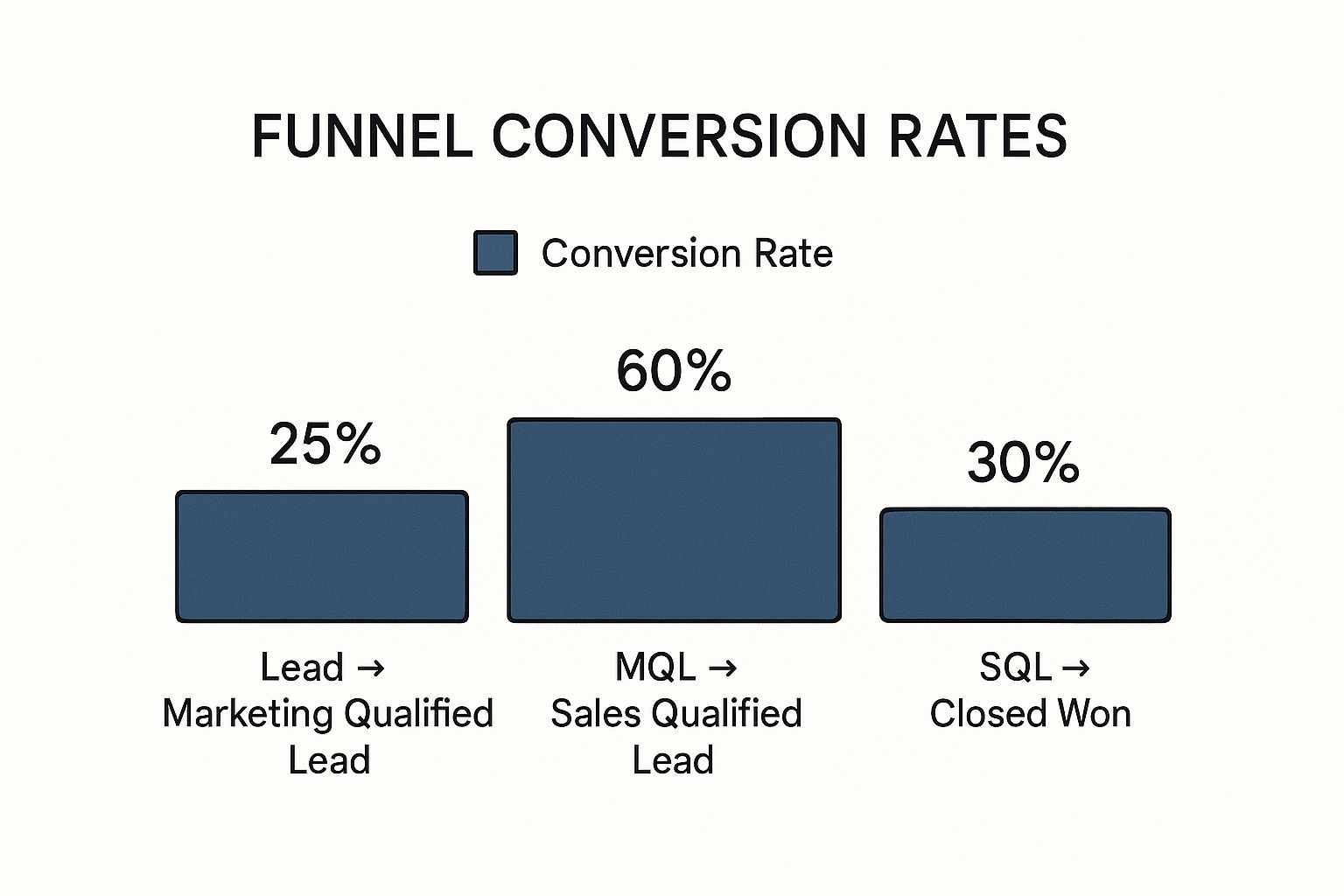
The numbers show a big drop-off from a raw lead to a marketing qualified lead (MQL). But look at the next step: a solid 60% of MQLs become sales qualified leads (SQLs). This proves that once you find someone with genuine interest, they're much more likely to move forward. It’s all about quality over quantity.
Crafting Outreach That Cuts Through the Noise
When you're focused on a small list of high-quality prospects, the message itself is everything. Nothing gets an email deleted faster than a generic, copy-pasted pitch. Your outreach has to feel like it was written for a single person.
Effective outreach isn't complex, but it does require thought.
- Do Your Homework: Spend just five minutes on their LinkedIn profile or company blog. Find a real reason to connect, like a recent company achievement, a post they wrote, or a shared connection.
- Make It About Them: Don't lead with "My product does X and Y." Instead, try something like, "I saw your team is growing, and companies often struggle with Z during that phase. Is that on your radar?"
- Be Brief and to the Point: Your message should be easy to scan in under 30 seconds. End with a simple, low-pressure question, such as, "Is this a priority for you at the moment?"
This hands-on, relationship-first approach does more than just win your first customers; it sets the DNA for a customer-focused startup sales process. It teaches you exactly who your ideal customer is and what problems they truly care about. As you grow, finding people who can continue this personalized, value-first approach is critical. A great product won't sell itself, and building the right team is a must. For help on that, check out our complete guide on the sales recruitment process.
Spotting Serious Buyers From Window Shoppers
Having a ton of leads pour in feels great, but it can be misleading. It’s like panning for gold—you have to sift through a lot of dirt and gravel to find a few valuable nuggets. An effective startup sales process isn't about having the most leads; it's about finding the right ones.
Wasting time on prospects who aren't a real fit is a surefire way to burn through your resources and slow down your business. This is where ruthless qualification comes in: the skill of telling serious buyers apart from the "just looking" crowd.
The Art of Asking Without Interrogating
Think of qualification as a doctor's visit, not a police interrogation. Your job is to diagnose the problem, not just fire off a list of questions. You want to understand the real story behind why they reached out to you in the first place.
Instead of hitting them with a blunt question like, "Do you have the budget for this?", guide the conversation around their challenges. Try asking questions that get to the heart of their problem:
- "What prompted you to start looking for a solution now?"
- "What happens if you don't solve this in the next six months?"
- "How are you currently handling this process, and what are the main frustrations?"
Questions like these encourage them to open up about their pain points. When they explain the problem in their own words, they also reveal how urgent it is. This changes the entire conversation from a sales pitch into a problem-solving discussion, which is how you build trust.
Uncovering Budget, Authority, and Need
Once you have a good grasp of their problem, the next step is to see if they're actually in a position to fix it. This is where a classic sales framework called BANT comes in handy. It stands for Budget, Authority, Need, and Timeline. But be careful—this isn't a robotic checklist. You've already established their need, so now you can weave the other parts into the conversation.
To get a feel for their budget, you could ask, "Have you bought similar software in the past? What was that investment like?" To understand authority, a simple question is, "Who else on your team usually weighs in on these kinds of decisions?" And for timeline, try, "What's the ideal schedule for getting something like this up and running?"
Gathering this information helps you understand if the opportunity is real. This is essential for building a sales pipeline that accurately shows what deals are likely to close and when.
Navigating the Buying Committee
In most B2B deals, you're almost never selling to just one person. You're selling to a group, often called the buying committee. You might have a champion—someone who loves your product and is fighting for it internally—but they might not be the one who signs the checks.
Your goal is to find the economic buyer, the person who has the final say on the budget. If a deal feels like it's stalling even though everyone says they're on board, it often means the true decision-maker hasn't been convinced yet.
A great way to uncover this is to ask your champion, "What does the approval process for a new tool typically look like here?" This simple question can reveal all the key players you need to win over. Remember that serious buyers also look for proof from others. This is why it's so important to get more customer reviews from happy clients. Strong testimonials can help build the trust needed to get the entire committee on board.
Demos That Actually Close Deals
The product demo is where the magic is supposed to happen in the startup sales process. After all the work of finding and qualifying a lead, this is your moment to show them how your solution solves their problems. But too many founders turn this into a museum tour of their product, proudly pointing out every single feature they’ve built. This "show and tell" approach is a surefire way to get glazed-over eyes and a quick rejection.
A great demo isn’t a monologue. It’s a hands-on workshop where you and the prospect work together to solve a painful, specific problem they are facing right now.
The Biggest Demo Mistake
The most common trap founders fall into is the "sausage factory" demo, where every prospect sees the exact same scripted presentation. This one-size-fits-all method completely misses the point of the buyer's journey. A prospect who is just starting to understand their problem (on a discovery track) needs a very different conversation than one who is actively comparing vendors (on an action track).
Giving both the same demo turns your product into a commodity, forcing you to compete on features instead of value. Pushing a feature-heavy presentation on someone who is still trying to define their problem is just overwhelming. It makes doing nothing and sticking with the status quo seem like the easiest path forward.
In fact, research shows that 40-60% of B2B sales purchases end in no decision. A generic, impersonal demo is often the reason why. It simply fails to give the prospect the confidence they need to make a change.
Structuring a Story-Driven Demo
Instead of running through a feature checklist, frame your demo as a story where the prospect is the hero. This narrative approach makes your solution feel less like a foreign tool and more like the next logical step in their journey. A simple but effective framework for this is:
- Start with Their Reality: Begin by recapping their main challenges, using their own words. This proves you were listening and instantly centers the entire conversation on them.
- Introduce a Better Way: Now, show them only the parts of your product that directly solve those specific problems. Connect every click to a real business result, like "this will cut your weekly reporting time in half."
- Show Their New Future: End by painting a clear picture of what success looks like with your tool—less manual work, more reliable data, and a more productive team.
A well-planned demo creates a clear line from the current problem to the ideal solution, as this outline shows.

This visual highlights the need to focus the demo on creating an "Aha!" moment for the audience, rather than just reciting a list of features. It’s all about building a narrative that makes your solution the obvious choice.
When you get this story-driven approach right, the entire dynamic shifts. You’re no longer just a vendor selling software; you become a trusted partner showing them a better way forward. Customizing the story for different people is also critical—an executive wants to see the ROI dashboard, while a manager needs to see the day-to-day team workflow. Even if you hit a technical snag, a strong story keeps everyone focused on the value you deliver, proving you’re a guide they can count on.
Using Technology Without Losing The Human Touch
For a lean startup, technology can feel like a secret weapon. Automation and AI can perform the work of several team members, giving you the ability to compete with much larger companies. The real skill, however, is knowing when to use technology and when a personal connection is required.
The objective isn’t to create a sales team of robots. It's to build a team of highly effective salespeople where technology amplifies their natural skills. Finding this balance is a critical part of any modern startup sales process.
Where Automation Amplifies, Not Annihilates
The best way to use sales automation is to get rid of the repetitive, low-impact tasks that drain a salesperson's time and energy. Think of it as hiring a super-efficient assistant who never gets tired. This assistant doesn't close your deals, but it does all the prep work, freeing up your team to focus on building relationships and solving customer problems.
Effective automation can handle tasks like:
- Scheduling meetings and sending calendar invites.
- Logging call notes and activities in your CRM.
- Sending standard follow-up emails after a demo.
- Creating summaries of call transcripts to identify key points.
This approach gives your sales reps their valuable hours back. With research showing it now takes between seven and eight orchestrated touchpoints to secure a meeting with a qualified buyer, automation is essential to manage this frequency without burning out your team. Discover more on these sales trends. This allows for persistent follow-up that still feels personal and keeps deals moving forward.
Building Your Essential Sales Stack
Choosing the right tools is a make-or-break decision for a growing sales team. Your technology stack should support your sales process without making it overly complicated. Below is a breakdown of the key tools that form a strong foundation for any startup, with recommendations for different growth stages.
Essential Sales Technology Stack for Startups
Key technology categories and recommended tools for different startup stages and budgets
| Tool Category | Early Stage | Growth Stage | Monthly Cost Range | Key Features |
|---|---|---|---|---|
| CRM | HubSpot Free, Pipedrive | Salesforce, HubSpot Pro | $0 – $150+ / user | Contact management, deal tracking, activity logging, reporting dashboards. |
| Email Automation | Mailchimp, Lemlist | Outreach, Salesloft | $20 – $150+ / user | Email sequencing, A/B testing, personalization tags, open/reply tracking. |
| Sales Intelligence | LinkedIn Sales Navigator | ZoomInfo, Apollo.io | $80 – $200+ / user | Verified contact data, company technographics, buying intent signals. |
| Conversation AI | Fireflies.ai | Gong, Chorus.ai | $10 – $150+ / user | Call recording, transcription, keyword analysis, AI-powered coaching. |
The main takeaway here is to start simple. An early-stage startup can operate effectively with a free CRM and basic email tools. As you grow and your needs become more complex, you can invest in more powerful platforms for intelligence and analytics.
Personalization at Scale: The Data-Driven Approach
The real advantage of a good tech stack isn't just about working faster; it's about working smarter. Using your data correctly enables a level of personalization that would be impossible to do manually. This is how you use technology to sound more human, not less.
Instead of sending generic outreach, you can create specific, relevant messages. A good CRM (Customer Relationship Management) platform doesn't just store a name and email; it tracks every touchpoint. A salesperson can see which blog posts a prospect read or which pages they visited on your website.
This turns a cold follow-up into a meaningful conversation. You can go from "Just checking in" to "I saw you were interested in our case study on scaling; did that company's challenge with data management seem familiar?"
This applies directly to your product demos. Rather than a one-size-fits-all feature tour, you can use what you know about the prospect to focus on the benefits that matter most to them. To see how top companies present their products, you can find great examples in collections of the best product demo videos. The key is to make every interaction feel like it was designed just for them, which shows you’ve done your homework.
Think of technology as your co-pilot. It handles the navigation and system checks, but you are still the pilot who makes the final decisions, builds trust with the passengers, and ultimately lands the plane. Empathy, intuition, and strategic thinking are human skills that technology can support but never replace.
Closing Deals When You're The Unknown Player
Making it to the final round against an established competitor can feel like you're a speedboat racing a cruise ship. The cruise ship is massive, stable, and feels like the "safe" choice. Your startup is the speedboat—quick and agile, but viewed by prospects as a potential risk.
The secret to winning isn't to pretend you're a bigger boat. It's to prove that your speed and maneuverability are exactly what the customer needs to get where they're going, faster. Your job is to reframe their idea of risk into a clear strategic advantage.
Turning Your Weaknesses into Strengths
When a potential customer points out your company's size or short history, don't get defensive. Agree with them, and then pivot to the upside. This approach turns what they see as negatives into compelling reasons to choose you. Your entire proposal should be built around these ideas:
- You’re small: This means your customers get personalized attention. They won't be just another ticket in a huge support queue. Instead, they get direct access to founders and senior leaders who are deeply invested in their success.
- You’re new: This means you have modern technology. Your product isn't weighed down by years of legacy code, which often slows down older platforms. This makes your solution more efficient and easier to adapt.
- You’re unproven: This gives them a chance to influence the roadmap. Early customers have a unique opportunity to help shape the product to solve their specific problems—a privilege they would never get from an industry giant.
This same logic works for handling price objections. When a prospect pushes back on your cost, resist the urge to immediately offer a discount, as this suggests your initial price was inflated. Instead, connect the price directly to the value you provide. A strong response is, "Our pricing reflects the direct access and dedicated partnership you'll receive, which is something larger vendors don't build into their models." This frames your service as a premium, hands-on experience.
This high-touch, consultative approach requires a team that is excellent at building relationships. For founders already stretched thin, this can be a difficult role to fill. Exploring options like sales team outsourcing can bring in the specialized talent needed to carry out this strategy without getting stuck in long hiring cycles. It’s about having the right people to deliver on your promise of superior service.
To reinforce your commitment to being attentive, your communication must be on point. For instance, using tools for WhatsApp marketing automation enables immediate, personal follow-ups that keep a deal moving forward. This small touch shows you’re responsive and accessible, directly fighting the "faceless corporation" feeling they might get from your competitors.
Ultimately, your underdog status is a powerful asset. By embracing your agility and focus, you shift from being a risky bet to being an exclusive opportunity for partnership and growth. Your final proposal should reflect this, acting less like a price list and more like a business case for a close, collaborative relationship that solves their specific challenges.
Why Smart Startups Still Fail At Sales
Even with a brilliant product and a solid plan for closing deals, the journey from a great idea to a lasting business is a difficult one. It’s a hard truth that the startup sales process is often the final challenge that many founders can't overcome. The numbers tell a clear story. Despite all the modern sales tools and techniques available, up to 90% of startups ultimately fail. The first year sees an average failure rate of 10%, but that number jumps to a massive 70% for businesses in years two through five, showing that making money is a constant battle. Explore these insightful startup statistics here.
The Product-Market Fit Fallacy
Founders often celebrate achieving product-market fit (PMF) as if they’ve already won. In reality, it’s just the ticket to enter the game. PMF proves you’ve created something people want, but it says nothing about your ability to sell it effectively and grow your business. This is where go-to-market fit enters the picture—the essential, and frequently overlooked, other half of the puzzle.
Think of it like this: having an amazing car (your product) is a great start, but it's not going anywhere without roads to drive on, fuel in the tank, and a driver who knows the way (your go-to-market strategy). Many startups with incredible products stall because they never build the sales engine needed to connect their solution with the right customers. They assume the product's quality will automatically create demand, leading to a slow and frustrating decline.
Solving Problems People Won't Pay For
Another common mistake is confusing positive feedback with a real willingness to buy. A potential customer might love your product, call it "a game-changer," and agree it solves a problem. But will they actually pay for it? The difference is between selling a vitamin and a painkiller. A vitamin is a "nice-to-have" product that offers small improvements. A painkiller, however, solves an urgent, expensive, and critical problem.
Startups that build vitamins often hear a lot of praise but close very few deals. Customers are happy to talk about the issue, but it isn't painful enough to get a budget approved. A successful startup sales process is built around finding and solving true painkillers—the problems that keep leaders up at night and have a clear, negative financial impact on their company.
Early Warning Signs of a Broken Process
Is your sales engine running rough? Your business provides plenty of warning signs if you know what to look for. Ignoring them is a recipe for failure.
Here are some clear signs that your sales process is in trouble:
- A Pipeline of Ghosts: Your pipeline seems full, but deals drag on forever and end in "no decision" instead of a clear yes or no.
- Reliance on Heavy Discounts: You can only close deals by offering big discounts, which means prospects don't see the full value of what you're selling.
- The "Founder-Only" Sales Team: Deals only get signed when a founder is in the room. This is a major warning that your value proposition can't be repeated or scaled by a team.
- High Early Churn: New customers sign up but cancel within the first few months, revealing a mismatch between what was promised and the actual product experience.
Fixing these issues takes more than a new sales script. It requires having the right people with the skills to get the job done. A perfect process means nothing without a talented team to execute it.
Building a world-class sales team is the ultimate solution to a broken process. AboutHire connects you with the top 0.5% of remote sales talent, ready to drive revenue and help you scale effectively. Start building your high-performing team today.